Shel Talmy and Harvey Kubernik Interview
By Harvey Kubernik
“I thought he absolutely was going to make it. The only unfortunate thing is that he and I were about six years ahead of the market.” —Shel Talmy, 2017
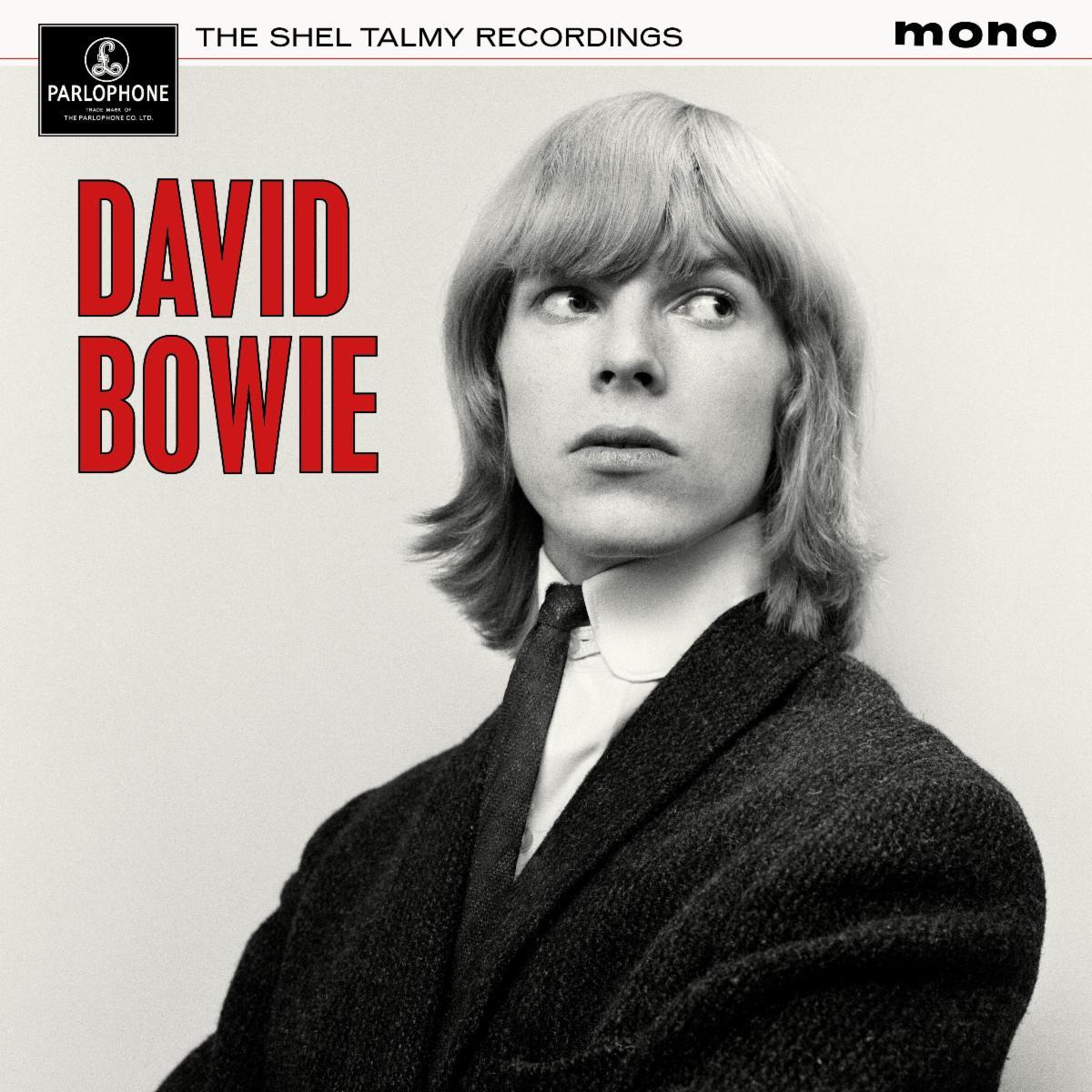
Just released is David Bowie The Shel Talmy Recordings, which is the most complete collection of tracks recorded by a nascent David Bowie, then Davie Jones, with legendary ‘60s producer Shel Talmy, best known for his groundbreaking hits with The Who and The Kinks.
It’s available on CD, LP and digital at Davidbowie.com. Also scheduled for release on Parlophone September 18, 2026.
The album features ten previously unheard tracks on CD and digital, and six songs on LP, with contributions from legendary Yardbirds and Led Zeppelin guitarist Jimmy Page, then a guitar slinger for hire, and Nicky Hopkins, celebrated piano player for The Rolling Stones, The Beatles, The Who, Jeff Beck, Jefferson Airplane and Quicksilver Messenger Service.
As the musician and music historian Alec Palao puts it in his comprehensive sleeve notes that accompany the album, “David Bowie the artist is a book of chapters, the turn of each page delivering something completely different and unexpected from the last. And in perusal, a cardinal error would be to pit any of these episodes against the others, when in fact each fascinating phase in his career should be considered complementary. This collection, a primary chapter if not the very earliest instalment in David’s musical journey, deserves legitimate consideration. It is invariably tempting to search for clues in an artist’s tentative beginnings, and Bowie’s juvenilia has been dissected more than most, but this has rarely been done within the proper context. The sounds here should not be judged by the standards of his later career, but by the standards of what was happening in Britain at that precise point in time. In which case, they speak as loudly of the excitement of London and its music scene in that pivotal year of 1965 as they do for the launch of its brightest future star.”
Bowie and Talmy first encountered each other while frequenting London’s Denmark Street, which is now a guitar aficionado’s paradise but was then the centre of the British music industry, where budding songwriters sold their songs to the big publishers of the day. Talmy had already achieved huge success with The Who, The Kinks, and others, but was now branching out on his own to develop new talent.
Talmy signed David and the Manish Boys in December 1964 and set about recording them, but Bowie was already moving on, forming Davie Jones & The Lower Third. The majority of the recordings Bowie made with Talmy featured The Lower Third or were solo demos.
Talmy’s studio of choice was invariably IBC in Portland Place, also a favourite of The Who, who later recorded Tommy there, and which he considered to have the best outboard gear in London.
The up-and-coming Glyn Johns, later to work with The Beatles, The Rolling Stones, The Who, and many more, was the engineer, and the producer had enough confidence in The Manish Boys to bring in just the one outside player. Jimmy Page was the precocious guitar-slinger Talmy used to supercharge the more anaemic of his acts, and in this period, the future Yardbirds/Led Zeppelin eminence would frequently bring along his new toy, a custom-built fuzz pedal, to add extra bite. For The Lower Third’s IBC session, Nicky Hopkins was featured on keyboards.
This year in Bowie’s career clearly held great importance to him; in 1973, when he recorded the Pin-Ups’ album, it was very much a love letter to that time in his life and to the sound of the bands that had inspired him. No fewer than four titles on ‘Pin-Ups’ (by The Kinks, The Who and The Easybeats) were originally produced by Shel Talmy. Featured on this new collection are tracks such as ‘You’ve Got A Habit Of Leaving’ and ‘Baby Loves That Way’, originally released as singles on Parlophone, that Bowie would return to later in his career, re-recording them with his Glastonbury band for the album TOY, which would be released in 2021.
By the end of September 1965, Davie Jones was now David Bowie, and he was once more writing another musical chapter, but the twenty-two songs featured here capture a very special time just before the ‘birth’ of David Bowie.
DAVID BOWIE
THE SHEL TALMY RECORDINGS
CD
You’ve Got A Habit Of Leaving (2026 Remaster)^
I Want Your Love *^
Cupid *^
I Pity The Fool (2026 Remaster)+
Baby Loves That Way (2026 Remaster)^
Keep Up With The Jones (Instrumental) *^
Leave Her To Me *^
I’ll Follow You^
You Gotta Tell Her (2026 Remaster)*^
Take My Tip (2026 Remaster)+
Certain Woman *^
Today (Demo) *-
I Want My Baby Back (Demo) (2026 Remaster)-
I Live In Dreams (Demo) *-
Bars Of The County Jail (Demo)-
That’s Where My Heart Is (Demo) (2026 Remaster)-
I Do Believe I Love You (Demo) *-
You’ve Got A Habit Of Leaving (Alternative overdub/vocal) (2026 Remaster)^
I Pity The Fool (Alternative vocal take) (2026 Remaster)+
Baby Loves That Way (Alternative vocal take) *^
Take My Tip (Alternative vocal take) (2026 Remaster)+
*Previously Unreleased
^ Davie Jones & The Lower Third
+ The Manish Boys
– Davie Jones
DAVID BOWIE
THE SHEL TALMY RECORDINGS
VINYL
Side One
You’ve Got A Habit Of Leaving (2026 Remaster) ^
I Pity The Fool (2026 Remaster) +
Baby Loves That Way (2026 Remaster) ^
I’ll Follow You^
Take My Tip (2026 Remaster) +
Side Two
I Want Your Love *^
Cupid *^
Keep Up With The Jones (Instrumental) *^
Certain Woman *^
Leave Her To Me *^
You Gotta Tell Her (2026 Remaster) *^
*Previously Unreleased
^ Davie Jones & The Lower Third
+ The Manish Boys
– Davie Jones
All tracks produced by Shel Talmy
Mastered & Remastered in 2026 by John Webber
Davie Jones & The Lower Third
Phil Lancaster – Drums
Graham Rivens – Bass
Denis Taylor – Guitar
Les Mighall – Drums
David Bowie – Vocals & Harmonica
The Manish Boys
Mick White – Drums
John Watson – Bass
Johnny Flux – Guitar
Bob Solly – Organ
David Bowie – Vocals
Shel Talmy arranged and produced the Kinks recordings 1964-1967, “My Generation” by the Who, and hit singles by the Easybeats, Manfred Mann, Chad & Jeremy, and worked with the Creation and Pentangle.
Talmy was raised in Chicago and a graduate of Fairfax High School in West Hollywood. He later attended Los Angeles City College, before relocating to London in early 1963, where his A&R skills and recording endeavors changed our world.
I knew Shel for half a century and interviewed him numerous times. He was a neighbor of mine in Southern California.
Our last encounter was in 2022 for a recording studio documentary. He told me over the last few decades he would occasionally hear from David Bowie, who had fond memories of the record producer who was literally one of the first-ever record producers who believed in him and ushered his bands into the studio.
These early seminal recording sessions were never lost on Bowie, who appreciated that the producer of the Who and Kinks seriously took his songs and saw the early promise of a budding star.
Do I have to remind everyone that on Bowie’s 1973 Pin Ups, Bowie covered the Who’s “I Can’t Explain,” “Anyway, Anyhow, Anywhere,” the Kinks’ “Where Have All the Good Times Gone,” and the Easybeats’ “Friday on My Mind,” songs first recorded by producer Talmy in the 1965-1967 era.
In 1976, I interviewed Bowie for Melody Maker at CBS’ Television City, on the corner of Beverly Blvd. and Fairfax Ave. He was guesting on The Cher Show. During our chat, I told David that his first record producer, Shel Talmy, like myself, graduated from Fairfax High School, located just a few blocks up the street.
David was impressed and comically replied, “You get to ask another question!” I did babble something about wanting a second Pin Ups LP. “I’ve got some ideas for it.”
“I went to Fairfax High School and Los Angeles City College before I went to England in the early sixties,” reminisced Talmy in an interview we did last decade.
“In Los Angeles and Hollywood for my sessions I insisted on being there for the mastering on everything I did. I started as an engineer with Phil Yeend. I spent a lot of time trying to perfect the sounds we were getting at Conway Studios. We spent time isolating instruments and working on drum sounds. Working on guitar sounds. In terms of days and hours. Microphone placements we did were utilized with the Who, Kinks, and David Bowie.
“Nik Venet gave me his demos when I first came to England in late 1962. That is what I used to talk my way into a gig at Decca. What I learned from Nik, bless his heart, was how to handle artists. He allowed me to come to Capitol while he was going stuff. I went to one of his Lou Rawls’ sessions. Lou and Sam Cooke were fuckin’ brilliant. I would hear how he would talk to artists and the engineers. And I have done that forever.
“I returned the favor, and I wrote to Nick in 1963 and said, ‘there’s a band called the Beatles you really got to take a listen to. I think they are gonna be enormous.’ Never heard another word. 30 years later I ran into Nik at a studio and he told me when he got my letter he ran into Alan Livingston’s office, the head of Capitol, and badgered them into signing the Beatles. Nik had signed the Beach Boys in 1962.
“I brought with me from Conway a way to use the equipment of making everything louder, apparently louder than it actually was. I did that by bringing up a guitar through channel one, which was right at the beginning of distortion, and the other one which was normal. So, I used to bring up the distorted one underneath the good one and the entire level went up. And I always tried to do everything I could without distorting. So, I was always near the red line of the meter. I brought that with me. I liked hearing records that I think it actually expands the vocal audio range of what you’re hearing. As far as echo, Conway had a damn good echo chamber that Phil worked on and it was in a little closet. I like echo where it applies, and I don’t like echo where it doesn’t apply. There’s a lot of stuff I think that sounds a hell of a lot better dry than it does with echo. I loved working with Chad & Jeremy. They were more folky and orchestrally-arranged. I loved working with the Pentangle.
“The UK technical people didn’t think I was weird. They thought I was different because I was pretty much the first American producer there. The first place I went to was IBC on Phil’s recommendation. That’s where Phil worked. And, they were way ahead of everybody else. In terms of gear, they had young engineers who were willing to experiment. Glynn Johns. And then Olympic. Initially it made my life easier. Glyn Johns and Eddie Kramer, who I used twice. Gus Dudgeon was my assistant at Olympic with Keith Grant.
“I always felt the song was seventy-five per cent of the record.
1967 and the Summer of Love? By NME or Melody Maker, I was the record producer of the year. I thought Sgt. Pepper was brilliant. Psychedelic or not it had form as far as I was concerned. Maybe they went a little overboard with the psychedelic stuff. The songs were great. What they did was a little too long for me. If there was a great song that went five minutes, that’s cool. Even six, maybe at a stretch. But I still subscribe to the fact that if you’re gonna hear a great song you’re gonna pretty much know it in the first eight bars. And then it continues to develop, three to four minutes is about the right amount of time for it.
:Ray Davies of the Kinks. How we used to work it, and at that point in time, was the most prolific songwriter I’ve ever known. He’d go home and bring you back a dozen songs the next day. What we used to do was sit down, in a studio, and he actually played piano, not guitar, and he’d play me the stuff. I heard four bars of ‘Sunny Afternoon,’ and I said ‘that’s gonna make number one.’ He’d play me songs. ‘That’s good.’ ‘That’s not quite there yet. Let’s put that aside. He went along with that. We never did demos. Sitting down and playing the stuff live.
“‘See My Friends.’ Jon Mark was already influenced by Indian stuff. And I played a recording he did to Ray. And Ray came back the next day with ‘See My Friends.’ We had to tune down the regular guitar and double-tracked it for a kind of sitar sound. It broke a lot of ground. We were so far, as you know of the market that it was the lowest chart record I ever had with the Kinks.
“I have been saying for years that Dave Davies is probably the most underrated guitarist in rock ‘n’ roll. A damn good guitarist. He’s also a very good songwriter. He’s not as good as Ray, but then again, very few people are. Ray was in a class by himself. As was Pete Townshend. Lennon and McCartney. Dave was one small step beneath that in terms of how good he was. But he wrote some damn good stuff. I still hear from Dave. He recently invited me to his show at the Roxy Theater.
“Contrasting Pete and Ray. The easy way in broad strokes…Is that Ray was the major social commentator of what was going on in England at that time. Pete was much more into early blues and what he could so with his guitar and loved sound. Of course, I encouraged all the power chords and all that kind of stuff and that’s what attracted me when I first heard them. I thought they were the first rock ‘n’ roll band I heard since I came to England. When I first arrived, I thought everything was incredibly polite. Pete and Ray, the only thing they really have in common is that both of them are really brilliant songwriters. I think it’s fair to say that Ray could not write a song that the Who would do and Pete could not write a song that the Kinks could do. As a producer, I knew they had global appeal.”
I asked Shel about keyboardist Nicky Hopkins, who I always thought was a secret weapon on many recording dates.
“Nicky Hopkins…With the Who, the Kinks and David, I found him real early. Nicky was one of my favorite people. A really nice guy. Easy to work with. A heavy-duty talented musician. I had him playing live with all these people, by the way. I didn’t bring him in for overdubs. I don’t know how to describe him. When you hear something that’s undefinable but you know it is brilliant. That’s what I saw with Nicky Hopkins. All the bands loved him that I introduced him to.”
Besides the IBC studio for sessions with teenage Bowie, Talmy used the Pye #2 studio in the basement of ATV House for the Who and the Kinks.
“I’m guessing the dimensions about 20X 30 to 40. Pye #1 was the orchestral studio and a lot bigger never worked in it. Entering the studio, the control room was on the left, again guessing dimensions 10 X 15. We had Ampex tape machines, 3-track and mono, and a little later, 2-track. They had a good selection of mics, Neumann, Telefunken, Shure, AKG etc, and I made use of a lot of them as I was miking drums with a dozen mics. There was also a good B3 organ with the Leslie speakers that John Lord played for the first Kinks’ LP, and a good piano, I think a baby grand that Nicky Hopkins played on. The drum corner was near the control room, and I had guitar and bass amps against the walls with baffles around them. This studio had really good acoustics and one of the reasons it was in constant use.”