By Harvey Kubernik
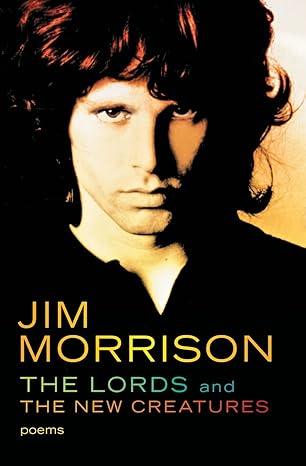
Originally published as two separate volumes in 1970 by Simon & Schuster, both works are now housed in a single volume entitled The Lords and The New Creatures.
Jim Morrison’s first published volume of poetry gives a revealing glimpse of an era and the man whose songs and savage performances have left an indelible impression on our culture.
Intense, erotic, and enigmatic, Jim Morrison’s persona is as riveting now as the lead singer/composer during The Doors’ peak in the late sixties. His fast life and mysterious death remain controversial even to this day.
The Lords and the New Creatures, Morrison’s first published volume of poetry, is an uninhibited exploration of society’s dark side—drugs, sex, fame, and death—captured in sensual, seething images. Here, Morrison gives a revealing glimpse at an era and at the man whose songs and savage performances have left their indelible impression on our culture.
On July 21, 1969 when the Doors gave two performances at the Aquarius Theatre in Hollywood, a poem Jim Morrison wrote for the occasion, Ode to L.A. while thinking of Brian Jones was printed as a four-page pamphlet on textured yellow paper with dark green ink, and distributed to concert goers. Morrison’s work is a meditation on the July 3, 1969 death of Jones.
Last decade I interviewed Tony Funches, who in 1970-1971 headed security for the Doors, and was a close associate of Jim Morrison then.
Tony was present at the Doors’ office in West Hollywood on La Cienega when the initial limited-edition shipment of hard copies of Morrison’s The Lords and the New Creates arrived from Simon & Schuster.
“I had a copy Jim autographed and gave to me but I lost it. Yeah…That was so cool. That was so fuckin’ cool. On that particular day I had no specific real duties to perform other than I just happened to be there. Jim was really excited. Everybody was. All of his band mates and all of the Doors family as it were just really happy for him. An incredible festive moment that wasn’t real done in a formal sense. The cases of the books arrived and everybody went, ‘Hey Jim. Your books are here.’ Low key. Jim was like real shy about opening it up and he was trying to hide how proud he was because this was a step to legitimacy as a poet and after we opened the first case of books, everyday said, ‘Fuck it, man, let’s party.’ I thoroughly enjoyed the occasion of seeing him that happy. Unbridled pure happiness. Not with sticking his chest out getting all stupid, the quiet happiness of seeing oneself validated. So that was so fuckin’ special.
“Jim was really as humble guy and almost apologetically so. He cared about such things that others would recognize if not his talent his efforts to be an artist. That’s why the Lizard King, bull shit teeny bopper shit that drove him up the wall,” underscored Funches.
“I knew Jim was a great poet,” Doors’ co-founder/keyboardist Ray Manzarek reiterated to me during a 1995 interview.
“See that’s why we put the band together in the first place. It was going to be poetry together with rock ‘n’ roll. Not like poetry and jazz. Or like it, it was poetry and jazz from the ‘50s, except we were doing poetry and rock ‘n’ roll. And our version of rock ‘n’ roll was whatever you could bring to the table. Robby, bring your Flamenco guitar, Robby bring that bottle neck guitar, bring that sitar tuning. John, bring your marching drums and your snares and your four on the floor. Ray, bring your classical training and your blues training and your jazz training. Jim, bring your Southern gothic poetry, your Arthur Rimbaud poetry. It all works in rock ‘n’ roll. Jim was a magnificent poet.
“I loved his poetry, that he was doing ecological poetry. But don’t forget in late 1967, the potheads were aware. That’s what was so great about marijuana opening the doors of perception. The potheads were the first mass ecological movement.
“The Doors were part of Raymond Chandler, John Fante, Dalton Trumbo. It was the dark streets and The Day Of The Locust, ya know. Miss Lonely Hearts. That’s where the Doors come from.
“Dorothy (Manzarek’s wife) and I went up to San Francisco in approximately 1963, during a spring break from UCLA. We tried to get up to San Francisco as much as possible. I always wanted UCLA’s film school to be at Berkeley. San Francisco was really happening then, lots of stuff going on. L.A. was pretty square in 1962. Real beach Boys country. Great if you were a surfer but the West Coast jazz scene had passed by then.
“So, we went to San Francisco to feel the atmosphere and there was a poetry reading going on featuring Lou Welch, who had just come out of the forest after being a hermit for the last three or four years. This was his return, reading the stuff he had written over the last five years. He was just charged and wired out of his mind. (poet) Gary Snyder had just come back from Japan, wearing his Japanese schoolboy’s outfit. he was mellow and tranquil. And Phillip Whalen read. Whalen was just a house of fire. Words were coming out of his mouth so fast you had to listen so closely Somebody in the audience yelled, ‘speak slower!’ And Phillip Whalen stopped for a second after he heard that and said, “Listen faster!’ There were 2,000 people in the audience, man. This was probably 1963.
“Those guys had complete control of the stage, complete control of the audience. Anything added to what they were doing would have been superfluous. There’s a point where you don’t want to add anything to poetry, and that was certainly one of those moments. But it did reinforce for me just the power of the word on the stage. So maybe, subliminally, probably, it was the sheer force and power of the word, well delivered, that had an influence on the music and words I would be involved with later.
“It’s my job to give Jim voice, and my job to explain Jim Morrison, and the guy who put the band together on the beach in Venice before John and Robby joined up a couple of weeks later. The two of us assembled, and met on the beach in Venice. Jim sang some songs to me, I said, ‘that’s it. We’re going to get a rock & roll band together, we’re going to make a million dollars, we’re going all the way to the top.’ He said, ‘That’s exactly what we’re going to do. We’re going to fit in somewhere between The Beatles and The Stones,’ and ‘We’re gonna do psychedelic music; it’s going to be strange and eerie and LSD-infused with my Slavic organ and his Tennessee Williams / Carson McCuller Southern gothic words.’ And I knew we were gonna go all of the way with it. It’s my job now to explain that Jim Morrison to people, ’cause that’s the artist, that’s the poet that I put the band together with in the first place. Rock & roll and poetry? That was the whole point of it, just like the beatniks did with poetry and jazz, we were going to do poetry and rock & roll.
“But don’t forget that’s late 1967, and the potheads were aware. That’s what was so great about marijuana opening the doors of perception along of course with LSD. The pot heads were the first mass ecological movement. And I hope they continue on and continue it into future because it’s our obligation to save the planet. We were working in the future space. The Doors on their third album were in future space. And many things have come to fruition that Jim Morrison wrote about.
“The Doors. Pure serendipity. It was an energy of the time. Morrison had a great line, ‘in that year we had an intense visitation of energy.’ Those years lasted from approximately 1965 to 1970. The psychedelic generation had come of age. The young people had come of age. We were the fruit of the American dream. We had everything. All the education and all the pampering. Low and behold, we are all one with everything. Everything is one with us. We, especially the hippies, are all each other’s brothers and sisters. Now let’s become artists and let’s see if we can change the world. Let’s see if we can take love and make love change the world.
“So, what happens with the playing of Doors’ music you enter at a lower state of consciousness into an almost hypnotic state and at the same time an elevated cosmic state of consciousness. So, you are comically aware and you are hypnotically down into the vibrations, the energy of the telluric force, the energy of the planet, the energy of the thousand miles an hour spinning globe that we’re on. With that hot molten center, you’re part of that and you’re part of the infinite cosmos at the same time all in playing your music. And that’s what Doors’ music is about. It’s right there.
“It is a collective journey that’s a good way of putting it. It’s of course Jim Morrison as the charismatic lead singer, and I’ve got to address Jim Morrison, but it’s [John] Densmore, [Robby] Krieger and Manzarek (too). It’s a journey of these four guys, The Four Horsemen of The Apocalypse, the diamond-shaped, no bass player that made a five-point pentagram, shape of the diamond. It’s the inverted pyramid. It’s an archetypal journey of four young men into the unconscious, and coming out of that and creating a musical art form.
“We have the first CD version of An American Prayer. It’s the first time the entire album is on CD format. It’s the original album plus two new pieces. Originally, four hours if Jim’s poetry were recorded. An American Prayer has not been available for many years and is out of print. We’ve also included one bonus track that hopefully they can play on the radio, a three and half minuets version of “The Ghost Song” that will have (John) Densmore, (Robbie) Krieger and me uniting to polish up the tracks that are there and to make some segues to the cuts. Paul Rothchild and Bruce Botnick (Doors producer and engineer) are there, too. All the Doors. It was the first full-length rock ‘n roll poetry record that’s been released. Back in the 50’s, we used to get spoken word records by everybody, Dylan Thomas, e.e. Cummings, Kenneth Patchen. This is entirely different. I don’t think anybody has actually been ready for this record. I think the record was 15 years ahead of its time. The subject matter was very different, very difficult,” summarized Manzarek.
“The Doors radiated a sexual heat that evoked ancient blood rituals,” suggests Dr. James Cushing, a retired Professor of English and Literature at Cal Poly San Luis Obispo.
“Morrison’s poetry formed one part of a larger theatre-music-performance that climaxed when tragic heroism blossomed up out of his intimate Freudian night-garden. The Doors’ first two records almost captured that dark bloom, and they retain great power to disturb us with their shadowy images of private life palpably heightened to the realm of myth. When the band performed, they also had a jazz flexibility in their set lists.”
In July 1995, at the MET Theatre on Oxford Avenue in East Hollywood, I produced and co-curated a month-long Rock and Roll in Literature series with director Darrell Larson and associate producer Daniel Weizmann.
Manzarek, Densmore, and Krieger reunited for us and played “Peace Frog,” “Love Me Two Times,” and “Little Red Rooster” on July 8. Music journalist Kirk Silsbee read from Art Pepper’s Straight Life, John Densmore recited an entry from his new novel, and actor Michael Ontkean recited Ode to L.A. by Jim Morrison.
Last decade I discussed the Doors and Morrison’s relationship to cinema with UCLA graduate and novelist Weizmann.
He subsequently emailed me Motel Money Murder Madness: Jim Morrison and the Noir Tradition.
“Some like to make fun of Jim Morrison for his poetic ambitions—he was young, ultra-serious, and at times he had the somber college student’s yen for Hamlet-like navel-gazing. What’s more, like Michael Jackson and Elizabeth Taylor, the force of Morrison’s stardom at times threatens to overshadow his artistic gifts. Patti Smith recently wrote that she felt ‘both kinship and contempt’ watching Morrison perform. But Jim Morrison’s lyrics did introduce a whole new and highly literary sensibility to pop music—the Southern California noir of Raymond Chandler and the Southern Gothic tradition of William Faulkner. And pop music has never really been the same since.
“Of course, new things were already happening to the song lyric before Morrison made his move: Dylan shocked the airwaves with biblical passion and Whitmanesque frenzy. The Beatles followed with colorful utopian imagery that had roots in James Joyce, Lewis Carroll, and Edward Lear’s nonsense verse. But nobody brought the gravity, the hard realism and the psychological pressure of noir to the popular song before Jim. He represented a major leap toward adulthood in ’67 and the boomers flipped for it. After a youth saturated with sunshine and goody-goody-gumdrops consumerism, they had secretly been craving just such a counter-move.
“The first album’s shadowy album cover, and billboard, shot by Guy Webster, was a knowing nod to noir film posters like Out of the Past and In a Lonely Place. And Jim’s crooner voice and movie-star good looks defied the rock template, as well. But most of all, the words, their impressionistic, nightmare-like alienation, were strange and yet instantly recognizable.
“We can’t know exactly what inspired Morrison to fuse the noir dreamscape to the popular song… but he was a military brat, raised in Florida and New Mexico. The South, with its backwoods quiet, its open highways, its malevolence, and its anti-culture, was in his bones. Throw a UCLA dose of Nietzsche, Rimbaud, the exotica of Eastern philosophy, Jungian psych, and the Native American tragedy into the mix, and you’ve got a potion powerful enough to challenge the lyrical norms as deeply as the sound of Hendrix’s guitar did.
“One of the last of the Venice Beach beatniks, Morrison self-published slim volumes of verse, even at the height of his rock stardom. He certainly had a hard time straddling his roles as shaman, youth leader, pop icon, and serious artist. But he struggled in earnest, and it’s impossible to talk about the Los Angeles tradition that stretches from Chandler, West and Fante to Didion herself, Bukowski and beyond, without seeing Morrison’s part.
“What’s more, for better or worse, whole music genres have Morrison to thank for forging darkness to the pop song. Bowie’s Berlin Trilogy, post-punk, and even grunge couldn’t have happened without him. Some, like the Cult, seemed only to get the histrionics; others, like Jane’s Addiction, reached harder for poetry but lacked the warmth of Morrison’s highly intimate voice. Because, in the end, despite the shaman poses, the billboards and the spotlights, Morrison really portrayed himself as a lone human, in true noir fashion, struggling through the night. He wrote from the personal inner space that is poetry.”
(Harvey Kubernik is the author of 20 books, including 2009’s Canyon Of Dreams: The Magic And The Music Of Laurel Canyon, 2014’s Turn Up The Radio! Rock, Pop and Roll In Los Angeles 1956-1972, 2015’s Every Body Knows: Leonard Cohen, 2016’s Heart of Gold Neil Young and 2017’s 1967: A Complete Rock Music History of the Summer of Love.
Sterling/Barnes and Noble in 2018 published Harvey and Kenneth Kubernik’s The Story Of The Band: From Big Pink To The Last Waltz. In 2021 they wrote Jimi Hendrix: Voodoo Child for Sterling/Barnes and Noble.
Otherworld Cottage Industries in 2020 published Harvey’s Docs That Rock, Music That Matters. His Screen Gems: (Pop Music Documentaries and Rock ‘n’ Roll TV Scenes) was published on February 6, 2026 by BearManor Media. For 2027, Kubernik is doing a book on the Beatles for an UK publisher.
Harvey spoke at the special hearings in 2006 initiated by the Library of Congress held in Hollywood, California, discussing archiving practices and audiotape preservation.
In 2017, he appeared at the Rock & Roll Hall of Fame in Cleveland, Ohio, in its Distinguished Speakers Series and was a panelist discussing the forty-fifth anniversary of The Last Waltz at the Grammy Museum in Los Angeles in 2023.
During 2025, Kubernik was interviewed in the Siobhan Logue-written and -directed documentary The Sound of Protest, airing on the Apple TVOD TV broadcasting service. The film also features Smokey Robinson, Hozier, Skin (Skunk Anansie), Two-Tone’s Jerry Dammers, Angélique Kidjo, Holly Johnson, David McAlmont, Rhiannon Giddens, and more.
Harvey was an interview subject with Iggy Pop, the Beach Boys’ Bruce Johnston, Love’s Johnny Echols, the Bangles’ Susanna Hoffs, Victoria and Debbi Peterson, and members of the Seeds for director/producer Neil Norman’s documentary The Seeds: Pushin’ Too Hard. In summer 2026, GNP Crescendo will release the film on DVD/Blu-ray). Author Miss Pamela Des Barres narrates).