By Harvey Kubernik
Nearly a half century ago on August 16, 1975 in Orange County, California, I interviewed Johnny Cash for the now defunct UK music weekly Melody Maker at the Royal Inn Hotel in Anaheim when he was touting his autobiography, Man In Black, at a Christian Book Sellers convention.
In our conversation, I asked Cash about Bob Dylan.
“I became aware of Bob Dylan when the Freewheelin’ album came out in 1963.
“I thought he was one of the best country singers I had ever heard. I always felt a lot in common with him. I knew a lot about him before we had ever met. I knew he had heard and listened to country music. I heard a lot of inflections from country artists I was familiar with. I was in Las Vegas in ’63 and ’64 and wrote him a letter telling him how much I liked his work. I got a letter back and we developed a correspondence.
“We finally met at Newport in 1964. It was like we were two old friends. There was none of this standing back, trying to figure each other out. He’s unique and original. I respect him. Dylan is a few years younger than I am but we share a bond that hasn’t diminished. I get inspiration from him.
“I keep lookin’ around as we pass the middle of the 70s and I don’t see anybody come close to Bob Dylan.”
The Bob Dylan Blonde On Blonde Bob Johnston-produced recording sessions began in New York City in October 1965 at CBS studios and relocated to Nashville, Tennessee at the company’s facility until March 10, 1966.
Dylan and Johnston during April ’66 in four days did the bulk of the final monaural mixdown session at Columbia’s studios in Hollywood. A stereo mix was subsequently done in a four-hour booking before the double LP (Long Player) was released to AM radio stations and retail outlets on June 20, 1966.
Opening on July 18th at The Bob Dylan Center in Tulsa, Oklahoma will be Thin Wild Mercury: Dylan 1966. It’s an immersive multimedia exhibition that captures the spectacle, power and fury of Dylan’s landmark year following his controversial electric performance at the 1965 Newport Folk Festival.
From his fall 1965 US concert dates with The Band, to the recording and release of Blonde On Blonde and the writing of his first novel, Tarantula, to the raucous and defiant 1966 World Tour, Thin Wild Mercury: Dylan 1966
features numerous never-before-seen manuscripts, photographs and newly restored film footage from the era.
Along the way, visitors will experience Dylan’s emergence as a cool and at times combative rock star, rubbing shoulders with the likes of The Beatles, The Stones, Marlon Brando, Françoise Hardy and Andy Warhol, who captured Dylan in two iconic yet seldom-seen screen tests. Visitors will be able to make their own screen tests by way of an interactive Screen Test Machine, on loan from The Andy Warhol Museum in Pittsburgh.
Highlights will include:
Original “Blonde on Blonde” lyrics including “I Want You” and “One of Us Must Know (Sooner or Later)”
- Original typescript drafts from “Tarantula” and associated writings from his mid-’60s oeuvre
- Never-before-seen photos and documents and footage from the 1966 World Tour
- Brand-new hour-long film program featuring never-before-seen footage and newly conducted interviews with key figures from the era including Jerry Schatzberg, Richard Alderson and Harve
“The year following Newport is one of the most visually and musically exciting periods of Dylan’s long career. With his wild hair, impenetrable sunglasses, and hip tailored suits, Dylan was unequaled in style and attitude. And yet, he bristled at being called a pop star, sparring with the press and audiences alike. It was Dylan and The Band against the world.” —– Mark Davidson, exhibition curator and senior director of archives and exhibitions at American Song Archives
Since 1975 I’ve interviewed sound engineers, record producers, session musicians, and photographers who helped create Blonde On Blonde.
I bought my first mono copy of Blonde On Blonde at The Frigate record shop in Los Angeles on 8101 W. 3rd Street and then the stereo one at Wallichs Music City in Hollywood at 1501 Vine St.
Since 1975 I’ve interviewed sound engineers, record producers, session musicians, and photographers who helped create Blonde On Blonde. I’ve also asked writers, authors, poets, and filmmakers about it.
John Hammond: When I first heard Bobby…It was his natural talent, repertoire, and originality in the recording studio.
Billy James: As an actor, I appeared on Broadway and then television. I saw Dylan in the Village. I met James Dean around the NBC TV studios in New York. I then was a publicist at Columbia Records. In 1961 I taped an interview with Bob Dylan for the company and prepared his first biography. I worked for Columbia as a talent scout as well. I went to Bob’s solo acoustic recording sessions and continued as a writer for the Columbia label.
“Regarding the early Dylan that I met, I wrote an article for the weekly edition of Variety when I worked at Columbia Records. My headline ran ‘Folk Fans Find a James Dean.’
“On January 1, 1964 I moved to Los Angeles and worked for the company at their Sunset Blvd. offices. At the time I was Manager of Information Services for Columbia Records. I met the Byrds in November 1964. Terry Melcher invited me to a session. We had fabulous times together. As for the Byrds, I was on the dance floor with everybody else at the nightclub Ciro’s. Agent Ben Shapiro got them on Columbia through his client, Miles Davis, and Terry was assigned to produce them. I wrote the liner notes for their debut album Mr. Tambourine Man.
“My two heroes at Columbia were label president Goddard Lieberson and talent scout/record producer John Hammond. I introduced Phil Spector to Bob Dylan at the Fred C. Dobbs Coffee Shop on Sunset Blvd. I arranged local press conferences for Dylan in 1965, and in 1966 before he performed at the Hollywood Bowl.
“One of the ways I have bracketed my life as a grownup is to describe my relationship with four people: James Dean, Bob Dylan, Jim Morrison, and Jackson Browne.
Allen Ginsberg: Dylan said that Jack Kerouac’s Mexico City Blues had inspired him to be a poet. That was his poetic inspiration. We were being more candid and truthful than most other public figures or writers at the time. We were switched over to writing a spoken idiomatic vernacular, actual American English, which turned on many generations later.
“In the days of Wordsworth, who in his preface of lyrical ballads suggested that poets begin writing in the words and diction of men of intelligence, or talk to each other intelligently, instead of imitating another century’s literary style.
“I thought the whole 40’s, 50’s literary movement was historically really important, and was kind of a wall built against authoritarianism, that there would be a counter reaction building on the suppression of literature.
“I don’t think I would have been singing if it wasn’t for younger Dylan. It was a concert with Happy Traum that I went to and saw in Greenwich Village. And I suddenly started to write my own lyrics, instead of Blake. Dylan’s words were so beautiful.
“The first time I heard them I wept. I had come back from India, and Charlie Plymell, a poet I liked a lot in Bolinas, at a ‘Welcome Home Party’ played me Dylan singing ‘Masters of War’ from The Freewheelin’ Bob Dylan, and I actually burst into tears. It was a sense that the torch had been passed to another generation. And somebody had the self-empowerment of saying, ‘I’ll Know My Song Well Before I Start Singing It.’
Jerry Wexler: Ginsberg and Dylan both are geniuses. Top of the line. Allen Ginsberg may not have influenced the generation as such but he sure influenced a hell of a lot of writers. And Bob Dylan, of course, changed the culture. So, there is a correspondence between the two guys.
Fred Catero: I was a Columbia Records studio staff engineer from 1962-1972. I started as a mixing engineer. Roy Halee did most of the rock stuff. John Hammond introduced me to Dylan. I worked with producer Tom Wison on Dylan [1964 and 1965] sessions.
“The head of Columbia engineering, Eric Porterfield, designed all-tube hand-built consoles from the former radio rooms. Columbia studios had a custom Ampex 8-track, a live chamber and Altec Lansing A7 speakers. ‘The Voice of the Theatre.’
“For microphones I used a Neumann U47 and maybe a SM57 on lead vocals. The studios had great natural echo, reverb and leakage. You wanted that. In fact, it added to the drama. I knew the rooms and where the best place was for piano or bass or the singer. I used two Neumann mikes. One for the guitar which I aimed at an angle down, so it’s not picking up too much voice, and then the vocal mike, not in front of him, almost where the same mike is for the guitar is facing upward. ‘Cause they tend to look down anyway as they play.
“I had worked with Mel Torme. I mixed The Tender Land opera (and music) by Aaron Copeland. So, there was a variety of people I had to deal with. I knew concepts of chamber recording.
“I did some work with producer Bob Johnston at Columbia. He was blasting the music so loud and saying, ‘turn it up!’ And I got to the point where I said, ‘here’s the volume button. Close the door when I leave the studio control room. Turn it up as loud as you want. But wait ‘till I get outside since I have to make my living with my ears. I can’t risk it.’
“I remember him saying once, ‘Damn it! If I don’t feel it in my chest, I can’t tell if I have it. It’s there.’
Al Kooper: When I recorded with Dylan on Highway 61 Revisited it used to be on 799 7th Avenue. And that was Columbia Records and they had the studio in the same place as the offices. So, when moved to Black Rock they then moved the studio further east. So, it was on 49 E. 52nd.
“They duplicated the studio on 7th Avenue. There were three studios there. 2nd, 3rd and 4th floor. And, so they could do a lot more sessions. And they had the same monitors and the same gear at every place. In those days they had rotary pots instead of faders that slid up and down. It was very archaic. It was also a union shop. With required breaks every three hours. If you were signed to Columbia, you couldn’t record at any outside studio.
“I used to cop Dylan acetates out of producer Tom Wilson’s office. He was a very bright and high-class guy, and he really saved my life that day on that Dylan ‘Like A Rolling Stone’ session.
“I went to him and said, ‘Man, let me play the organ.’ They had just moved Paul Griffin from the organ to the piano. And I went over to Tom Wilson, and I was invited just to watch, you know. And I said, ‘Man, why don’t you let me play the organ? I got a great part for this.’ Which was bull shit. I had nothing. And he said, ‘Man…You’re not an organ player…’ And then they came to him and said, ‘phone call for you Tom,’ and he just went and got the phone. And I went in to the studio and sat down at the organ. He didn’t say no. He just said I wasn’t an organ player. OK.
“On ‘Like A Rolling Stone,’ I was waiting to see what chord they were going to do. There was no music or lead sheet, or anything. I was just playing by ear and I didn’t want to be the one making a mistake because I was doin’ like a rebel run there.
“That was the moment he could have just thrown me out and rightfully so. And you know what? He didn’t. And that was it. That was the beginning of my career. Right then and there.
“I was supposed to play guitar on that record. I packed up my guitar when I heard Michael Bloomfield warming up. It never occurred to me that somebody my age, and my religion could play the guitar like that. That was only reserved for other people. It never even occurred to me that that was an option for someone my age and my color. I had never seen that, or heard that up to that day. So, that pretty much ended my guitar playing by and large. I said, ‘well OK, he’s as old as me and he can play like that. I’m never gonna be able to play like that. Thank you. Goodbye.’ I ended up playing organ on that record, and then I became a keyboard player really that day. So, it was a damn good thing because, you know, that was competition I couldn’t deal with. I brought [bass player] Harvey Brooks into the sessions.
“The pianist Paul Griffin. Oh…man…A big influence on me as well! Paul Griffin came from the Baptist church. On Highway 61 Revisited we did the tracks to ‘Tombstone Blues’ and ‘Queen Jane Approximately’ in one day. Done at Columbia studios in New York.
“The best thing I can say about Paul Griffin is take five minutes out of your busy day and get a time where you have nothing to bother you at all. Find a real nice stereo system and sit back and put on ‘One of Us Must Know (Sooner or Later)’ from Blonde On Blonde. And just listen to the piano…And tell me if you can find on a rock ‘n’ roll record anybody playing better than that. And I would really like to hear what your decision is.
“To me it is the greatest piano achievement in the history of rock ‘n’ roll. I don’t hear anything than him playing the piano when I hear that record. And I’m thrilled that I’m playing organ but I’m embarrassed. And I think that Dylan should be embarrassed too. ‘Cause Paul just steals that fuckin’ record. It’s the most incredible piano playing I’ve heard in my life. If you’re a piano player try playing that note for note. Paul Griffin on piano was so brilliant. He plays amazing things. And the thing that is really eye-opening about it, are the drums.
“During Blonde On Blonde, I was astounded by everything. (laughs). I was astounded by the musicians. I mean, astounded by the musicians. Do you know at one point in ‘Most Likely You Go Your Way (And I’ll Go Mine,’ Dylan refused to overdub things. He just wanted to play it live right there, and forget about the fact that you could overdub. OK. I said to Bob, ‘horns would be really nice on this.’ (imitates marching horn line). And he said, ‘well…There’s no horns here.’ So, Charlie McCoy says, ‘I play trumpet.’ So, Bob said, ‘I don’t want to overdub anything.’ So, Charlie said. ‘I can play the bass and the trumpet at the same time.’ And Bob and I looked at each other, and Bob was laughing, and Charlie said, ‘no really, I can.’ He played them at the same time.
“There are a few reasons Blonde On Blonde holds up. The main reason is the chemistry of the participants. That’s the main reason. And the other reason would be the songwriting. I think the combination of those two things could make if they were as wonderful as those two were on that record it could make any record last a long time. The credit has to go to Bob Johnston. It was his idea. He had tried to get Dylan to record there in late 1965. He knew about the chemistry. I also think he felt more comfortable there because he lived there and knew all the musicians intimately.
“I had the benefit of whatever time differences there was between Highway 61 Revisited and then the Blonde On Blonde record of being a better player. So that was helpful. I knew how to operate the machine a little better, the Hammond organ. And then I ran in to a methodology thing. Because in New York I was raised, all the sessions I played on and everything, it was three songs in three hours. I had never seen what they did in Nashville. They just hired the musicians and they were booked until we were done that day, or night, or whenever it was. They didn’t have any other distractions, there were no breaks, just whatever it was and I had never worked like that in the studio, but it was a big eye opener for me.
“During the day, Bob had a piano in his room and I would go up to his room and he would teach me the song and because there were no cassette machines in those days, I would play the song over and over for him and he would write the lyrics. Actually, I think of myself as the music director of that album. ‘Cause that’s what I did.
“I learned after I did Highway 61 Revisited that these sessions were going to be heard for a very long time. So that one time during Blonde On Blonde I started thinking, ‘You know, where ever my hands move next it’s gonna be around for all time.’ I started thinking like that and I said to myself ‘Will you please shut up and just do what you do.’ It can completely freak you out if you thought like that. I had that thought for one second, and then I said, ‘I really can’t think like this and do this job.’ So, yeah, but not on Highway 61 Revisited but on Blonde On Blonde I did have that thought…
“The other thing was, by then, Bob and I were friends. We had spent a lot of time together. Off hour time together. Just sitting around bars and shit like that. Going to the movies and all this kind of stuff, so it was a much more comfortable situation and Robbie Robertson came to. Robbie and I split a room together at Roger Miller’s King of The Road Motel. So, Bob brought Robbie and I for his comfort level, rather than just go in there cold. You know what I mean?
“No one talks about Bob’s piano playing because they don’t know. Bob had a very unusual way of playing in that he didn’t use his pinkies. So, both his pinkies were up in the air when he played the piano and that’s very interesting to me. It was very interesting looking to watch that. I used to really get a kick out of that.
“I had played live in 1965 with Robbie and Dylan. The Hollywood Bowl and Forrest Hills in New York. The Hollywood Bowl show was the only place where Bob played where he wasn’t booed. How ‘bout that?
“In 1966 I got the itinerary for the Dylan tour. I said to myself “I can’t do this.” They were playing Dallas, Texas. 2 years after JFK. I said to anybody who would listen, except Bob, of course, ‘You’re going to fuckin’ Dallas. I don’t want to be the John Connally of rock.’ That was my line (laughs). I thought I’d be sitting in the fuckin’ front seat and I’ll get killed.
Bob Johnston: After Tom Wilson produced ‘Like A Rolling Stone,’ I was working with Bob Dylan in New York on Highway 61 Revisited and I flew in Charlie McCoy from Nashville. I introduced him to Dylan, and the first thing we cut was a version of ‘Desolation Row,’ with Dylan on acoustic, Charlie on electric, and Harvey Brooks on bass.
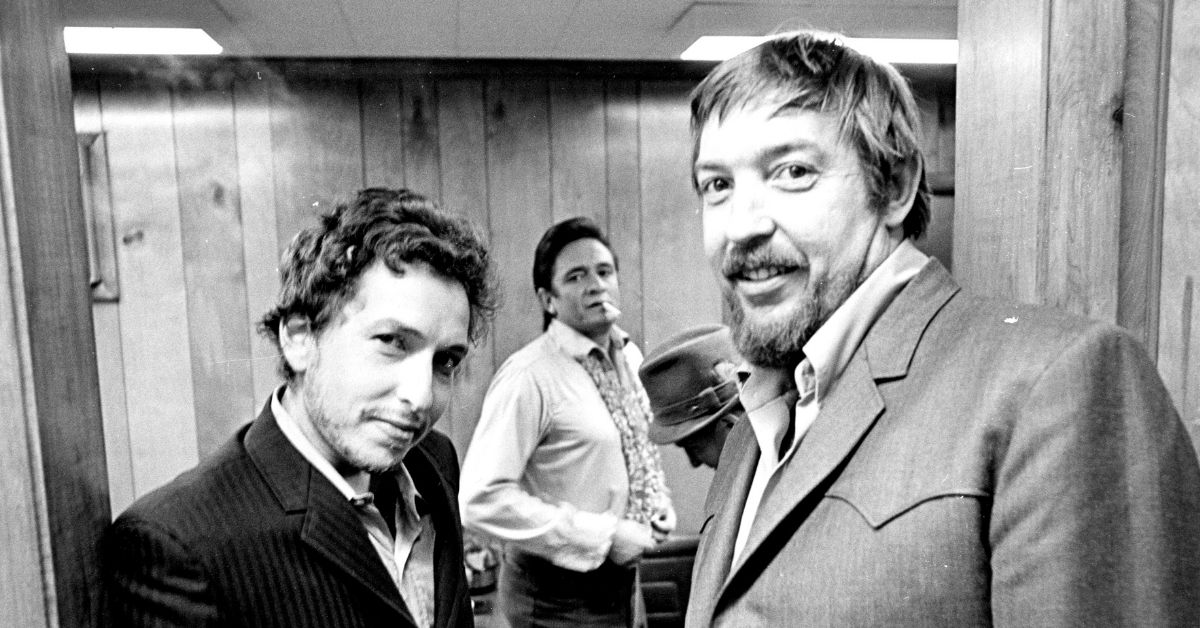
“I was standing by the sound board and I said to Dylan ‘Listen man, you ought to come to Nashville sometime. I got a fix up down there with no clocks and the musicians are fuckin’ great.’ He’d never answer you, he’d just go ‘hmmm,’ like Jack Benny.
“So, I finished Highway 61 Revisited and then Dylan called me about six months later and he said, ‘I got a bunch of songs. What do you think about going to Nashville?’ ‘That’s what I was talkin’ about!’
“In 1966 we went down there for Blonde On Blonde and the first thing was beautiful. He said, ‘Well, I got an idea…’ He stayed out in the studio 10 or 12 hours. He never left it. He’d eat candy bars and drink milk shakes and all, and nobody does that much.
“I sent the musicians away and told them to do anything you want to and be in phone contact. Don’t go home… you can be in the studio down here if you need some beds or something. About 2:00 in the morning Dylan came out of the studio and said, ‘I got a song, I think. Is anybody left here?’ First thing we did was ‘Sad Eyed Lady of the Lowlands.’
“I told everybody if they quit playing, they were gone. It didn’t matter because I could overdub anybody but Dylan. But if you quit with him, you’ll never hear that song again. And he’d go to the count and play something else. So, they came out and got all around. And Dylan said, ‘it goes like this. C. D. G.’ And then he went over the thing and they said, ‘Man, we haven’t heard this thing.’ ‘I said that’s right. The first one who misses just walk out of the room. Don’t stop.’
“And he went out there and started counting off, and that’s another thing. Nobody ever counted off for Bob Dylan. Every other artist in the world that I’ve been around has a drummer or somebody else counting. He went 1, 2, with that foot and it was gone. When we got through, he said ‘let’s hear it back.’ And he came in the studio and played back ‘Sad Eyed Lady of the Lowlands.’ 11 or 12 minutes. And that was the first thing that we did for Blonde On Blonde. And from then on, it just went up and up and couldn’t go up any higher and higher. I think that’s one of the best tracks ever cut along with ‘Desolation Row.’
“Dylan and I were notorious for using first takes. I don’t see any sense in doing it over and over. They knew what I wanted them to play not what I gave them. That’s why they were there. When I started with Dylan he said, ‘my voice is too loud.’ Good enough. So, I turned it down. Then I’d turn it up. ‘Man, I can’t hear myself,’ and had that voice out there. Finally, we got to the place where he said ‘I can’t hear myself.’ ‘Cause I’d brought it so low. So, I told him I’d take care of it and never asked him about it anymore and turned everything up and had that voice out there.
“I would place glass around Dylan for recording. He had a different vocal sound. I didn’t make his different vocal sound. He always had different sounds on. I always had 4 or 8 speakers all over the room and I had ‘em going. The louder I played it the better it sounded to me. This is the way I really did it.
“I’ll tell you something else I did recording with Bob Dylan and Johnny Cash. Everybody else at the time was using one microphone. Which means you have to sacrifice something. If you’re gonna have a band you can’t have the band playin’ full tilt, if you’ve got him in the middle because and can’t understand everything with different people in there raising the guitar up, raise the drum up, and do shit like that. And what I always did was that I had three microphones because he was always jerking his head around, and I put the microphone on the left, center and right and it didn’t matter where in the fuckin’ room he went. And then I’d mix and start on the left and go all the way over on the right.
“So, I’d usually have the piano on the outside left, without any echo. And then I’d put the echo on the right side. And then I’d have one of the guitars on the right and put the echo on the left. And then I’d match it all alone and brought up everything even so they could fight it out. And then that’s the way the band was.
“They didn’t have to raise this and lower this, and 15 people sitting around doin’ all that shit. The band was there and he was full tilt. Then you could go any place in the room and understand him. And I never heard another word from him about anything. What I did was put a bunch of microphones all over the room and up on the ceiling. I would use all those echoes when everything got through and I could do that as much as I wanted. I wanted it to sound better than anything else sounded ever, and I wanted it to be where everybody could hear it. And I don’t know what Dylan would have been if he stayed in New York with those people, and been mixed like that. And I know he would have never done that shit like he did in Nashville.
“During Nashville Skyline I had Cash in the Columbia Music Row studio and thought it would be nice to get Dylan in there, too and I didn’t say anything to them. Cash was in the studio and Dylan came in. ‘What are you doing here?’ ‘Gonna record.’ ‘Well, I’m recording too.’ So, they invited me to dinner, but I said ‘no thanks.’ And when they returned, I had a ‘café’ set up outside with microphones and their guitars, and they came in, looked at the lights, sorta smiled at each other. June (Carter Cash) was there. We did like 18 tracks.
“As a songwriter, I wrote songs, too. Dylan changed the world. Every song he did I loved. I was a Dylan freak and I knew he was changing the world. I knew he was changing the society as we know it.
Leonard Cohen: I came to New York City in 1966 and was unaware of what was going on at the time. I had never heard of Phil Ochs, Bob Dylan, Judy Collins or any of these people, and I was delighted, overwhelmed and surprised to discover this very frantic musical activity. Producer John Hammond was extremely hospitable and decent. He signed me to Columbia Records.
“I liked the work Bob Johnston did with Dylan, and we became good friends. Without his support I don’t think I’d ever gain the courage to perform. I admire Dylan’s work tremendously, especially the later work.
Charlie Daniels: One thing that needs to be said about Bob Johnston and bringing people to town like Dylan and Leonard Cohen. There was skepticism about Bob coming to Nashville because he was taking the place of a legendary producer, Don Law, who was an institution in town.
“Here’s this guy Johnston from New York, who had been doing Simon & Garfunkel, Bookends, Dylan, and now Leonard Cohen, who were not really thought of as being country. But the first thing Bob did when he came to town was to do a number one song with Marty Robbins. And in ‘68 produced the albums John Wesley Harding, Flatt & Scrugg’s The Story of Bonnie and Clyde, and of course, Johnny Cash’s live album at Folsom Prison.
“He had gained credibility. He was also at the same time, bringing Al Kooper, Dylan and Leonard Cohen into town who had never lived here. Dylan recorded in Nashville in 1966 for a while, but it was he’d come to town, do his stuff, and leave. Dylan happened to record in a studio in Nashville and worked in it.
“Hassles with long hairs, prejudice, racism, didn’t exist in our world. In the sixties everything was pretty much in the throes of a lot of upheaval. This was back in Martin Luther King, Jr.’s salad days, when he was going around, doing things that a lot of people didn’t understand it or didn’t get it. I was in Nashville when Dr. King was assassinated in Memphis. The thing was, when you’re goin’ in to make music that is a whole other thing.
“Nobody wanted to work in the big Columbia studio until Bob Johnston came to town and basically took it over. Nobody else wanted to be there. He worked with it, got engineers he enjoyed working with like Neil Wilburn, and he actually brought an engineer from New York with him when he first came down.
“The Columbia Studio was union. In Nashville, in the studios, you had to have the machines to be a certain distance away from the boards so the engineer could not work them both. But the thing I remember mostly about Studio A., the big studio, it was the new studio. The old studio, the Kwansit Hut, was the legendary studio where the hits had been cut. Everybody wanted to work in that room.
“With people like Cohen and Dylan…Most of the Nashville sessions, the country artists they would bring a demo in, they’d play the demo, you play it like the demo, you may change a key on it, but basically, it’s gonna be the same thing, how they want the demo. So, you’re playin’ pretty much inbounds.
“Charlie McCoy was the band leader. And he was asked ‘how much do you want him to play? How many bars? How much do you want him to do?’ And Dylan replied, ‘all he can.’ Well that really describes what this is all about.
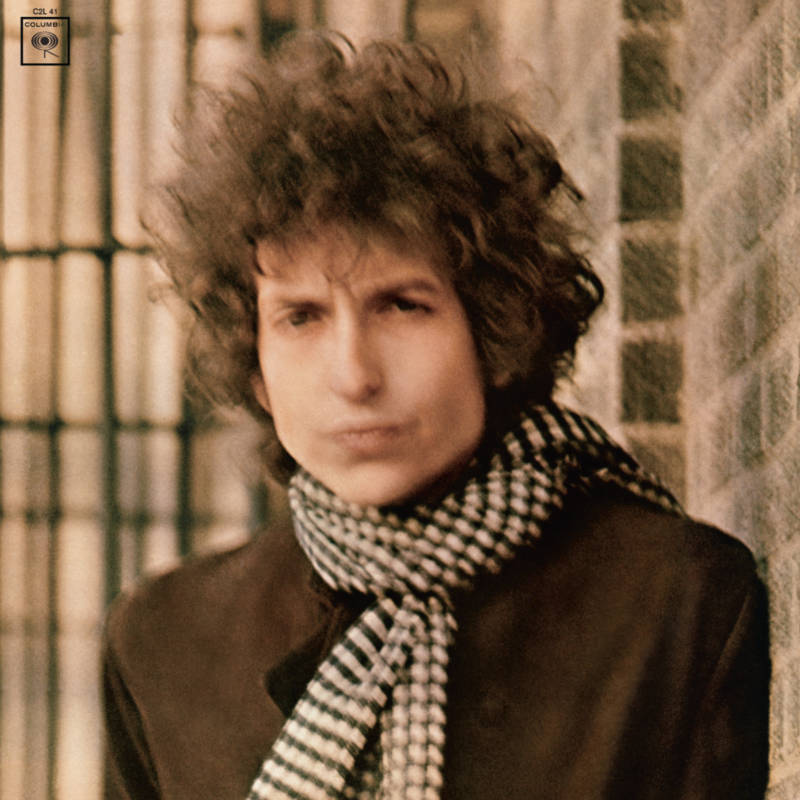
Jerry Schatzberg: Everybody was trying to figure out what kind of drug trip we were trying to portray for the Blonde On Blonde cover since it was out of focus. Nothing to do with that. It was January. Dylan had on a light jacket and I just had on a light jacket and a number of the images while we were moving around were moving, you know. So, they were blurred a little bit. I must say Dylan chose that one and I was delighted. I knew there are a number of other good images from that shoot that were quite good which I use now. For a while I used just the Blonde On Blonde cover. But now, at shows and different places, I show them. They are quite good and absolutely sharp. But people thought we were trying to say something more than what we were.
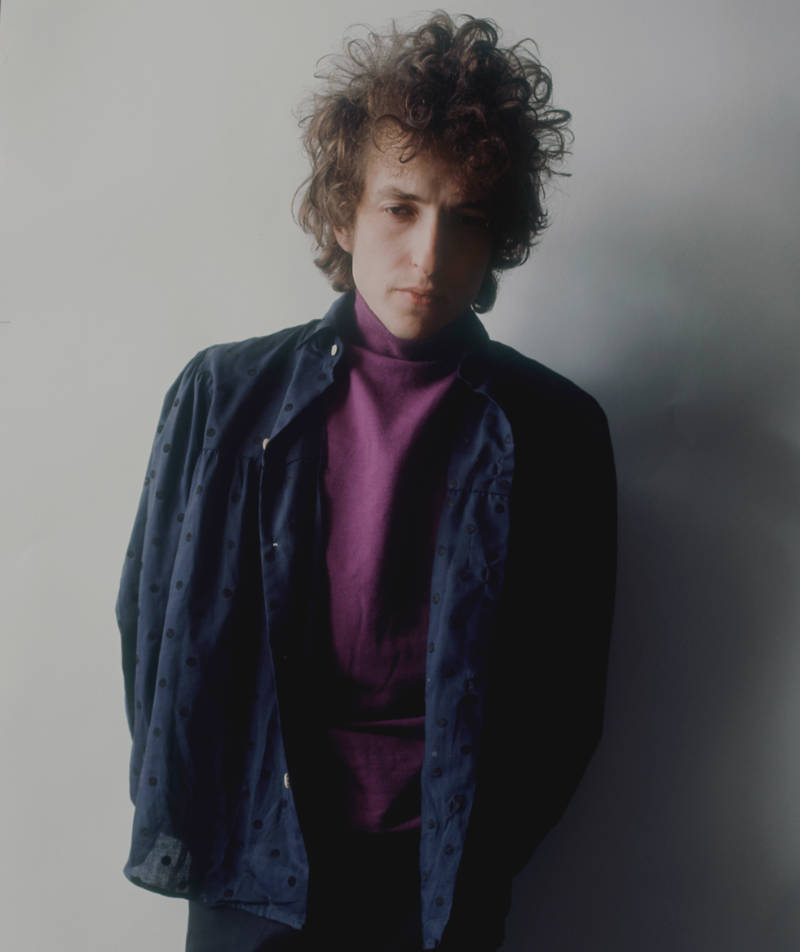
“I think any photographer that photographs another person tries to capture that person as best he can. By this time, I knew Dylan quite well. I’d been photographing him for about a year. We’d hang out together and go places. When you’re in that kind of a relationship you are getting into somebody’s soul.
“That is one thing. A lot of people want to know where it was photographed. To the best of my recollection, it was a meat packing district in Manhattan which I had gone over a number of times to find out exactly where and it just doesn’t exist anymore. So, it was either a building that was torn down or totally surfaced and I have no idea. Sony is now in the process of doing a search on a number of albums and where they were shot in New York. A while ago, we went down to the meat packing district with a camera crew and Sony looking for it. But we found a couple of places they might have. I liked the meat-packing district in contrast to Dylan. I felt that would be a good place to shoot.
“In color and black and white, it’s the same guy. It’s me photographing Bob Dylan. The first set of photographs I took of him were in 1965 in the recording studio with a Nikon. In color I used a Hasebland camera.
“I had asked Al Aronowitz who was in my studio who was talking to a disc jockey that I knew and I was probably photographing somebody. My ear heard them say, ‘Dylan, I saw him yesterday. I’m quite friendly with him.’
“I said, ‘Hey. The next time you see him tell him I’d like to photograph him.’ The next day I got a call from his wife Sara. Who I knew before she even knew him. She was the one who kept telling me about Bob Dylan. Sara said to Bobby that I would like to photograph you’ and he said ‘OK.’ And I replied, ‘I’d love too.’ She gave me the address where they were recording Highway 61 Revisited.
“Next day I went over and was welcomed. He even let me hear some of the sides they were doing and comment on it. I must say I was a little intimidated at first but they really made me quite at home. I had photographed a lot of people. The Duke of Windsor when he was once the King of England. I don’t have to be intimated by anybody.
“But, you know, when you come across a talent like Dylan…I didn’t catch on to him at the beginning. I was listening to him and it was Sara and Nico from the Velvet Underground they kept yelling, ‘Genius.’ I was very impressed what I heard and what he was doing. He was funny. We used to go to my club, Ondine’s. I was a stock holder, sit at the bar and hang out.
“Because the first shoot was during the Highway 61 Revisited recording studio and, of course, that’s his kingdom. He could do anything he wants because he’s comfortable there. He was also comfortable around me because of Sara and Al. I got the photographs in and wanted them to like them and they did. And that’s when I wanted to get him into my studio where I had more control. And once he came to my studio, there was nothing he’d say no to, basically. I’d find a prop that I might have used in a previous photograph, I’d give it to him and he’d do something with it. He was just very cooperative and he felt at home too. My studios and film sets are always that way. I want people to feel comfortable and I want them to do something usually a little bit different from what they do in real life. I make them comfortable and they do it.
“The reason is, the period we’re mentioning was such a special time. I mean, it started in the fifties with the beat generation. 52nd Street jazz. The poets, Allen Ginsberg, Lawrence Ferlinghetti were talking to the people. Listen to the rock music in the early and mid-sixties. It was really about the people. It was the revolution of saying ‘we’re not getting into what we did yesterday. We want to do something different.’
“The special time, and a bit later, 1967, the Summer of Love. LIFE Magazine putting rock groups in the pages and cover.
“I don’t think it happened after Dylan’s motorcycle accident. I think it really happened at the start of the fifties. With the beat generation and poetry that went on. Ginsberg and Ferlinghetti and all those people. They were saying ‘you don’t have to write things the way they used to be. You can do this and you can change.’
“I think that just crept into the music, and of course, maybe the Beatles and all that music coming. It wasn’t exclusively America. It really started in London England where the music was coming through differently. It all started with our own rhythm and blues. It took the French to tell us that we started jazz, you know. But we did have those roots. And I think you can go back all the way to there. Like the rock ‘n’ roll 1952-1960. The early rock people, the blues recording artists. Those artists were not gonna give up what they were doing. The rest of us had to catch up to them in some way. And we eventually did.
“The 1966 UK photographers of album covers, along with myself were seen in 1967 by everyone. They were struggling to get things out. We were struggling to get things on. There were still some great photographers from the older generation when I started. And I was working before [David] Bailey. People found out about the music from the photographers because we were all friends with each other. My favorite club in London was The Ad Lib.
“You look through the sixties and that was the golden age of advertising. Really was. Advertising was a big thing. You look at advertising today and it’s so awful, and it was really creative in those days. The literature of that period. I think we go through periods and I guess we have to get release.
Andrew Loog Oldham: I worked as a press agent for the Beatles, Chris Montez, Bob Dylan and the Little Richard/Sam Cooke/Jet Harris 1962 tour before I met the Rolling Stones in 1963.
“I worked for fashion designer Mary Quant in 1960 when fashion was the pop business – the only pop Britain had. It was a time when American Cinema gave us hope and attitude, and the pill gave us time and disposable income.
“In 1963 I managed to score some press for the still-unknown-folk singer in England. I was doing PR in January ‘63 and bumped into manager Albert Grossman at the Cumberland Hotel, Marble Arch. His client, Bob Dylan was in London to play a minor role in a BBC2 television drama, Madhouse on Castle Street. He would eventually perform two songs: “Blowin’ in The Wind” and “Ballad of a Gliding Swan.” [It was broadcast on January 13, 1963].
“It was written by Evan Jones and the director was Philip Saville. I got a ‘fiver’ for ten days of work. I managed to get Dylan into Melody Maker. Thanks to Max Jones or Jack Hutton. They were doing me a favor-Nobody else cared…
“Dylan and his manager Grossman were very happy together. They acted like they knew something we didn’t know yet. In a different realm it was like being in a room with Dylan and Grossman. There was this conspiratorial thing that was so powerful; you knew it had to work. And then I met the Rolling Stones and said hello to the rest of my life…
“I’d always regarded Sam Cooke and Elvis Presley, and later Bob Dylan as the real self-producing artists of the era. Sinatra and Bing Crosby had to be the Guv’ners – Joe Smith at Warner Bros./Reprise in 1966 invited Keith Richards and I to watch Mr. Sinatra record in Hollywood at United Western, that was an education in form and producing thyself. – To know thyself and how to dress yourself in sound, song and polish every word so that it belongs. It places you above anything that can be deemed the A&R domain.
“Dylan did look back. He looked back at the Beatles and the Stones, went hmmm, went into the studio and changed the goal posts.
Richard Williams: In the summer of 1966, everything about Blonde On Blonde was a mystery. The title, certainly. The bold statement of a vinyl double album (before the Mothers’ Freak Out, the Beatles’ White Album and Hendrix’s Electric Ladyland). That cover photo: great hair, great scarf, great suede coat, and the most enigmatic facial expression since the Mona Lisa – but out of focus. Why on earth would Bob Dylan choose that one? What was he trying to tell us?
“And then to kick off with the Salvation Army Band march of ‘Rainy Day Women Nos 12 & 35’: as uncool a piece of music, despite the injunction that ‘everybody must get stoned, as you could imagine in the year of ‘Reach Out, I’ll Be There’ and ‘Walk Away, Renée’. Followed by the Chicago-style eight-bar blues ordinaire of ‘Pledging My Time’, a throwback to Highway 61 Revisited, although that shivering harmonica solo at the end suggests that something different might be in the offing.
“As it indeed is, with ‘Visions of Johanna’, where the mysteries stop being riddles and become poetry. A song whose incantatory melody and atmospheric, image-filled lyric – ‘Lights flicker from the opposite loft / In this room the heat pipes just cough’ – take everything we already know about Bob Dylan one step further. And adding Johanna herself to his gallery of elusive, sphinx-like women.
“Here is where the album really begins, the album we knew we wanted back then without knowing what it would be, sweeping us through one mystery after another. The exuberant piano of ‘One of Us Must Now (Sooner or Later)’, the spring-heeled jangle of ‘I Want You’, the low-slung narrative of ‘Memphis Blues Again’, the Beefheart pre-echo of ‘Leopard Skin Pill Box Hat’, then the plunge into the beady-eyed erotica of ‘Just Like a Woman’ – ‘her fog, her amphetamine and her pearls’ — and on and on and on through cryptic hints (‘Temporary…’ ‘Absolutely…’ ‘Obviously….’) all the way to the culminating 11 minutes of ‘Sad Eyed Lady of the Lowlands’, an endlessly unscrolling love letter to the muse and to a world of matchbook songs, gypsy hymns, dead angels and a cowboy mouth, a world that was his alone and yet in which he invited us to immerse ourselves.
“Six minutes and 31 seconds into this masterpiece, at the start of the fifth line of the fourth verse, Joe South, who is playing bass guitar in Columbia’s Nashville studio, makes a mistake. He forgets that the first four lines of the melody are repeated and picks the wrong chord change. I love that. His minor lapse of concentration would normally mean the junking of the take. But we’re in the early hours of the morning. Even though this is the fourth take, Dylan hasn’t made it clear to the exhausted musicians how many verses the song will have.
“Was there even a decision to be made? South’s little goof is left in, acting as a reminder that this music was made by human intelligence and skill, prizing the intuitive and spontaneous. It survives as part of a work that has lost none of the power to enthrall and mystify so coolly wielded by its maker 60 years ago. We were hungry then, and it fed us.
Michael Simmons: Blonde On Blonde perfected what Dylan had created on his two preceding albums. It’s the sound of an entire branch of American popular music busy being born. ‘I’ve never heard it before,’ Dylan said of his own music at the time — and no one else had either. A line was drawn and from there on in, rock songwriters and musicians strove to elevate their standards to match what Dylan had achieved. What followed Blonde On Blonde was rock music as art and literature. While the Beatles, Beach Boys and others had been experimenting with great success, Dylan was leader of the quality lit pack of rock ’n’ roll.
Heather Harris: In Blonde On Blonde Bob Dylan generated the same sophistication as his previous political, folk and protest phases with this double album about-change of humorous tunes, love songs and the normal Dylan crypto-musings of any of his eras that we always loved and will love. The musicianship is of course flawless with that pedigreed bunch on board.
“I liked the sea change since I believe artists should do whatever they want. This was even more fun listening than his last two sea-changes Bringing It All Back Home and Highway 61 Revisited. And hey, purists, Dylan already made the finest protest music ever. The end. Time for something new. (And who knew that the pendulum would swing back a half century later with his writing the astonishing ‘Murder Most Foul,’ a protest with all the bite, poetry and precision of his younger self.)
“Since Blonde On Blonde was released while I was in college, of course all we art students loved the impudent blurry album cover portrait, since this was a meme before the word existed. (Art teacher: You photo is out of focus. We art students: I meant to do that!) And I hope my fellow college student who lived in the dorm room next to mine fries in Hades for his having played Side 4 (just the one song ‘Sad Eyed Lady of the Lowlands’) over and over and over sans variation for a full semester. Perhaps he grew up to be the one who thought up torturing Manuel Noriega via music…
Mark Sebastian: I was in Spoleto, Italy, running errands for my Godfather, Gian Carlo Menotti, the first time I heard ‘Rainy Day Women #’12 & 35’ I’d been listening to Radio Caroline that July searching the dial of an old timey radio, for any sign of my song, ‘Summer in the City’ getting airplay back in the States. Dylan’s song seemed a silly adolescent ditty, a march begging for a bust. Cannabis experimentation was so clandestine then and only alluded to obliquely in songs. It was a hidden thing, extremely illegal. This was a joke song, sung to the sounds of a party, with Bobby Neuwirth providing silly whoops and hollers.
“The day after arriving home on the RMS Queen Elizabeth, I went uptown to Matthew Cowles’ apartment. Matthew was my best friend, and as rabid a devotee of Dylan’s work as existed. We sat in amazement and pored over ‘Just Like a Woman,’ ‘Memphis Blues Again,’ ‘Visions of Johanna’ all the wondrous gifts of BLONDE ON BLONDE. And, of course, the unexpected ‘Sad Eyed Lady of the Lowlands.’ This song was an Iliad: a storm of Dexedrine-propelled lyrics, taking up a whole side of the record. I realized Dylan had reached a new height. So much for the three-minute song, tailored and sped up to fit radio. The gates had been flung open and those of us writing lyrics in that time realized the era of the teen lament was over, for better or worse.
“Over time, Blonde On Blonde became one of my favourite records. I would put it on all the time, usually skipping ‘Rainy Day Women’, which still seemed like a silly space filler. I knew that many of the characters in Dylan’s songs were part of the music scene in the Village. I figured Suzy Rotolo was part of the landscape, who fed and sheltered Bobby, with little reciprocal generosity once he was in the ducats. I could imagine Neuwirth or David Blue, Phil Ochs, all the people on whom Dylan unleashed so much of his ire. I later understood that Edie Sedgwick was in there, poor, starved Methedrine muse to Warhol, though she wasn’t on my radar yet at 16.
“I could feel the ambiance of my native Greenwich Village, could smell the musty air of clubs like the Gaslight, where I later played, I could sense the foreignness felt by this tramp from Hibbing. No wonder he felt he had to create all the fictions about ‘ridin’ the rails with Woody and Cisco.’
“Many of us felt the line ‘Shakespeare, he’s in the alleyway’ was about John Maurice Beaton, aka Ian Orlando, our marvelous Village eccentric, who dressed in Elizabethan garb. Joan Baez, (her stunning cousin had been my babysitter!) was certainly included, an object of both Bob’s affection and disregard, even as she introduced him to anyone who mattered in the folk music circles of the Village and the Newport Folk Festival. She fed the paper to his typewriter as he sped and free-associated lyrics. We should all have someone like Joan in our lives.
“I met Bobby on Washington Square a few years later. I was being developed in demo recordings by the great A&R man, John Hammond, who signed him to Columbia. I was spending a lot of time at Dylan’s friend, John Hammond Jr’s loft, passing guitars around, swapping songs and I told Bobby I hoped we could meet there someday.
“He was very unfriendly and I realized he looked at me as competition and probably a spoiled brat and not his new best friend, even though my family was very friendly with the Hammonds and my brother John had hung out with Bobby a lot. The world of folk music wasn’t all camaraderie at the Kettle of Fish and passed joints. It gradually became very competitive, especially as some artists migrated to pop and made fortunes, and others didn’t.
“This album is still always at arm’s length, so I guess, at least during that period, I was taken in by his magic. The musicians were chosen so well; some of my buddies like Area Code 615’s Kenny Buttrey.
“There is a theory among some rather extreme music buffs that Dylan was a case of mass hysteria; The theory is that everyone was waiting for the ‘next big thing’ after the Beatles and they made him it. I don’t ascribe to that theory but I find it intriguing.
Robbie Robertson: When I would visit the Brill Building with Ronnie Hawkins, one of the things that I really took away from that was Doc Pomus and Mort Shuman or Jerry Leiber and Mike Stoller, or Otis Blackwell, and really got from them, because the obvious thing was that they tapped into something that felt good. But it had to feel good writing for others. The song could be about anything but it had to feel good.
“Then, the other door was Bob Dylan. Who it wasn’t about that. It was about emotion and an energy. But it was really about saying something. It wasn’t about ‘these words could be anything.’ No. No. It was specific. So, to me it was rebelling in a beautiful way against this other thing.
“Blonde On Blonde was an unusual time which caused all those songs to be written.
“We’ve been playing with Bob for years there’s no surprises involved. We know the technique very well.
“There was a thing that happened between Bob and us that when we played together that we would just go into a certain gear automatically. It was instinctual, like you smelled something in the air, you know, and it made you hungry. (laughs). It was that instinctual. And the way we played together was very much that way.
“And whether, we were playing in 1966, or 1976, or when we did the tour together in 1974, we would go to a certain place where we just pulled the trigger. It was like ‘just burn down the doors ‘cause we’re coming through.’ And it was a whole other place that we played when we weren’t playing with him. It was a whole place that he played when he wasn’t playing with us, so it was like putting a flame and oil together, or something. I don’t know.
“When we did the Dylan and Band tour in ’74, where we went and did a lot of the same things we did back in ’66, and peoples’ response was ‘this is the shit and I knew it all along.’ It was like you weren’t really there all along. It’s interesting and it’s one of the things I talked about in my keynote speech that I had to make at this [SXSW] conference. It’s really a very interesting experiment to see.
Al Stewart: When the Byrds released ‘Mr. Tambourine Man,’ and Dylan did “Like A Rolling Stone,” I thought, ‘My God!’ This folk-rock thing was in the back of my mind as being interesting, but I thought it had no commercial applications whatsoever, and all of a sudden, it’s the biggest thing in the world. And I thought, ‘That’s it. I’m going to be a folk rocker because that’s the future.’
“In 1966 I saw Dylan and his group at the Royal Albert Hall. But I had a completely different take on it because I had been around rock bands and around sound systems. And so, I knew the technical side of it.
“The Royal Albert Hall had one of the worst P.A. systems imaginable. It was set up for political speeches. Winston Churchill made speeches there. That’s fine if the audience is sitting and listening and you’re talking into the microphone you can hear it. With an acoustic guitar you can still hear it. That’s fine. You put a rock band in the Royal Albert Hall and Dylan I think was using the house system. You couldn’t hear a word. It was totally underpowered. It was like if you had a rock band behind you and you’re singing through a transistor radio. And there was no way anybody could hear what was happening.
“So it wasn’t that I didn’t think it worked, because I had his album Bringing It All Back Home and I knew that it would work with a band, but it just didn’t work with the sound systems of the day. They just weren’t powerful enough in the UK. And that I think is the problem. [A sound board tape by a hired engineer did record a pristine 1966 UK performance].
Patti Smith: The Bob Dylan Live 1966 Royal Albert Hall record. I can tell you this. I saw Bob Dylan in that period. I saw him right before he went to England in 1966. I was really lucky. I saw him in 1963 when Joan Baez introduced him. I saw him through various changes. Then when he started wearing a jump suit, this lion-like hair and had a band, The Hawks, behind him. I saw him booed by the people even though he was really great. When I hear that record, I see him in my head because I can remember when he sang ‘Visions of Johanna’ acoustically for the first time. He said, ‘This song is called ‘Seems Like a Freeze-Out.’ He didn’t have that title, you know. So, when I listen to that record it’s almost like a visual experience for me.
David N. Pepperell: The major revelation to me of seeing Bob Dylan and the Hawks in Sydney and Melbourne Australia in 1966 was not Bob himself – I had followed his career via all his album releases and expected the best although I have to say that I thought his vocal vivacity on stage was far superior to the performances on his recordings – but rather the five young men he brought to Australia to back him on his electric set.
“This group, known as the Hawks before hooking up with Bob, and known later as just The Band probably in homage to their superiority over most of their contemporaries, gave this country a whole new view of what Rock Music could achieve.
“We were so excited at the prospect of finally seeing and hearing Bob Dylan in Australia that we didn’t notice he was on the stage until the first few strums of his acoustic guitar, apparently loaned from a Sydney musician after Bob’s own guitar was damaged in transit, rang out through the old Sydney Stadium, more used to wrestling and boxing than musical genius.
“He cut an amazing figure on that stage, dressed in an orange and brown hounds-tooth suit, floral shirt and Cuban heel boots whilst his hair was teased out in an afro reminiscent of the corona of the Sun. At certain times when the light struck his hair you could see right through it and it resembled a halo.
“From the opening strummed chords of ‘Mr. Tambourine Man’ the whole room was hanging on every word. What was interesting was that despite everyone in the audience knowing the words no-one sang along, the song was accepted with deference and awe. Still the applause was deafening as Bob left the stage for the interval.
“Following the interval things got dark.
“After we got back to our seats after smokes and cokes, he walked back on to the stage, again with no introduction, a Fender Stratocaster electric guitar hanging around his shoulder and accompanied by five musicians playing piano, organ, guitar, bass and drums.
“From the moment after the count-in ‘1,2,3’, when they deluged the Sydney Stadium with gorgeous sound, The Band made all the previous groups we had seen – including the Beatles, Kinks and Rolling Stones – sound like amateur outfits, almost kid’s bands.
“This was an aggregation of Adults, people who understood dynamics as much as volume, tapestry of sound rather than just harmonics and the way that playing less can be playing more.
“As Bob said in a speech from the stage of his last concert of the 1966 World Tour, ‘This is not English Music we’re playing, this is American Music’ and he certainly proved that on stage in Australia. Many folkies booed and walked out of the second half of the show complaining that the band were too loud. This was untrue.
“The Band just played with an amazing dynamic sound that fully engaged anyone listening and coloured the night with magic. To this day I will still say that Dylan and the Band was the greatest music concert I ever attended and I attended so many in the 60’s and 70’s.
“Bob’s singing was full of fire and light. He whooped up to the top notes and growled the low ones but the main aspect of his vocals was the immediacy and meaning he put into those wonderful words. The Band added so much to his performance by filling in the empty spaces between the lines of poetry and illustrating them with power and maybe even exultation.
“Having the unusual combo of piano and organ gave the group so much rhythmic and harmonic variety and the songs lived with a wall of sound filled with excitement, madness and ecstasy – all the things that make Rock Music the miracle that it is.
“Richard Manuel and Garth Hudson formed a keyboard juggernaut anchored by Mickey Jones’ skittering drums, (who had replaced Levon Helm just for the World Tour), Rick Danko’s bedrock bass and Robbie Robertson’s guitar which howled keening cries in the thin, wild, mercury sound of it all.
“This event provoked a furious response from a section of the crowd who began catcalling and booing. Dylan ignored them and started the electric half with ‘Tell Me Momma’ another new tune. However, it wasn’t the tune that was so surprising but the volume of his backing band who played louder than I had ever heard a band play, including the Rolling Stones and the Kinks. It was wonderful music though that swept you up in it and it was obvious Bob loved playing like this as he was dancing around, sometimes raising one arm up in the air in a kind of mad joy. I looked at the people with me and they reacted the same was as I did, enraptured by the best music we had ever heard.
“At the end of that song the noise was horrific. Again booing, shouts of ‘traitor what happened to Bob the folkie’ and a slow handclap, although I could see that this response came from one section of the audience who seemed to be organized in some way.
“Dylan’s response was to look more bemused as the stage rotated and go into a rocked-up version of another oldie, ‘I Don’t Believe You’ which again seemed to gain so much from the electric backing compared to the rather spare version on Another Side. ‘Baby Let Me Follow You Down’ was rocked up next -well, why not, when the Animals had already had a hit with it as a rock tune two years before – and Bob had me and practically everybody else in his sway, except of course the yahoos. This was amazing, inspiring music played brilliantly and sung by a singer whose ability was only half shown by his records. Dylan sang and whooped and hollered and hit notes right off the scale. My heart was beating so loud I felt it could almost be heard above the tornado of Bob and the band’s music.
“A totally glorious version of ‘Just Like Tom Thumb’s Blues’ ensued with the same Latin, south-of -the-Border feel that it had on Highway 61 Revisited.
“Regrettably the detractors, many of whom had symbolically walked out, yelling epithets and insults, were still booing and slow clapping after every song – the band were far too loud to hear them during songs which was a blessing. It seemed obvious they were some kinds of folk purists/leftie dogmatists who had decided that Dylan was a fake and a sellout – I heard these words often used – and they were determined to disrupt and destroy his performance. How they were unaware of Bob’s two most recent, electric albums I couldn’t work out. They failed in their intent anyway as the bulk of the audience was totally enraptured with the music and only wanted to hear more, so there then began screaming matches between the pro- and anti-Dylan forces in the audience which didn’t make being there any easier.
“Undeterred the group and Bob continued with a comic ‘Leopard Skin Pill Box Hat’ which really drove the ‘folkies’ into a frenzy followed by a beautiful re-arrangement of ‘One Too Many Mornings’. The harmony on the last line of the verses sung by Bob and the group’s bass player was just gorgeous.
“On ‘Ballad of a Thin Man’ Dylan crossed to the piano and, seemingly annoyed at the nay-sayers response, really spat the words in the direction of the section of the crowd still cat-calling. They couldn’t wreck the show – it was far too good for that – but they were so annoying you just wished they would either stop or get out.
“Those elements must have got under the Bob’s skin because instead of ending the show with ‘Like A Rolling Stone,’ as we all had expected, he finished with a vicious ‘Positively Fourth Street,’ again aimed at the goon squad, then stormed off the stage despite the tumultuous applause from most of the people there. It was a sad end to a magnificent show but it could not spoil it for me – I was just dazzled by Dylan’s performance. I had never heard musicianship like that and had never heard such a cavalcade of extraordinary songs and could not remember ever hearing a greater singer.
“I left the concert hall in a state of almost perfect bliss, believing that a new world was possible and I was seeing its beginning in the music of Dylan and his Band. After we left the Show to walk and to our car my four friends and I did not say anything for about half an hour.
“What we had experienced was really beyond words.
D.A. Pennebaker: During the 1965 filming of Dont Look Back, I learned to trust myself. I was in the zone for Dont Look Back. Maybe Dylan was in the zone. I knew that once I got started, I just had to roll and not plan anything. I didn’t try and be smart about anything. I never asked him a question. I didn’t want to know anything. I just wanted to get inside that camera and not come out.
“In 1966 I worked with Dylan on a color music movie that was commissioned for ABC-TV, Stage ’67, that was initially titled But You Know Something Is Happening. Later Dylan edited that footage as Eat the Document.
“After Dont Look Back Dylan said, “I want you to shoot a film and I’m going to direct it and it will be my film. You have your film and this will be mine.” That was the kind of handshake arrangement. We didn’t have anything signed or no papers about it. We went off. I only knew how to film one way. I didn’t change the way I filmed. And Dylan really didn’t know how to direct and nor did I. It kind of stumbled along. We were moving around a lot. Sweden, France, England. It just wasn’t a tour of English music halls.
“And I think that Dylan got really intrigued by the kind of locals he was in and how they responded to him. And then John Lennon came in and we sort of got involved with John. At no time did I think I’m gonna capture this movie and do it myself. Although I could sort of see how to do it because it was different than Dont Look Back. Dylan was playing on stage with 4 or 5 musicians and having a great time doing it. I mean, it was so much more interesting than what he had been doing all by himself. And he kind of took to it. And I could see by shooting the stage performances were really an important part of it. At one point I actually got out on stage with the band and he didn’t know I was gonna be there and when he saw me, he really cracked up, because it was such a funny idea that I was just like the band.
“I felt that 1966 tour Dylan was really writing music sort of with Robertson and for Robbie. He was trying to show Robbie how to write music. There was something going on that drove him so that he would stay up all night. I filmed Bob endlessly where he’d write many songs during the night and Robbie would play along. Robbie made him somehow do this. And on the first tour there was nobody doing that. Bob Neuwirth never made him do that. He never felt competitive with Dylan.
“There was no difference in shooting Dylan in color than black and white. By then I was sort of interested in shooting color and I liked the fact you could make scenes. The contrast between one scene and another you could make much stronger. Whereas in black and white it went from black and white to black and white. But you could make sky blue turn into blue velvet. And that was sort of interesting but it did not affect the storyline.
“Well, you see, Dylan had the motorcycle accident. The thing was done for ABC television. And so, Albert came and said, “We gotta give them something. Can you guys cook up something?”
“So, Bob Neuwirth and I cooked up the beginning of But You Know Something Is Happening. But then Dylan said he wanted to edit Eat the Document. And then he and Robbie (Robertson) kind of had a competition about doing that, which always soured Dylan on the film. And so that film got made but ABC didn’t want any part of it. So, the film just sat and was in limbo. And my film was kind of in limbo. I wasn’t trying to compete with Dylan at all.
“I showed it to the critic in San Francisco. He wrote a review of it, which was unexpected, and Albert took not kindly to it. Because Dylan thought we were playing games with him. But I never had any intention of releasing that film and haven’t.
“I turned the footage over to Martin Scorsese for No Direction Home. That was the only way it was gonna get released. Someday my version will get released but it doesn’t really matter. Because all the work was done on the first film, Dont Look Back. And that’s what people remember.
“The first time I screened it for Dylan I didn’t know what was going to happen. But I knew that room was full of people that I hated. I didn’t know where they came from or where they went. Two nights. At the end of the first evening Dylan said, ‘we’re gonna do the same thing tomorrow.’ It was a terrible screening anyway. It was out of synch and I was really depressed. And then we were going to figure out how to change it, or whatever he was going to do. And then the next night, ya know-bang! ‘It’s fine. That’s it.’ He had an empty pad. So, I thought well this guy is an amazing person and I was really not only lucky to be able to film but to have his mind contemplating its release.
“Dylan viewed the Dont Look Back DVD. We’re partners. We deal with Jeff (Rosen) in his office all the time. Dylan came over and he looked at some footage on the DVD and said at one point, ‘how did you get that great sound?’ I said, ‘well Bob, you’re gonna be surprised at this. It’s all mono.’ ‘Mono…I gotta tell the guys down at Sony about this…’
“I think that it will take 50 or a 100 years to really digest Dylan. He’s like John Brown. He’s out there singing a song and he’s gonna sing it until he drops. That’s what he’s going to do. The concerts now are like transfigurations but they’re interesting because you can’t sit on a talent like that and whatever you do is going to be interesting.
Marianne Faithfull: I recorded ‘Blowin’ in the Wind.’ Never in my wildest dreams could have imagined anyone like Bob in 1965 during Dont Look Back. His brain, but I was frightened. He played me the album Bringing It All Back Home on his own. It was just amazing, and I worshipped him anyway. That was where I got very close to Allen Ginsberg ‘cause Allen was the only sort of person I could recognize as being somewhat like me.
Gene Aguilera: So, how do you follow Highway 61 Revisited? Simple . . . you just make one of rock’s best double LP’s . . . Blonde On Blonde. This is Dylan’s 1-2 ‘knockout punch’ for you all. In my humble opinion, the crest of Zimmy’s career: 1965-1966. Following the formula of Highway 61 Revisited, Dylan brings back producer, Bob Johnston, who then convinces him to relocate to CBS Studios in Nashville for that trademark country ‘butter’ sound. Parlay Highway 61 Revisited returning musicians Al Kooper (piano and organ) and Charlie McCoy (guitar); then toss in key musicians Joe South and Jaime (Robbie) Robertson just for good measure.
“Some trivia on Blonde On Blonde for its 60th anniversary. The original inside cover pressings of the album included a picture of 60’s Italian movie actress, Claudia Cardinale–used without her permission. After complaints from her management, Claudia’s photo was removed from subsequent pressings, making it a collector’s item. Also on the album cover, note there is no title, no artist name (no writing, except for the spine and record company logo) . . . if you know, you know.
“It was an honor to personally meet Bob Dylan on two sit-down drink occasions in the 90s. Photos or autographs were not in the cards; but knowing Dylan was a gentleman, a true artist, and an all-time favorite, is a memory worth keeping forever.
Clive Davis: In June 1967 I really came to the Monterey International Pop Festival not knowing what to expect, but seeing a revolution before my eyes. I was very aware that contemporary music was changing. At Epic I signed Donovan and I was in the business side of it for a year at Columbia. I was working with Andy Williams, the young Barbra Streisand and the young Bob Dylan. I was observing and seeing the business change.
“The only rock that Columbia was in was more of Bob Dylan as a writer, with some of his hits being popularized by Peter, Paul & Mary, and the Byrds.
“I was seeing music change, but I was waiting for the A&R staff to lead into these changes that were showing evidence in becoming important in music. The success of the artists I signed at Monterey gave me confidence that I had good ears and the confidence to trust my own instincts.
Mick Farren: The weight of anticipation that was loaded upon the release of John Wesley Harding was probably more than any artist should be expected shoulder. How in hell was Dylan going follow something as monumental as Blonde On Blonde? And in the landscape that I inhabited, not only were fans, musicians, writers, and rock critics asking the question. So were individuals who had regularly spent entire Sunday afternoons skulled to Neptune on the best obtainable acid listening to ‘Sad Eyed Lady of The Lowlands’ over and over again, searching for some nebulous electric dharma of their own imagining. And when the answer turned out to be relaxed, controlled and even reserved, conflict broke out between those how just wanted more, just B-on-B 2, and others who were frankly baffled and studied the cover photo for mystic clues. Acidheads did not come to blows, but they glared at each other with their third eyes. Me? I accepted what I was given, and then I learned to love it. So, we had no more recklessly complex, declamatory monoliths like ‘Like A Rolling Stone.’
“Dylan had constructed cottages; neat formal songs that smelled of Jerry Lee Lewis, Sam Phillips, Hank Williams and A.P. Carter. He had edited and simplified, and in so doing had created tunes that, down the years, proved to be of incredible durability. Think of all the songs from JWH, that are still covered, to the point that ‘All Along the Watchtower,’ the song itself, can, in 2007, function as a crucial, cliffhanging, metaphysical, deep-space entity in the TV sci fi cult series Battlestar Galactica.
Jackie DeShannon: In 1963, I was invited by Peter, Paul and Mary to see Bob Dylan at his first concert appearance at Town Hall in New York. Immediately I knew how important he would be. When I returned to Los Angeles, I tried to convince the [Liberty] record label to let me do an entire LP of his songs. No one at the company listened and understood. I did eventually record a few of his tunes: ‘Blowing in the Wind,’ ‘Don’t Think Twice It’s All Right,’ and ‘Walkin’ Down the Line’ on a 60’s Liberty album.
Roger McGuinn: Dylan’s stuff is brilliant. I coined the term that he was the ‘Shakespeare of Our Time.’ It was like knowing Shakespeare here. Dylan was carrying on [Jack] Kerouac and [Allen] Ginsberg. The baton had been passed. I remember Ginsberg said ‘I think we’re in good hands.’
“When I recorded the vocal on the Byrds’ ‘Mr. Tambourine Man” I was trying to place it between Dylan and John Lennon.
“Ray Gerhard was the engineer at the Columbia Records studio when the Byrds started recording. And at the time Columbia was a middle of the road record label, and they were scared of rock ‘n’ roll. So, Ray, to protect his precious equipment would put limiters on everything, compression, and double compress it for the Rickenbacker, and that is what gave it the wonderful sound.
“When I heard the sound for the first time, I could not believe we had done it. It knocked me out. At the time I was on the band track with the [American Federation of Musicians Local 47] Hollywood session guys, and that was fun, and we did the vocals, and it was all different parts. But when it all came together on the playback it was bigger than the sum of its parts. I couldn’t believe we had done it. It sounded so creamy, rich, big and full.
“In the Byrds I had to play lead lines with a flat pick so I started combining the two styles by having a flat pick between my thumb and fore fingers and moving the finger picks down one to middle and ring finger and then doing those banjo rolls like that. That’s how I did my arpeggios in the Byrds. The jingle jangle sound. In the Byrds we used a lot of electronic compression on the Rickenbacker and it gave it a sustain that it didn’t have as a natural instrument. That was a really important thing.
Chris Hillman: The Columbia recording studio. I loved that place, knowing the history going back to radio broadcasts with Fred Allen and Jack Benny. Columbia was a union room. The engineers had shirts and ties on. Mandatory breaks every three hours. Record producer Terry Melcher was a good guy. I didn’t really get to know him. I was shy. Columbia was comfortable to record in there. Terry was good. I liked him.
“One thing I’ve said before, melody and lyrics, and what our manager Jim Dickson drilled into our heads, the greatest advice we ever got, and he said, ‘Go for substance in the songs and go for depth. You want to make records you can listen to in forty years that you will be proud to listen to.’ He was right.
“The Byrds do Dylan. It was a natural fit after ‘Mr. Tambourine Man’ was successful. Roger (then Jim) almost found his voice through Bob Dylan in a way. Literally a voice through Bob Dylan in a sense. And then we start doing some Dylan stuff. ‘All I Really Want to Do.’ Great song. ‘Chimes of Freedom’ is a killer. It’s just one of Dylan’s beautiful songs and he was just peaking then.
Steven Van Zandt: The Byrds introducing Bob Dylan to the world, really, with ‘Mr. Tambourine Man’ was a major factor. I can’t give them enough credit for that. I don’t know if Bob Dylan would have been accepted at Top 40 radio if it hadn’t been for ‘Mr. Tambourine Man.’ I mean that. That gang has been a great service to the world. I was a huge Byrds’ freak. Still am. As you know they lead you to Bob.
“I’ve played Dylan’s songs with Bruce and in top 40 bands earlier. Dylan was an extremely good folk guitarist as far as the folk style he played on his first few albums. Extremely adept at that.
“Then Dylan went electric and started having some fun. His first solo might have been the intro on ‘Leopard Skin Pill Box Hat.’ It’s a funny solo and expresses that part of him. And when he wasn’t playing the guitar himself, he brought in Michael Bloomfield for Highway 61 Revisited and Robbie Robertson for Blonde On Blonde.
“I tuned in for Highway 61 Revisited and then Blonde On Blonde, which I think is the greatest record anyone ever heard.
Brian Wilson: I was a fan of Bob Dylan in 1965. We did ‘The Times They Are a-Changin’’ on the Beach Boys’ Party! I thought Dylan’s voice was an interesting voice.
Howard Kaylan: In the Turtles we cut ‘It Ain’t Me Babe’ and met Bob one night. All of us, as singers and performers keep those great songs in the pipeline so they aren’t forgotten. It doesn’t have to be a great Bob Dylan song or a Tim Hardin song or even a great Leiber and Stoller song. If it’s great and forgotten you kind of feel like you are a missionary as far as getting those things to the public.
Robby Krieger: I saw Dylan perform in 1963. I was in high school in Menlo Park, near San Francisco. There were some guys there from Boston and New York in the dormitory with me and they were into Bob Dylan. I had never heard him before. They had his debut LP. So, they played the first album and I got totally into him.
“On Dylan’s first album I really liked his guitar playing. I thought he was a great fuckin’ acoustic player. He did some stuff that was pretty damn good. And his harmonica work. I had never heard anyone play harmonica like that. Not a blues harmonica player sucking in the notes. I was amazed he could do all that stuff and sing at the same time.
“Then, what do you know. He came to Berkeley for the first time and we saw him at the Community Theater. We just got tickets. I wasn’t hooked up then. (laughs). It was a good experience. He had the buckskin jacket. I bought into the whole thing, basically. I later bought a harmonica rack holder.
“When I saw him live, I sort of realized at the time there were some interesting and unique tunings on stage. I thought he was pretty cool at that first concert, and then the week after that we saw Joan Baez play at Stanford University.
“I loved his Bringing It All Back Home LP. That was my favorite. It all made sense. The lyrics fit exactly what I was thinking when I was acid. It registered, you know. ‘Wow. I’m listening to this guy.’
“My favorite song was ‘Mr. Tambourine Man.’ I might have been in my band then called the Psychedelic Rangers. I had been playing guitar for a couple of years and started at age 15. At the Long Beach concert at first, I didn’t know what to think. Because I was expecting it to be how it was before. But then I realized this. I didn’t really get into Dylan until I saw him the next time in Long Beach in ’65. An auditorium. That’s when he first came out with the electric set. Not only that, but I was on my first acid trip. It actually was not even acid but Morning Glory flower seeds. I think I drove down from Menlo Park.
“I went by myself. I had two tickets, and I had taken these seeds with my girlfriend and she didn’t want to go. So, I went by myself and my mind was blown. I expected him to be the same as he was earlier in Berkeley, and here he comes out with an electric band and wearing a Hollywood Zoot suit. I didn’t know what to think. In Long Beach he was totally different. And that was one thing about Dylan that was always great. He always changed. I loved Dylan’s Highway 61 Revisited album. I loved Michael Bloomfield’s guitar playing on that album and loved Bloomfield on the first Paul Butterfield Blues Band album.
“I never saw Bob Dylan again except when the Doors were being inducted into The Rock & Roll Hall of Fame when the ceremony was held locally in Los Angeles at the Century Plaza Hotel. We all hung out backstage for a few minutes.
Stan Ridgway: If someone doesn’t like Bob Dylan, I tend not to trust them somehow. On my album, Black Diamond, I did a version of Dylan’s ‘As I Went Out One Morning’ from the John Wesley Harding album. The biggest influences on my songwriting are Bob Dylan and Tom Waits. It’s such an influence on me that I’m almost self-conscious about talking about it. I really think to a point, with Dylan, we’re literally living in a time when Shakespeare is alive and he’s right there if you want to go see him. He’s changed the popular song so much, and he had so much to do with that. He’s still here. His influence is so wide-ranging, how everybody writes like that now. It’s hard for a lot of people to realize how much he changed things. He sang his own songs. He broke the game open.
Jackson Browne: What Bob Dylan did for me, everybody and our generation it will never have to be done again. The way he opened up our thinking and our feeling and our view of the world only has to be done once. Maybe it’s done in other fields like film and painting and other art. As a people, we’re constantly growing, expanding but the changes that Bob Dylan brought to rock and roll and songwriting are permanent. They’re part of us. People who are just being born into it now are being born into a world that wasn’t that way until Bob Dylan made it that way. It’s a particular skill to write something in a few words that speaks volumes.
“It is very difficult to say how I feel and how I think about Bob Dylan in a few words.
Bill Walton: I played the albums of Bob Dylan before my UCLA Bruins basketball games and I recited lyrics to Dylan’s ‘I Shall Be Released’ on the free throw line in the NBA. Music has a big role in the game and creates atmosphere.
Gary Pig Gold: Although in actuality not rock ‘n’ roll’s first-ever double long-player; that honor belongs to Frank’s Freak Out! our boy Bob’s 1966 piece-of-resistance remains as undeniably inventive today as it was to innocent listeners six long decades ago.
“And while Jerry Schatzberg’s utterly iconic 12-by-26 cover image may appear a trifle off-focused, the Dylan imagery across all four sides therein is as precise, clear and surgically cutting as anything he had up until then created …or has blessed us with since for that matter.
“Said words of wit and wisdom were then accompanied by downright flawless arrangements and performances via some of Music City’s finest – despite their initial misgivings towards this high-voltage cat from NYC – and ultimately Bob Johnston’s production of perfection resulted in, with ‘I Want You’ in particular, three minutes absolutely without equal during a year that also gave us ‘Paint it, Black,’ ‘Tomorrow Never Knows’ and, dare I say it, even Brian’s ‘Vibrations.’
“After emptying my teenaged bank account circa 1971 and bicycling home with every single Dylan album I could carry from the nearest record store, it was Blonde On Blonde I eagerly slit the shrink wrap to play first …right after Self Portrait, that is. And I’ve been most merrily stuck inside its leopard-skinned blues ever since.
“P.S.: yes, and the true mixes are of course the mono’s, need I remind anyone.
Dr. James Cushing: The website rateyourmusic.com lists 31 ‘popular music’ double-LPs released prior to 1966. (The list excludes opera recordings, which were double or triple-LP packages out of necessity.) Of those 31, eight were by Ella Fitzgerald, two by Judy Garland. Other artists included Benny Goodman, Louis Armstrong, Stan Getz, Glenn Miller, Stan Kenton, the MJQ, Dave Brubeck, Charles Mingus, and Miles Davis, with most of those being concert recordings. The closest thing to Bob Dylan was Peter, Paul and Mary In Concert (1964), only because it included ‘Blowin’ in the Wind.’
“You see the pattern: the double-LP was made for sophisticated grown-ups, not for teenagers. To make a double-LP was to announce that your target audience was adults, and to own one was evidence of one’s adult status — doubles cost twice the money, after all. They were an investment, and what kind of person thinks in terms of investments, kids or adults? So, it’s not too far-fetched to say that Freak Out! and Blonde On Blonde served as ‘announcements’ by Frank Zappa and Bob Dylan that their music had now achieved adult status, and had to be taken seriously as an art form for grown-ups. And both albums insisted on that seriousness with their endings, ‘Sad-Eyed Lady of the Lowlands’ and ‘The Return of the Son of the Monster Magnet,’ both AM-radio-unfriendly at 11-minutes-plus, and both examples of Modernism in lyric (Dylan) and sound (Zappa). So, in a way, these albums suggest that the very definition of ‘adult’ was in flux.
“I was age 13, certainly not an ‘adult,’ when I first heard and fell in love with these albums, and I love them both to this day. Part of why I loved them then was the sense that they were ‘adult’ music and hence conferred that status, at least while they were playing, on me. These double-albums offered a kind of map out of the frustrations of childhood, and suggested that the adult world, in all its bizarre complexity, could be negotiated with humor and honesty. The surreal parables of ‘Help, I’m a Rock’ and ‘Stuck Inside of Mobile with the Memphis Blues Again’ were contained enough to be digested (even memorized, and I memorized both), yet opened out into the larger world. They gave me lenses through which the world around me could actually make sense, even thought was changing as fast as I was.
“Jerry Schatzberg’s cover for Blonde on Blonde must have worried a lot of squares at Columbia Records.
“I’m pretty sure it was the first ‘rock’ album not to have the artist’s name or the album’s name printed anywhere on the front or back – the cover has virtually no printing at all. Dylan’s face became the ‘word’ on the cover. If you know the word, you’re in…
“Furthermore, this was the first time to my knowledge that an album cover photo was deliberately out of focus. Almost a year earlier, Robert Freeman had elongated the Beatles’ faces on the cover of Rubber Soul (and omitted the group name), but despite that distortion, the focus was sharp, and the meaning clear: The Beatles were stretching their ambitions.
“Dylan and Schatzberg made a more radical move, and it fit Blonde on Blonde as well as Freeman’s move fit. Schatzberg’s Dylan is captured in an ambiguous moment of blurring; the subject is veiling himself in an urban shimmer. The face on the album cover is ‘in motion,’ suggesting the constantly shifting perspectives of ‘Visions of Johanna’ or ‘Stuck Inside of Mobile with the Memphis Blues Again.’ Dylan’s scarf and hair are as large as his face, and the viewer’s eye goes up and down the image, trying to read the man’s expression through his veiled eyes.
“Does anyone still make those tan suede coats with the long buttons? Can I get one? They were way cool in 1966 and I say they’re way cool now.
“We must remember that, as far as I or anyone in my circle knew, Bob Dylan’s June 1966 motorcycle accident had left him either 1) dead, or 2) so permanently disfigured that he would never tour or record again.
“Like the Bob Dylan’s Greatest Hits LP released that same season, Pennebaker’s movie functioned within the context of the star’s disappearance; this movie was as close as you were ever going to get to seeing this brilliant-but-now-vanished legend in concert… And the Dont Look Back movie kept functioning that way until early 1974, when the legend returned to the boards…
“On its own terms, the mono Dylan bestows a single-sound-source structure on the music. The reason the mono is preferable to the early stereo LP’s is that with solo acoustic Dylan there is one single sound source. Instead of two sound sources. You get much more of a natural sound with the thing blended as it is right now.
“The first few acoustic albums ought to sound as good on the CDs as they do right now. It’s the three rock albums, Bringing It All Back Home, Highway 61 Revisited and Blonde On Blonde that really make the big difference. Also, I bought the original LPs in mono in 1965-66. So, I first fell in love with those records in mono.
“The mono does give that single sound source and that evenly blended sound that adds to the mysterious of it. Whereas the stereo mix somewhat separates the instruments and add an additional clarity. Which is not always exactly what you want. I think some of the early Beatles’ records are terrible in stereo and much better in mono.
“The stereo mixes, when I first heard them, added separation-definition to the instruments, so that I heard the two guitars and the upright bass in ‘Desolation Row’ clearly — but is clarity the most valued goal with music that creates/inhabits a surrealist dreamscape? Also, other minor details are different, such as ‘It Takes a Lot to Laugh, It Takes a Train to Cry’ being 40 seconds shorter in mono, or the lead guitar on ‘Visions of Johanna’ coming in at different places.
“Armed with the knowledge that the mono mix took up most of the studio time, both in the case of Dylan, the Beatles and the Rolling Stones, given that, I think that the mono need to be taken seriously in the spontaneous sense and the need to be thought of as an alternative sound experience.
“Dylan brings his own private lexicon of images. Mythic and circus images and literary and fantasy images swirling them into this marvelously surreal stew that has the effect of those of us who partake in it the energy to explore our own subjectivities.
“I think the meaning of many of the songs has much to do with how one can explain the statement they make then it has to do with that the way the song gives every listener a kind of permission to explore his or her own private imaginative world and take it seriously to present it to others. Bob Dylan gives people permission to speak. And permission to sing,
“Dylan takes the idea of modern poetry, which is that the poem is a dramatic monologue, spoken by a character and whatever the character is talking about the character is also describing his own interior state of mind. Which includes his analysis of society. That’s what Walt Whitman is doing. That’s what T.S. Elliot is doing. That’s what Ezra Pound is doing. And that’s what Bob Dylan does. So, the character that Dylan creates in these albums is one that he is perfectly suited to play. And he plays it magnificently.
“Dylan is a genius and we are fortunate to be able to share the same time and space with him. Geniuses do that. Geniuses continue to grow and develop. Geniuses have different periods in their art. Geniuses continue to have work that resonates with people. And Bob Dylan is the one genius to have come out of American rock music. And there are no others, except possibly for Jimi Hendrix. But he died too young for us to really tell.
Anthony Scaduto: In my [1971] book [Bob Dylan: An Intimate Biography], I write with a lot of compassion for Bob Dylan. I respect him as a person and an artist. The people surrounding Bob Dylan always felt that he was a very fragile person. It was as if he had to be protected. It wasn’t until a few years later that Joan Baez and Dave Van Ronk would talk freely and honestly about him. Dylan only wanted to be the next Elvis. There was this intense pain that forced him to write certain things that came out of the air. A poet feels his own persona, his place in the world, and the screwed-up condition in that world. If you are going to get into a superstar level, you have got to be hard.
“In the beginning, Dylan had the bodyguards, Grossman. Mick Jagger has the ability to build a wall around himself. You’re an idol, and it’s the kind of thing they put you on the crucifix for. You have to be hard and be protected, or it’s going to destroy you.
Murray Lerner: At Newport in 1965, I knew that ‘Like A Rolling Stone’ was going to be a major breakthrough. It was a mixture of booing, applause and bewilderment. I was intensely involved in the filming so I didn’t pay much attention to what the audience was doing. I was hypnotized in a way by the electric music and had to get the shot. The words just fell on his music. I knew that when I saw him walk in a room at a party around 1962 for Cynthia Gooding. He came in and pulled out his guitar, played a few songs about New York, packed it up and split. He intrigued me.
“At Harvard University I majored in English and my main interest was modern American poetry. T.S. Eliot and Ezra Pound and their technique of two opposite symbols creating a third idea. Two different images, the unexpected juxtaposition of two different images for the third idea. Which guided me into filmmaking.
“Dylan is brilliant. I trust in a sense whatever he says. He actually likes to tour and likes the involvement with the crowd. You never know what he really thinks. He loves teasing people.
James Williamson: Where do I start about Bob Dylan’s ‘Like A Rolling Stone’? I was in 8th grade when I first got excited about Bob Dylan and in quick succession his annual releases. By the beginning of 10th grade, I had been sent to Juvie (for not cutting my hair) and once out was sent to Upstate New York to a boarding school for fuck ups….by then I was so enamored with Bob Dylan, that I actually went out to the highway outside the school and stuck out my thumb trying to hitchhike my way to Woodstock where he lived. Sadly, a guidance counselor happened by and shortly I was asked to leave the school and was back in Detroit. Bob Dylan had that effect on people! The following year, ‘Like A Rolling Stone’ came out and shattered my musical world. Not only was the song writing par excellence but the guitar work of Mike Broomfield just blew me away (shortly to be followed by The Paul Butterfield Blues Band initial release). I was never the same.
Ian Hunter: At the Mott the Hoople audition for Island Records and [talent scout] Guy Stevens], I sung a portion of Bob Dylan’s ‘Like A Rolling Stone.’ It’s no secret that I’ve always acknowledged Bob Dylan as one of my heroes.
“But the two artists I grew up with, Bob Dylan and the Stones (Mick Jagger) were both limited singers. But Jagger was the sexiest singer in the world, and Dylan would make your hair stand on the back of your head. Because his voice was so lousy. That’s the truth.
“I’ve got a lousy voice, and so have Randy Newman and Leonard Cohen. But it doesn’t really matter. I’m conscious of not being a good singer, but that’s just in your throat. I think we all get the message across.
“When we started there wasn’t any keyboards other than piano and organ. We didn’t have these little keyboards that now can do everything. And if you wanted piano and organ at the same time on a track, you couldn’t get a guy with his left hand on one keyboard and his right on another. You had to get a piano player and an organ player. So, then you had the piano and organ color and had all the different guitar colors. And it was also extremely powerful.
“Songs like ‘Ballad of Mott the Hoople,’ we would take ‘em down to zero and all of a sudden BANG, the whole lot would come in. It was easier to put dynamics in and drama, and beautiful, quiet stuff too. Sustaining stuff. Some things a guitar can’t do. It’s just that fraction too jagged. There’s a smoothness with a piano and an organ.
“On our first 1970 tour of America I discovered and got turned on to Delaney & Bonnie and Friends, especially Leon Russell. My thing was Leon. The piano playing…
‘“The Ghetto’ was the first time I heard Leon was on an album. I just couldn’t believe it. It was gospel rock. It was unbelievable. I went home and tried to learn that for months. I got near it but never got it right. The feel.
“When Dylan got ill a few years back, I was in England, and it hit me like a ton of bricks. I couldn’t believe it. I hardly know this bloke, you know what I mean? ‘Cause at first they didn’t know what it was. They thought he was seriously ill. I’m like, ‘Oh my God!’ I’ve had people die on me. A lot of people died. That really shook me up. I seem to have very strong feelings in another way, a deeper way with that guy. A lot of people do, you know.
Jim Keltner: Carl Radle, Jesse Ed Davis and I had recorded some Dylan tunes with Leon Russell as the Tulsa Tops which we did at Leon’s home studio in North Hollywood. ‘A Hard Rain Is Gonna Fall’ is my favorite. Jesse Ed was the only guitar player who ever made me cry.
“I was living in London when Leon called me, asking if I could come to New York to record with Dylan. We did ‘Watching the River Flow’ and ‘When I paint My Masterpiece’ on March 17th, 1971.
“For the August 1971 two Bangladesh concerts there was only one rehearsal. The rehearsal was in a basement of a hotel, or near the hotel. George (Harrison) was beside himself, trying to put together a set list and trying to find out if Eric (Clapton) was going to be able to make it, where Bob was gonna make it. Plus, George was nervous because he hadn’t played live for a long time. He was absolutely focused and fantastic as a leader. Of course he had Leon in the band. And Leon helped with the arranging and all. I remember that everything seemed to be fine at the sound check and that I didn’t have many concerns. When we started playing with the audience in the room it really did come alive.
“When George introduced Bob, I stood backstage, and Dylan walked on. Jean jacket, kind of quiet the way Bob always is.
“He walks out there on the stage and puts the harp up to his mouth and starts singing and playing and I get chills up and down my arms. His voice and the command, it was awesome. It was a tremendous moment. It was real dark on stage with a little light for them. Dylan was incredible. Standing in the back in the dark, it was great to see Leon have the guts to get up there with the bass and perform with him on ‘Just Like a Woman.’
“In 1973 I played with Bob on his recording of ‘Knockin’ On Heaven’s Door’ that we did on the big sound stage at Warner Bros in Burbank for the movie Pat Garrett & Billy the Kid. Roger McGuinn played pump organ on that session. To this day I cry when I hear Bob’s version. It’s been covered so many times but Bob’s is the only one that gets to me.
Curtis Hansen: I’ve had a decades-long dream of working with Bob Dylan. I saw a1963 Hollywood Bowl concert where he played with Joan Baez. I vividly remember seeing Pat Garrett & Billy the Kid the first time right in Westwood. I then saw it several more times. It was butchered but it was still great. Dylan’s music was such a knockout. That score cue when Pat Garrett is walking toward that house where he will eventually shoot Billy the Kid is just beautiful. It’s a stunning piece of music, and of course, ‘Knockin’ On Heaven’s Door’ and ‘Billy’s Theme.’
“It’s funny, each movie that I’ve made when I’ve gone on location, I’ve always taken that Pat Garrett & Billy the Kid soundtrack album with me. I’ll take a dozen things I enjoy listening to but I always include that album because to play it in my car driving toward location at certain times, is like a tonic. It expresses the feeling that you get when you fight and lose, and yet persevere and try to win the more important battles yet to come. It brings back Sam Peckinpah’s struggles. I’ve always carried that with me. It’s an important part of my musical identity.
“Dylan is the quintessential wonder boy. Bob Dylan, more than almost any wonder boy excels at reinventing himself decade after decade, challenging his fans and their expectations and keeping himself vital, which is what the theme of the Wonder Boys movie. The metaphors and themes in ‘Things Have Changed,’ the nuances of the character, were all there, restated with Bob Dylan’s unique imagery and poetry. It’s a compelling song that brilliantly captures the spirit of the film’s central character, Grady Tripp.
Daniel Weizmann: The romantic love songs on Blonde On Blonde, are as radical, more radical than ditching protest or embracing surrealism or going electric. They’re cinematic, intimate, filled with complex feeling, ambivalence, longing and, ultimately, a sense of defeat and catharsis that was not just totally new for him but totally new for the romantic love song. To cite just one example, ‘One of Us Must Know (Sooner or Later)’ wavers like a flickering electron between defensiveness, loss, guilt, and finally a total bewilderment about communication and miscommunication, attachment and detachment. It’s like a high stack of misunderstandings, an apology that reverses itself yet somehow manages to still be contrite and it’s a permanent farewell that permanently bonds. We already knew he was a visionary and a poet, we already knew he was a wizard, but Blonde on Blonde might have been Dylan’s first appearance as a man.
“It’s no accident that Dylan ultimately settled in Los Angeles to the degree that he ever settled anywhere.
“As a cowboy-pioneer of language crossing the American landscape, he knew that the Pacific is the end of the line. You haven’t completed the journey until you’ve arrived. Also, Dylan has always had showbiz in the blood–he’s a cinematic song and dance man and classic Hollywood iconography is always showing up in his work. For our greatest songwriter, L.A. is adversary, inspiration, hideaway, and shoreline.
“What is it about Bob Dylan that gives a certain sort of person permission to speak? Is it the spinning, kaleidoscopic verbal energy that distinguishes his finest songs? Is it the throng of traditional voices from an older America that can be heard resonating in those songs? Is it the sheer bulk of his legacy? Or is it the way his untrained voice, startling imagery and charismatic animal presence encourage his listeners to discover and enact their own uniqueness?
“Dylan is the last man standing from the sixties rock revolution, the only dignified superstar. While the Stones, McCartney, the Half-Who and Clapton harden into sclerotic irrelevance, Dylan continues creating vigorous, compelling new work, shaped by folk and blues traditions and flawed not by formula but by risk.
“By now, no one can give accurate measure of Dylan’s influence on forty years of singer-songwriters who discovered their own voices through hearing his. But as the shelf of books about Dylan grows into a wall, a reader might find some measure of those books useful. If the recent spate of Dylan-related books is a fair sampling of what his critics, commentators and chroniclers have discovered in his music, it seems they still have much to learn from his example.
“Bob Dylan has, over the course of his 64-year career, become something more than a music icon, visionary, or ‘the voice of a generation.’ He speaks to us through that ineffable marriage of words and music, suffused with the rarest emotional candor, compassion and empathy. Yet he remains an impenetrable, enigmatic figure.
“It is this very paradoxical character that entices generations of fans. Dylan is there to console in the dark of night, to provide succor at the dawn of a new morning.
“It’s only of marginal importance that he’s had X number of hits, sold Y number of records, or that digital platforms have recorded Z number of streams, downloads, etc. The one irreducible fact is that Dylan, like Gershwin, Ellington, Aretha, and maybe one or two others, has come to define an essential American character, an exceptionalism that Whitman described as containing multitudes.
Kenneth Kubernik: There is another American original, a musician whose body of work, scope of influence, and inscrutable personality mirrors so many of Bob Dylan’s most singular attributes. Pianist Keith Jarrett is not a name that leaps to mind when talkin’ ’bout Bob’s imperishable impact, that litany of artists long identified with his idiosyncratic approach to song craft, interpretive wanderlust, and rousing conviction.
“There is nary a one that reeks of jazz. But Jarrett – revered by players and serious students of improvisation, reviled by the jazz constabulary for his irascible nature – has, since the ’60s, spun closely within Dylan’s musical orbit. When jazz was moving uncomfortably towards rock and funk, Jarrett had his trio perform ‘My Back Pages,’ and ‘Lay Lady Lay,’ coping a Floyd Cramer groove more redolent of Nashville’s skyline than Manhattan’s hot house revelries.
“In an interview with England’s Melody Maker, Jarrett cited Dylan’s insight that artists ‘walk a razor’s edge,’ when asked to describe the opaque process behind his mesmeric solo piano recitals. More than Monk and Miles, Trane and Bird, Jarrett found common cause with Dylan’s redoubtable independence of thought and action. It is amusingly apt that Dylan, in recent years, has turned to performing the American songbook – ‘standards’ – that provide the beating heart of every educated jazz musician. He’s on Jarrett’s turf here and one can only imagine that aching croak nestled inside the pianist’s ineffable accompaniment. Wonder boys…
“Outside of maybe Bob Marley and Jimi Hendrix, no popular musician commands a more robust, enthusiastic international following than Dylan. His ‘voice’ is heard in every language that speaks through music to celebrate the resiliency of the soul against the tides of a world gone wrong.
Reflections on Blonde On Blonde (Excerpted from the upcoming book, A Bob Dylan Primer, by Michael Hacker. Used with permission.)
“1966 saw Dylan get more comfortable playing with a band, not just as a way to get electric backup for his songs, but also to prime his creative pump and give him a broader field to sow for new ideas. That January, Dylan went back into the Columbia recording studios in New York City where he’d recorded the first six albums. And in four separate sessions that month, he used a core group of musicians that he’d hooked up with just after the Newport Folk Festival the year before. And some of these musicians, including guitarist Robbie Robertson, keyboard player Garth Hudson, piano player Richard Manuel and Rick Danko on bass, were members of a tight-knit Canadian band known as The Hawks. They’d later become Dylan’s touring band and then one of the most important rock units of the late 1960s and early 70s – calling themselves simply, The Band. At this moment in time, Dylan was going all in with electric backup, and he needed a solid band. So, while Dylan was trying to assemble a group of musicians to record new songs, he was also looking for a touring band that could handle the upcoming live shows. In these January and February sessions, Dylan was also developing a close relationship with Robbie Robertson.
“There are a few examples throughout Dylan’s career of Dylan enlisting a sort of a surrogate-brother male figure to keep other people at bay – a sarcastic, cutting presence that served as a kind of alter-ego for Dylan. Someone coined the term “mind-guard,” to illustrate this, as in, not a bodyguard so much as someone to protect Dylan’s psychic and mental presence. Earlier, this role was filled by songwriter Bobby Neuwirth, and now Robbie seemed to be the one – so, as talented as a guitar player as Robertson was, it’s my sense that Dylan kept him around more for his personality than his chops.
“Anyway, the sessions in New York weren’t all that successful, and probably Robbie and the band were just a little too fixed in their ways for what Dylan was trying to accomplish in the studio. He was restless to get his new songs recorded the way he was hearing them in his mind. For that, he turned southward – Dylan’s producer Bob Johnston had suggested he try and record in Nashville and use some of the superbly talented studio musicians down there. And you also get the sense that Dylan, with his relentless impulse towards reinvention, was thinking that maybe he needed to break away from the tight hold New York City had on him. And from this point forward, although Dylan would still spend a lot of time in Manhattan, it would no longer be his pole star and his geographic center – from now on, he would remain much more an artist of the world than any particular location. So, on Valentine’s Day, 1966, Dylan went into the Columbia Studios in Nashville, Tennessee and recorded a few songs for the new record, including the haunted and haunting Visions Of Johanna, which contains what might be Dylan’s single greatest line – ‘The ghost of electricity howls in the bones of her face.’
“Robbie Robertson was still there, as was Al Kooper for a lot of it, and Kooper had played with Dylan when he went electric at Newport and was all over the Highway 61 Revisited record, but the heart of the new songs was kept beating by three Nashville musicians: Charlie McCoy, who played guitar and a few other things, Joe South, who mostly played bass, and Kenny Buttrey on drums. Just to give you a sense of Kenny Buttrey’s chops, he also played drums on Neil Young’s Heart of Gold and Margaritaville by Jimmy Buffett. And Charlie McCoy, who played mostly guitar on the album, was probably the finest harmonica player working at that moment in time. But all the harmonica on Blonde On Blonde was played by Dylan, except on the song Obviously Five Believers – so you gotta think Dylan was trying to up his game with the best harmonica player in the world sitting there watching him. These guys were amazing musicians and even though they were still very young, they were professionals in the best sense of the word. They didn’t get wrapped up in Dylan’s sometimes distant and strange affect, or the way he seemed pretty stoned a lot of the time – these guys just laid down a groove that was both tight and elastic enough to contain the smoky song poems that Dylan was putting out into the ether.
“So, pretty much all of the tracks for Blonde On Blonde were recorded, and it was already too much material for a single album, so a double album was planned, and Dylan went back into the studio in Nashville for two more days, and on the very last day of recording sessions for Blonde On Blonde, Dylan and the musicians ran through a song, sort of as a warm-up, a joke, a one-off, and it’s what was later titled Rainy Day Women 12 & 35, better known as ‘Everybody Must Get Stoned.’
“The song is full of carnival sounds, a blaring trumpet, drums, crowd noise, and basically, it’s a one-note joke about “they’ll stone you when you’re doing this, and that,” so everybody must get stoned. Obviously a drug joke, and one of the first overt drug songs in the rock idiom, although there was an R&B hit the year before called Let’s Go Get Stoned, and Ray Charles had a smash with the same song, but anyway, Dylan records this song, kind of as a goof, and then, what does he do, he goes and puts it on this major double album as the first track. The very first thing you hear when you put on Blonde On Blonde, arguably one of the greatest albums of all time, is this kind of jokey, novelty number. And so, the question is why Dylan put that one first, and my feeling today is that Dylan was kind of looking for some misdirection, because he was in the middle of his own insane rat race and he needed to get out and get off the wheel, and even though he’d just written these mysterious and surprising new songs, my gut sense is that he didn’t want to be thought of anymore as a kind of folk messiah, or any kind of hero or savior, so it makes sense to me that he put this joke song on there to kind of subvert expectations, and if there’s anything that Dylan inarguably does better than any performing artist who’s ever lived, it is to subvert expectations.
“The experience of listening to record albums from the 1960s has become a very different experience today, and Blonde On Blonde represents one of the extreme examples of this shift. Imagine you went to your record store in the spring of 1966 and bought this thing. Right off the bat, this album was the ‘first’” of several things: to start with there’s the album cover, it had no writing on the front, which was incredible, and just a picture of Dylan wearing a brown leather jacket and a houndstooth checked scarf wrapped around his neck. But the photo is COMPLETELY BLURRY!!! What major pop artist in 1966 would have had the gall, or the balls, to put out a record with a blurry cover? Only one. It doesn’t seem like that big a deal today, but trust me, it was.
“Blonde On Blonde was also the first rock double-album. So, you had to slide the two discs out of their pockets, and then slide them out of their paper sleeves, and then put Side 1 of the record on, and first song on the album was Rainy Day Women 12 & 35 with Dylan shouting the refrain, Everybody must get stoned! in his most cartoonish nasally whine – and the song hit number two on the pop charts, tying Like A Rolling Stone for Dylan’s highest charting single. Then, when Side 1 was finished you flipped it over for Side 2 and then when that was done, there was a whole other record to play, so you played Side 3 and then flipped that over and lo and behold there’s only one song on the last side of the double album – but it’s eleven and a half minutes long. ‘Sad Eyed Lady of the Lowlands.’ Try and find eleven and a half minutes where you can sit quietly and listen to the song. If your mind wanders, try and focus on Dylan’s vocal delivery, this voice of weariness, pleading, and somehow, wonder. One of the reasons that Blonde On Blonde is so magical is that it can represent so many different things, it’s kind of like a sonic hall of mirrors that changes drastically depending on where you happen to be standing. For me, the anchor songs on Blonde On Blonde are the three astonishing sort-of love songs, Visions Of Johanna, Just Like a Woman, and the worn-out majesty that is Sad-Eyed of the Lowlands, which Dylan referred to around this time as “the best song I ever wrote.”
“One more thing about the album specifics – there’ve been many paragraphs written about the meaning of the title, Blonde On Blonde, all sorts of theories and stuff. But one day I was writing down a list of Dylan albums using acronyms, so Bringing It All Back Home became BIABH, and Highway 61 Revisited became H61R, and then I came to Blonde On Blonde, which became BOB – which spells ‘Bob.’ So, I think that’s where the title comes from, just a little joke in the midst of all of Dylan’s other shenanigans.”
(Harvey Kubernik is the author of 21 books, including 2009’s Canyon Of Dreams: The Magic And The Music Of Laurel Canyon, 2014’s Turn Up The Radio! Rock, Pop and Roll In Los Angeles 1956-1972, 2015’s Every Body Knows: Leonard Cohen, 2016’s Heart of Gold Neil Young and 2017’s 1967: A Complete Rock Music History of the Summer of Love.
Sterling/Barnes and Noble in 2018 published Harvey and Kenneth Kubernik’s The Story Of The Band: From Big Pink To The Last Waltz. In 2021 they collaborated on Jimi Hendrix: Voodoo Child for Sterling/Barnes and Noble.
Otherworld Cottage Industries in 2020 published Harvey’s Docs That Rock, Music That Matters. His Screen Gems: (Pop Music Documentaries and Rock ‘n’ Roll TV Scenes) was published in February 2026 by BearManor Media. Kubernik is currently researching a book on the Beatles for a UK publisher with a summer 2027 publication.
Harvey spoke at the special hearings in 2006 initiated by the Library of Congress held in Hollywood, California, discussing archiving practices and audiotape preservation.
In 2017, he appeared at the Rock & Roll Hall of Fame in Cleveland, Ohio, in its Distinguished Speakers Series and as a panelist discussing the forty-fifth anniversary of The Last Waltz at the Grammy Museum in Los Angeles in 2023. Harvey was an interview subject with Iggy Pop, the Beach Boys’ Bruce Johnston, Love’s Johnny Echols, the Bangles’ Susanna Hoffs, Victoria and Debbi Peterson, and members of the Seeds for director/producer Neil Norman’s documentary The Seeds: Pushin’ Too Hard. During 2026, GNP Crescendo this summer will be releasing a DVD/Blu-ray. Author Miss Pamela Des Barres narrates).