By Harvey Kubernik
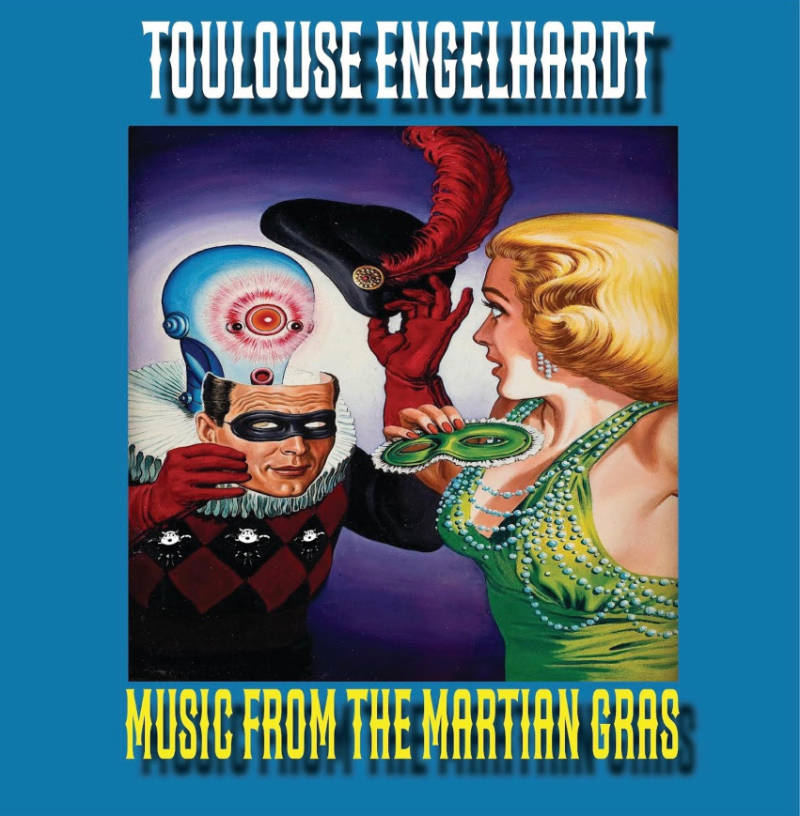
Five & Dime Universe Inc., in collaboration with guitar wunderkind Toulouse Engelhardt, the “Segovia of Surf,” has just released his newest album, Music from the Martian Gras. It’s available in Vinyl, CD, & Streaming formats. Distributed internationally by MVD Audio Entertainment Group, Pottstown, PA., USA
A cleverly crafted novelty record, Music from the Martian Gras is composed of nine whimsical and paradoxical Galactic Lounge Musicals which simply transcend rationality! Each composition is a total deviation from traditional musical norms and has evolved from the guitarist’s love of Sci/Fi and Fantasy and the wet reverb-crazed instrumental sounds of the early 1960’s.
It’s a cacophony of alternative musical stylings and Space Age motifs levitating above a colorful palette of acoustic fingerstyle guitar. The guitarist uses his “Rosebud of Choice”, a 1963 Mosrite “Ventures Model” electric guitar. to highlight the major themes in each of the nine sonic visualizations.
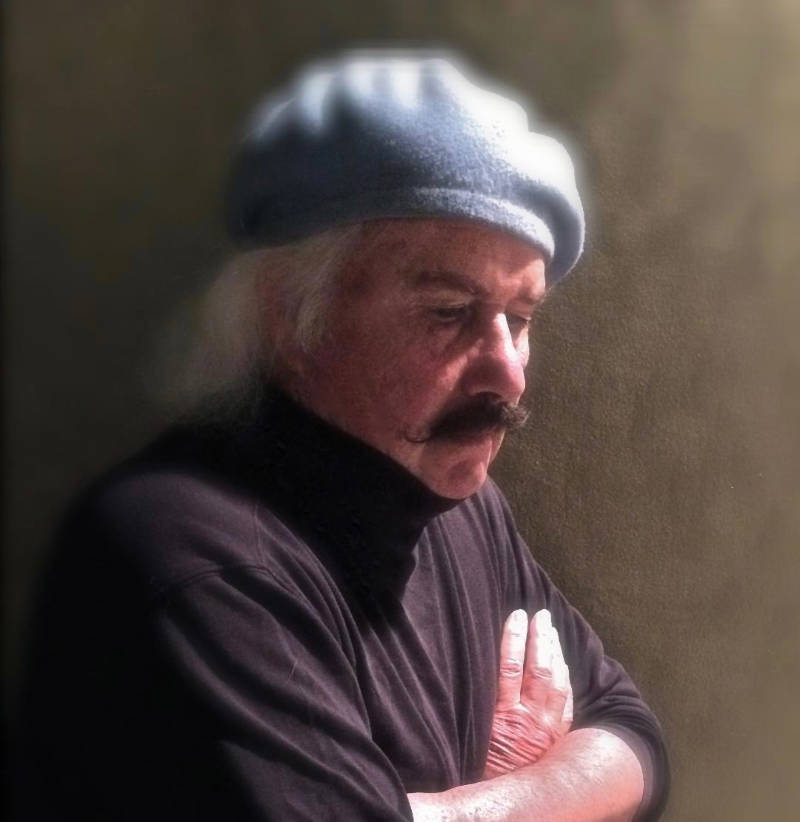
Toulouse Engelhardt was the last member of the “Takoma Seven,” a fraternity of virtuoso fingerstyle guitar innovators who recorded for Takoma Records and their affiliates. He was discovered and mentored by guitar legend John Fahey back in the 70’s for his exquisite fingerstyle guitar talents, combining elements of acid folk, jazz, and surf music idioms into his guitar arrangements. To quote John Fahey, “You’re the next gunslinger to be dropped into the OK Corral, Toulouse, all I can say is your toons are brilliant.”
Backed on this record are some of the finest veteran recording artists: Chris Darrow (Kaleidoscope, Nitty Gritty Dirt Band), Remi Kabaka (Paul McCartney’s Wings, Stevie Winwood Group & Ginger Baker’s Air Force), John York (Byrds) Phil Bunch & Franck Balloffet (French Afro-Pop Masters, Tea), Brad Stock (Atomic Clock), and Jonathan Stehney (LA Philharmonic). Music from the Martian Gras will undoubtedly ensure his continued presence in the stratosphere of guitardom and is guaranteed to send the listener on a sonic odyssey off into the Cosmorama.
For more info on the legacy of Toulouse Engelhardt, go to: www.Toulouse-Music.com
Toulouse Engelhardt and Harvey Kubernik Interview Music from the Martian Gras
HK: How did the genesis of Music from the Martian Gras begin? I know Mars, outer space exploration, science fiction, and possible visitors from another part of the galaxy have been topics and themes in your recorded catalog for over half a century.
TE: It’s a carnival of Sci/Fi and Fantasy music! The title and fabulous album cover design truly illustrate who I really am on this album. I’ve been masquerading as a fingerstyle guitar virtuoso all this time, but when you hear my new formula on this record, I take off my costume and mask and reveal that I’m really a Martian in disguise, and this is reflected perfectly in the cover art.
It’s all here: otherworldly dreamscapes, Xenomorphs & flying saucers, alien circus music, and cosmic wet dreams. In a way, it’s my “For the Benefit of Mr. Kite” kind of an idea. A random collection of performances at an alien circus with a tasty psychedelic twist.
HK: Tell me about your devotion to a 1963 Mosrite guitar that is the epicenter of your life and this album. What drew you to this specific guitar? Was it the Ventures?
TE: By the Winter of 1964, I was 12 years old. I had already been playing the guitar for more than three years. On a Saturday afternoon, my dad drove me down to Reno’s Music, a small Mom & Pop music store in Manhattan Beach, CA, so I could buy a set of strings for my Fender Mustang guitar. When we walked into the store, we were stopped in the doorway by a mob of people admiring something on the carpet floor. To my amazement, there was a brand new candy apple red Mosrite ‘Ventures Model’ guitar sitting in its case. The music store was buzzing. Everybody in the shop was talking about these beautiful new guitars and how they sounded.
At that time, I was an avid Ventures fan, and one of my favorite albums of all time had just hit Wallach Music City. The Ventures in Space. I somehow talked my old man into letting me trade in my Fender Mustang right there and, I got him to sign me up for a short installment agreement. I went home that afternoon with that Mosrite! I was in heaven! The full price for the guitar and the case was $395.00! Somewhere, I still have the original receipt dated Feb 6, 1964. It was one of the luckiest days of my life!
My Mosrite devotion continues to this day! Looking back to 1975, two years after I finished my tour with the Byrds, we approached John Fahey and Leo Kottke’s personal manager Denny Bruce, up in the Hollywood hills with my tapes that we had just finished in a Mormon Church up in the Rockies, The tapes eventually ended up on John Fahey’s desk at Takoma Records in Santa Monica next door to McCabe’s Guitar Shop. At first, Fahey wasn’t interested, and called me the “Guitarspieler” (German for fast talker), but after repeated listens, he called me over to his pad in Santa Monica and said; ‘Look, you’ve got some beautiful stuff here, but you need to present more variety on your albums. How about some slide, more alternative tunings, minor keys, and a little dissonance? Well ok I said, but I’ve got a better idea! That’s when I pulled out my Mosrite and began working out Scott Joplin rags buried in reverb, using the tremolo as a weapon! It was zany, crazy stuff, but my fans loved it! Does anybody remember “Pressed Hams”? They were hilarious, clever, and visual toons!
Ironically, I once tried to play these toons on a Fender Stratocaster, and it was impossible! It just doesn’t work, so I dumped the Stratocaster for good and went back to my ‘Rosebud of Choice’, my 1964 Candy Apple Red Mosrite. The inventive ball bearing bridge called a ‘Vibramute’ was a game-changer for me, along with the super-thin neck and the best whammy bar ever designed. You could push it and pull it in all directions to achieve a desired sound without going out of tune and at the same time, it was light enough to hold with your little pinky while you were ripping through a tune! All the ingredients were there to develop my ‘Martian Sound’.
Back in 2004, it was suggested that I put together a collection of Mosrite solo guitar works I had in the vault starting back in the mid-70’s up through 2003, and re-released the tunes in a collection of wacko tunes called Martian Lust. It hit the charts! No one knew how to take it. They either loved it and enjoyed a good laugh or couldn’t stand it and called it rubbish! Believe it or not, other than my debut acoustic guitar album Toullusions, produced by brilliant songsmith Chris Darrow with album cover design by art genius Rick Griffin, which went on to be one of the best-selling solo guitar albums of the 70’s. Martian Lust is still my second-best-selling record!
It was lyrically hilarious, zany as hell, a technical fingerstyle marvel, and delicious stuff, and really was the first solo instrumental guitar comedy album ever recorded! The foundations and formula for a new killer album were now set! Music from the Martian Gras was born.
HK: The album continues your implementation of ‘reverb-crazed instrumental sounds of the early 1960’s.’ Why did instrumental music and recordings, surf music, especially, impact your life and eventually incorporate electric guitar into these non-tonal poems in Martian Mardi Gras.
TE: It all started for me on a balmy night in the Summer of 1963. I walked out onto the patio at my parents’ house in Palos Verdes that night, the tiki torches were lit, and on the Hi/Fi was Quiet Village by Martin Denny. My ole man was out there too on the patio with a cocktail in his hand, grilling teriyaki steak, when all of a sudden, from down the street, I heard all this reverb-drenched surf music.
I followed the sounds down the street two blocks to Bob Knight’s house, and there before my eyes, in the garage, were the promising and recently signed to Liberty Records surf band Eddie and the Showman rehearsing & jamming away. I will always remember seeing those three huge blonde Fender Dual Showman amps, each with a blonde Tolex reverb unit blasting away into the night. Sitting in with the band that night was a very young Larry Carlton playing his 1959 Fender sunburst Jazzmaster. That’s all it took for me to get totally hooked on Surf Music and instrumental music in general.
No groups had influenced me more than the Ventures, Dick Dale and the Del-Tones, and the Astronauts. At twelve years old, I was already playing lead guitar in surf bands with guys in their twenties. I was kind of a novelty, I guess, being so young: in fact, some of the clubs wouldn’t even let me perform there because I was so young. There were curfews. Remember?
Years later, I went up to my local music store called Mr. B’s for Music and ironically ran into Bob Knight, the sax player with Eddie and the Showmen, who worked at the store. I asked him to turn me on to some jazz guitarists, and he pulled out Movin’ Wes by Wes Montgomery on Verve Records. I took it home, put it on the HiFi, and was floored! I spent the next couple of months trying my best to learn every improvisation on that album! Then, in 1966, the original five Byrds came to my high school to perform. I heard Roger McGuinn’s Rickenbacker 12 String, and I decided right there and then to save up my money and buy my first 12 String acoustic guitar. A Fender Villager.
I said to myself, ‘Who needs a band? I can play both the bass and lead melodic lines at the same time.’ It was a real challenge. I then started listening to all kinds of solo acoustic guitar players. Davy Graham, Bert Jansch, Sandy Bull, Leadbelly, Julian Bream, John Fahey and other acoustic fingerstyle innovators. I spent the next 30 years perfecting my style. I learned a lot listening to other guitar players, some who became legends and others who have faded off into obscurity.
Looking back 50 years, I now realize that I have gone full circle. It all started with the Surf Music Crazy. Then I journeyed off into jazz and solo acoustic guitar, and now I’m back to my 1960’s reverb-drenched roots with more knowledge than ever and have incorporated these ideas into my newest sonic space odyssey. Music from the Martian Gras.
So, the strategy for my new album was to build a palette based on my 50 years of acoustic guitar knowledge and then overlap a series of complex melodic lines performed exclusively on my Mosrite guitar to enhance the themes of each composition. Like adding a brush stroke of bright color to a painting to create an emotion or motion. The Mosrite guitar licks here are slightly reminiscent of Jimmy Wilsey, the original Silvertone guitarist, whose haunting, reverb-drenched sound can be heard on Chris Issac’s iconic 1989 studio riff for ‘Wicked Game.’ In the end, I created a cacophony of acoustic fingerstyle guitar saturated with a colorful palette of Space Age themes and variations. And then added more color with my 63’ Mosrite Ventures Model guitar. My goal was to take the listener on nine Sci/Fi & Fantasy audio explorations into the Cosmorama and beyond. Mission accomplished!
HK: I know Martian Mardi Gras contains newly recorded songs coupled with tracks from your archive. Tell me about selecting older material and weaving it into recent 2025 and 2026 productions.
TE: There are five new compositions on this record and four tunes we pulled from the vault that seem to encapsulate the concept behind this record. So, we brought them back to life and into the new century. First, we re-recorded and edited the songs, added some melodic colors with the Mosrite, and finally some cool special sound effects, which in many ways are groundbreaking because I was able to create them using my Mosrite guitar rather than relying on pre-recorded audio samples. Then we remastered the tracks with state-of-the-art audio technology. There are a total of nine tracks on this album, which I call Galactic Lounge Musicals. Each toon was composed in my signature writing style called the Tone Poem, where the composer tries to create a visual picture of an event, emotion, or a moment in time, utilizing only instrumental music with no need to write lyrics to tell a story.
I’m often asked why I am strictly an instrumentalist and haven’t recorded any vocals. I have always had a secret desire to write short stories like some of my Sci/Fi & Fantasy literary heroes: Isaac Asimov, Ray Bradbury, Robert Heinlein, and of course Rod Serling, Richard Matheson and Charles Beaumont of Twilight Zone fame, but I couldn’t express my ideas to my satisfaction in writing. I learned a long time ago that my gift was to compose instrumental music and turn it into visual imagery. I like to call my works “String Visualizations” like the impressionist composters of the past. I had a natural ability to compose melody; it was and still is a “Gift from the Gods”!
HK: Can you reflect on the engineering and mastering of the album?
TE: I worked with four incredibly professional studio owners, producers and engineers on this project who, over the years, have recorded many platinum recording artists. Brad Stock and Steve Crimmel at Painted Sky Studios, Scott Frankfurt at Dreamway Recording and Christopher M. Allport at Alpha Command Unit Studios. These pros had some insightful and wonderful things to say about our collaboration on this, the Music from the Martian Gras.
HK: Can you discuss the selections on Music from the Martian Mardi Gras?
TE: 1. Come Back to Earth with Me Princess Davana 3:45 It all started with this cosmic wet dream. I was in the studio at Painted Sky putting the finishing touches on my first major effort to compose a series of suites with a full orchestra which later became the award-winning score to Three Novells for Guitar & Orchestra produced by Christopher M. Allport. Late one night while in the studio, I asked my two engineers if I could pull out my Martin 12 String and lay down a scratch track. The constellations must have been aligned because all of a sudden, we were recording what we all thought had the potential to be a hit single. Come back to Earth with me Princess Davana was born and opens the album with a Big Bang! It’s a surreal, cosmic wet dream. A lonely and lost space traveler crosses the abyss of space/time and free-falls in love with a beautiful maiden in another dimension. She’s a beautiful Aquarian/Piscean goddess who dances and floats through her astrological water sign, but soon the space traveler realizes that no matter how strong their love, she can never journey back into his world in a parallel universe. It’s a 21st– century Shakespearean love tragedy, for he continues to yearn for her eternal love as she dances off through multi-dimensional space.
.
2. Tommy’s Robot 4:34
A young boy named Tommy (played by myself) is about to have a fantasy come true. Tommy is sitting on a large rock that overlooks a peaceful green valley, when all of a sudden, along comes a robot named “Adam’ walking slowly up the road. Tommy then invites Adam to sit down next to him and talk for a while. The boy now has a new bestie! Then Adam says goodbye and slowly heads back down the road, off into the distance, and vanishes. This lovely little tone poem opens with a clever Mosrite mechanical noise I created and also has elements of classic jazz guitar on a Barney Kessel level along with a touch of George Gershwinian influences.
3. Return to Mare Tranquillatatis 3:16
A beautiful journey back to our closest celestial neighbor, the moon. Originally produced by Chris Darrow back in 2004, but never officially released. We remastered the original to bring the sound up to today’s high-quality standards and then added some spacey drone electronica similar to a scene from 2001: A Space Odyssey when a transport vehicle is orbiting the Moon after the discovery of an extraterrestrial Monolith on the Moon’s surface.
4. Roswell Romp 3:09
UFO’s and Flying Saucers are all over the news every day now and Steven Spielberg just released his new blockbuster film Disclosure Day, we’re in perfect serendipity! The tune opens with the original ABC News flash from July of 1947 announcing that the Army Air Force has in its possession a real Flying Saucer! The Roswell Mystery was born! The tune has wonderful bee bop clarinet parts swirling around my Mosrite Guitar licks, giving the impression of being back in the 1940’s down at the Speak Easy, while the greatest secret in the history of mankind remained hidden from the world, in the desolate desert of New Mexico.
5. Above the Magellanic Clouds 4:29
Side One of the album ends with this dreamy, multidimensional journey off into the void of outer space, which if you close your eyes will lift your soul. It has the traits of a psychedelic experience and will make your spirits hover high above the celestial clouds and wander amidst the stardust of the Milky Way.
SIDE TWO (19:06)
6. Martiantinis 3:01
Alien circus music? You betcha! Masquerading as a goofy comical toon, Martiantinis in reality is a showcase of technical virtuosity. I wrote this sometime ago, but it was so difficult to play, I couldn’t record it without screwing up! 15 takes later in the studio, I finally got this monster solo down! Then it was such a gas to just kick back and add a series of completely different calliope- type harmonics on top of that crazy ass solo. A lot of outer space “Happy Hour” fun in the galactic lounge!
7) Martian Monsoons Suite 7:10
A classic example of Naturalism. I composed this pastoral suite in 4 movements utilizing all the ingredients necessary to tell a definitive story about a massive rain storm on the surface of the planet Mars.
i) Desolation (1:24)
ii) Coming of the Storm (1:50)
iii) The Tempest (1:22)
iv) Renewal (2:18)
8) Lubbock Lights 4:04
Back in 2005 I was working on a solo guitar project with producers Phil Bunch and Franck Balloffet of the fabulous World Beat group Tea when they played me an unfinished track called 777 off a proposed new album they were producing. My imagination started to wander, as I listened to the tribal rhymes and colorful instrumentation so I asked them if I could borrow the basic rhythm tracks and develop this into an outer space instrumental about one of the most infamous and unsolved UFO sightings of all time, the Lubbock Lights. Once I got their permission, I took the tracks back home and wrote a beautiful, haunting theme and added some radiating special effects performed on my Mosrite to the mix. The original song was over 10 minutes in length so I asked sonic songsmith extraordinaire Scott Frankfurt of Dreamway Recording if we could book a session and rebuild this tune. We cut the length of the song in half, highlighted the psychedelic special effects, reduced the volume of the string arrangement and hired Christopher M. Allport at Alpha Command Unit Studios in Los Angeles to re-master the final arrangement. As a result of their expertise and dedication to the project, the song now is nothing more than an audio aurora borealis!
Footnote: We did release a long version of this on an EP back in 2006, but most radio stations wouldn’t play it because it was too long for their programming. Then something extraordinary happened!
I was approached by a radio DJ in Lubbock, Texas who said he knew Carl Hart Jr. the person who took that amazing photo of a V-shaped flying saucer formation over the skies of Lubbock on the night of August 30,1951. Eventually, the photo made it on the cover of Life Magazine back in the height of the “Flying Saucer Craze of the Fifties”. The DJ asked me if I would sign him a copy of the EP so he could give it to that young boy, (Now a man in his 90’s) who woke up in his bed that Summer night, grabbed his Kodak Brownie Camera and from the dormer of his bedroom window took the picture that shocked the world! The infamous “Lubbock Lights”!
9) Golden Apple Vacancy 3:08
I ended the album with an epitaph for Princess Davana to coalesce with the opening track, Come back to Earth with me Princess Davana. Years ago, I recorded a simpler version of this song on my 5th album Mind Gardens. I wanted to do something extraordinary that nobody else had ever done before and compose a song completely out of just atonal minor chords, strummed on a 12-string guitar and nothing more. The results surprised everybody. It was a haunting, melancholy production that received many accolades. It was a perfect example of an epitaph so I decided to give it a reincarnation and develop it into a solemn farewell.
In a series of additional interviews, I asked the engineers involved in Toulouse’s album to comment on the joint undertaking.
“Working with Toulouse has been a great experience as a recording engineer and a producer. I loved the depth and surprise of his music immediately. He and I share a common love for surf guitar, classical and impressionist music, and space alien lore. I recall hearing ‘Princess Davana’ in its embryonic stage when I took over Painted Sky Studios, and going to the drum kit after all had left for the day, and laying down ideas I heard in my head. Duduk, bass, and more followed, and the song became a true collaboration. Later, we worked remotely across state lines to complete the album. I will always enjoy working with Toulouse; he is a true artist in every sense of the word.” —Brad Stock, Painted Sky Studios, Salt Lake City, Utah.
“The joy of meeting Toulouse Engelhardt personally, and the invitation to collaborate musically has been a gift. It’s nearly impossible to avoid derivative music efforts these days, but that is never an issue with Toulouse. Hearing the first cosmic note of the project I said ‘I’m in.’ It’s original, heartfelt, and there’s no lack of invention. At Dreamway Recording, we applaud artists who think for themselves, and Toulouse is front and center of that class picture.” — Scott Frankfurt, Dreamway Recording, Cambria, CA.
“As rich men merely attempt to launch their rockets from Earth, Toulouse Engelhardt is already gliding home from his epic journey to Mars. Music from the Martian Gras, is an instrumental space opera that is truly out of this world — and ahead of its time.
“Coming off our critically-acclaimed Three Novellas for Guitar and Orchestra, which I music directed and produced, I was thrilled when Toulouse asked me to master Music from the Martian Gras. The truth is that mastering an Engelhardt record is always a special endeavor — requiring proprietary tools and a deep understanding of the composition itself. The brick-wall approach does not work on Engelhardt music.
Every Engelhardt tune on Music from the Martian Gras emanates with nuance — and ripples with waves of childlike imagination. From ‘Tommy’s Robot’ to ‘Princess Davana’ herself, Toulouse captured my attention with each sonic poem. ‘Flying Above the Magellanic Clouds,’ you can actually see the Martians sipping their Martiantinis through their native Monsoons in the Martian sea, Tranquillitatis.
Toulouse brings back to Earth: the characters and celestial melodies of Mars, which to date no other artist has channeled. I was excited to set up and master this record for LP, CD, and streaming — with each format possessing its own dynamic and technical requirements. Our most important job was to tell the story. The ‘loudness wars’ that plague today’s music market are always a non-starter for me. Preserving every transient and letting the song breathe were lodestones that needed to suspend and pull the sonic detail out dynamically — through every passage, every medium.
As always, it is the greatest honor to collaborate with my dear friend and partner, Toulouse Engelhardt. I hope you enjoy his eclectic and imaginative romp through the oceans, atmospheres, spaces, and times of Music from the Martian Gras!” —Christopher M. Allport, Mastering Engineer, Alpha Command Unit Studios, Los Ángeles, CA.
(Harvey Kubernik is the author of 20 books, including 2009’s Canyon Of Dreams: The Magic And The Music Of Laurel Canyon, 2014’s Turn Up The Radio! Rock, Pop and Roll In Los Angeles 1956-1972, 2015’s Everybody Knows: Leonard Cohen, 2016’s Heart of Gold Neil Young and 2017’s 1967: A Complete Rock Music History of the Summer of Love.
Sterling/Barnes and Noble in 2018 published Harvey and Kenneth Kubernik’s The Story Of The Band: From Big Pink To The Last Waltz. In 2021, they wrote Jimi Hendrix: Voodoo Child for Sterling/Barnes and Noble.
Otherworld Cottage Industries in 2020 published Harvey’s Docs That Rock, Music That Matters. His Screen Gems: (Pop Music Documentaries and Rock ‘n’ Roll TV Scenes) was published on February 6, 2026 by BearManor Media.
Harvey spoke at the special hearings in 2006 initiated by the Library of Congress held in Hollywood, California, discussing archiving practices and audiotape preservation. In 2017, he appeared at the Rock & Roll Hall of Fame in Cleveland, Ohio, in its Distinguished Speakers Series and as a panelist discussing the forty-fifth anniversary of The Last Waltz at the Grammy Museum in Los Angeles in 2023.)