By Harvey Kubernik Copyright 2026
“Brian put his heart in his music at a time with Pet Sounds when we were all using other muscles.
“In 1966 Lou Adler arrived in London with an acetate of Pet Sounds. He came to my house from the London Airport. I sat in smoke with Paul McCartney and that first listen changed our lives.
“On the personal side it spoke for me when I was too busy to have a personal life. The sound and music, the words of Tony Asher blended into the melodic slices of Wilson, spoke of the pain and coming of age in a way that allowed all young ambitious dudes to let him speak for us whilst we hid whatever and hung tough. It was my ‘Primal Scream.’ It certainly got Paul McCartney to work on another level.
“Brian Wilson’s Pet Sounds changed my life for the better and travelling to the Hollywood Bowl in June 2000 was a privilege and a pilgrimage. For me it was like going to the Vatican and seeing the Pope. Pet Sounds changed the possibilities of pop music and the potential of what could be done in the long-play form.”—Andrew Loog Oldham
Side One
1. Wouldn’t It Be Nice
2. You Still Believe in Me
3. That’s Not Me
4. Don’t Talk (Put Your Head on My Shoulder)
5. I’m Waiting for the Day
6. Let’s Go Away for Awhile
7. Sloop John B
Side Two
8. God Only Knows
9. I Know There’s an Answer
10. Here Today
11. I Just Wasn’t Made for These Times
12. Pet Sounds
13. Caroline, No
Brian Wilson (vocals, keyboards, whistles), Al Jardine (vocals, tambourine), Mike Love (vocals), Carl Wilson (vocals, guitars), Dennis Wilson (vocals, drums), Bruce Johnston (vocals).
Joining Brian and band members on Pet Sounds were Hollywood-based American Federation of Musicians 47 Union session players including Gary Coleman, Jim Gordon, Barney Kessel, Carol Kaye, Mike Melvoin, Hal Blaine, Leon Russell, Jim Horn, Glen Campbell, Plas Johnson, Lyle Ritz, Steve Douglas, Tommy Morgan, Al De Lory, Ray Pohlman, and Don Randi on dates recorded between June 12, 1965-April 13, 1966.
Producer Wilson utilized United Western Studios, Gold Star Studios, Sunset Sound Recorders and Columbia Studios for the undertaking.
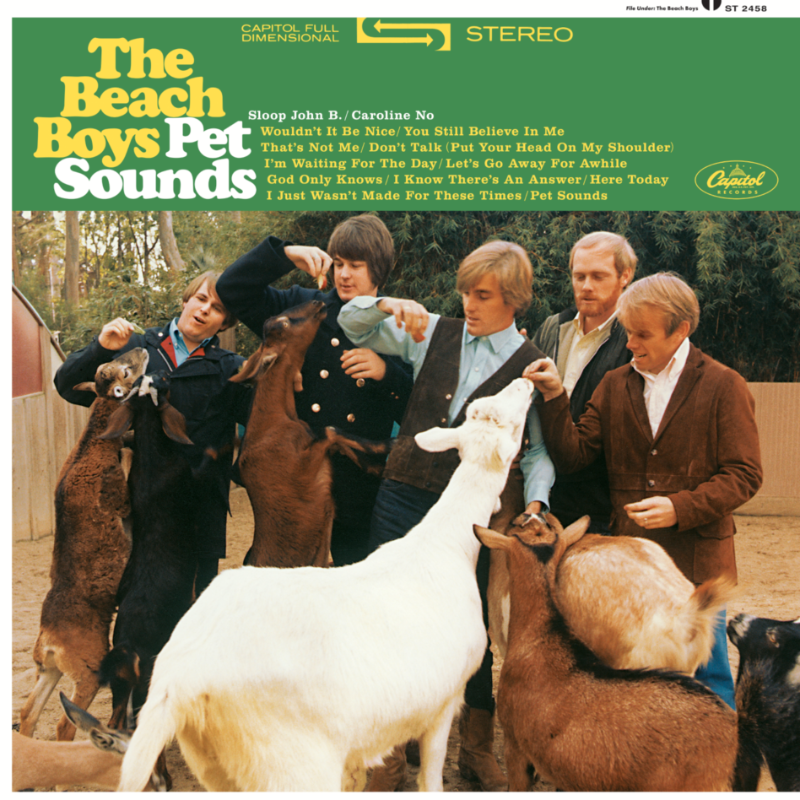
Capitol Records released the album on May 16, 1966. The LP’s cover photo was by George Jerman.
Providing deeper insight into the making of the album, The Pet Sounds Sessions Highlights compiles standout material from the 1997 Grammy-nominated 4CD box set, The Pet Sounds Sessions, which documented the legendary 1965–66 recording sessions. The new collection features 25 alternate takes, a cappellas, and tracking sessions, all making their vinyl debut. Available as a 2CD set and across multiple 2LP configurations.
The new audiophile pressings present Pet Sounds with the highest standards in sound and packaging, ranging from high-end to ultra high-end editions. The Vinylphyle Edition is pressed at RTI on 180-gram black vinyl and cut from the original mono and stereo analog tapes by Joe Nino-Hernes at Sterling Sound. The stereo mix, originally overseen by Brian Wilson and produced and engineered by Mark Linett in 1996 for The Pet Sounds Sessions box set, is included alongside the original mono album cut from the original 1966 assembled master reel. The release will have an initial pressing of 3,000 copies.
Each Vinylphyle album release is mastered in all-analog from original sources when available by leading vinyl cutting engineers and pressed at Record Technology, Inc. (RTI) California. The series emphasizes consistent quality control across mastering, plating, pressing, and printing.
In addition, Interscope-Capitol’s Definitive Sound Series (DSS) edition presents Pet Sounds in its original mono configuration using the state-of-the-art One Step process, which eliminates multiple steps in the plating process and delivers the recording’s intricate arrangements and vocal harmonies with remarkable clarity. Pressed at RTI on Neotech VR900 D2 180-gram vinyl, the AAA [All Analog Mastering] was cut by Chris Bellman at Bernie Grundman Mastering from rarely used circa-1972 original analog tapes. Limited to 6,000 individually numbered copies, the release draws from the early-1970s Brother Records pressing, long noted for its sound quality. Each copy includes a certificate of authenticity documenting the mastering, plating, and pressing process.
I first encountered Brian Wilson in 1962 at Rancho Music record shop in Studio Village in Culver City California when the Beach Boys were doing an in-store appearance, autograph party and “playing live” to promote their new record “SURFIN’.”
During 1965 I talked to Brian, clad in a blue Navy pea coat and white Levis, one afternoon after junior high school. He introduced me to his wife Marilyn at Fisher’s Hamburgers inside the Town and Country Market in the Fairfax District. I was planning to attend at Fairfax High School, and before she married Brian, Marilyn and her sisters Diane and Barbara Rovell graduated from the same institution. Our parents were both from Chicago.
In mid-May 1966, I purchased my first copy of Pet Sounds at The Frigate record shop in Los Angeles on 3rd St. I was with David Wolfe. We went back to his families’ duplex on 4th St. I lived on 5th St. We took off the Peter, Paul & Mary In Concert LP and listened to the Capitol Records Duophonic (artificial stereo) album.
I later learned that it was pressed in mono and done at the label’s mastering room where equalization and phasing were added to the original tape transfer.
One afternoon in late spring ’66 I chatted with Brian and Marshall Berle, the Beach Boys’ agent at The William Morris Agency at The Hollywood Ranch Market.
I asked Brian about the cover photo on the LP of the Beach Boys at The Zoo in Los Angeles. “That was a zoo in San Diego,” he revealed.
Marshall had gone to Fairfax High School with Phil Spector, and signed the Beach Boys to The William Morris Agency in 1962 when the band was on a bill with Dick and Dee Dee at The Hollywood Palladium.
“After meeting Brian’s parents Murry and Audree, I had papers drawn up and we signed them for 3 years at a 10 per cent fee,” remembered Berle in my 2014 conversation with him.
“I went on the road and settled up at the box office at the shows. Murry was at my office all the time. At least 2 or 3 times a week about bookings. He was a total control freak. But I had no clue or idea of what the real idea was regarding his competitive relationship with Brian and what was going on.
“Dennis and I were buddies. We were two of a kind and liked to party. He’d come over to William Morris and pick me up with his brand-new Jaguar XKE. And we would drive to their shows, like San Jose in 1963.
“When I saw the Beach Boys in 1962, Brian was like the sex symbol in the early days. Girls would swoon when he hit high notes. Almost overnight they became so huge. I went on the road with them. From Pandora’s Box to the Hollywood Bowl in 1963. I booked a lot of dates with Fred Vail, even the live album they recorded in Sacramento. I was with them when they recorded a live show in a TV studio in Burbank, California inserted into the February 1964 Beatles live theater broadcast from Washington, D.C.”
In my ’66 encounter with Marshall and Brian I was sort of surprised when Brian said something about writing songs in an office he had in Hollywood on the corner of Sunset and Vine across from Wallichs Music City. It’s no wonder I would see him occasionally inside one of their record listening booths.
Earlier this decade I interviewed songwriter/record producer Russ Titelman who was introduced to Brian in 1963.
“I met Brian around the Screen Gems publishing office, because Brian knew Lou Adler and used to visit him all the time at the office in Hollywood on Sunset and Vine. Leiber and Stoller’s Trio Music were also in the same building. Brian had a large office with a piano. I saw him a lot. By hanging out at the Screen Gems office, Brian and David Gates would come in. I met Barry [Mann] and Cynthia [Weil] there. I wrote ‘Sherry She Needs Me,’ and ‘Guess I’m Dumb,’ with Brian that was recorded by Glen Campbell for Capitol Records.
“I watched Brian Wilson write ‘Fun, Fun, Fun’ but the lyric at the time was ‘Run, Run, Run.’ It had different lyrics to it. My first impression of Brian was that he was a genius.
“I went to the recording session of ‘Guess I’m Dumb.’ I went to a couple of things that Brian worked on. I played a screwdriver and banged on a mike boom on ‘She Knows Me Too Well.’ I went to that session. Dennis was playing drums. It was another one of those things where there you are in the midst of this thing and you’re just a part of it. And at the time Brian was at the height of his powers, and, you know, Phil in a way, too. But it was before the Wall of Sound when I was doing stuff. I was there when they were just these small beautiful little records that only had a few instruments and his vision, I guess. His creativity and understanding of what made an arrangement work was something that in a way that I guess was passed on to me. You’re there and you see how it is done. So, you kind of take it in.”
In 1966 Jim Roup and I watched Brian lead a rehearsal of the Beach Boys developing “Good Vibrations” for a North American tour on Sunset Blvd. at the former site of The Moulin Rouge club which became The Hullabaloo, The Kaleidoscope and The Aquarius Theatre. I had just left the set of The Monkees in nearby Gower Gulch and walked inside the building like an invited guest.
In 1969 I saw the Beach Boys with Flame at the Whisky A Go Go, and in 1971 David Wolfe and I went to a Beach Boys concert at The Santa Monica Civic Auditorium where Flame was the opening act. In 2026, Wolfe reminded me that a horn section augmented a few tunes. We drove to San Diego the next night to catch the band at the San Diego Sports Arena. I was amazed how “current” they sounded and spell-bound by “It’s About Time” and “Long Promised Road.”
I was at the 1972 Beach Boys gig at The Long Beach Arena, where manager/songwriter Jack Rieley invited Brian up from the audience to perform “Day in the Life of a Tree.” Their 1969-1972 repertoire was from Sunflower and Surf’s Up.
By 1973 the group’s live show was turning into an oldies act, but the Holland-inspired shows at the Hollywood Palladium and Winterland Ballroom in San Francisco were still fun.
In 1974 I wrote the review in The Los Angeles Times Sunday Calendar section of the Beach Boys’ Endless Summer double album released by Capitol Records. Marilyn Wilson read the review and invited me up to the Wilson Bel-Air home for some dessert.
From 1977-1980 I covered the Beach Boys for Melody Maker, and conducted interviews in 1977 with Brian and Mike Love.
On The Pet Sounds Sessions 4 CD-box set Capitol issued in 1997, produced by produced by Brian Wilson, David Leaf and Mark Linett, that provided the foundation of the 2026 Pet Sounds release, that provided the foundation of the 2026 Pet Sounds release, I’m thanked in the liner notes.
In 2004, Brian supplied the back cover jacket testimonial for my first book This Is Rebel Music, published by The University of New Mexico Press.
During 2007 I wrote the program booklet text and conducted extensive interviews with Brian for his Pet Sounds 40th anniversary tour.
For the 2009 book That Lucky Old Sun for Genesis Publications, I did the interview with Wilson for his collaboration with Sir Peter Blake, and also thanked on the 2011 Capitol Records SMiLE box set.
In 2014 Brian penned the introduction to an award-winning book my brother Kenneth and I wrote and assembled on SMiLE-era photographer, Guy Webster, Big Shots: Rock Legends and Hollywood Icons, published by Insight Editions.
There are many records in Brian Wilson’s catalogue that were important events in my life. I had a special friendship with Brian.
Since 1969, I probably had 20-30 lunches or dinners with Brian, often with poet/songwriter Stephen John Kalinich. The first songwriter signed to Brother Records in 1967. Kalinich co-wrote songs with Dennis, Carl and Brian Wilson, including “Little Bird” and “Be Still” with Dennis on Friends. In 2007, Jeff Beck and Eric Clapton performed “Little Bird” at Ronnie Scott’s nightclub.
In a March 2026 conversation, Stephen reminded me of numerous eateries where I joined him and Brian, that even with my memory, I had completely forgotten about. Various pizza joints, steak houses, and the chocolate milk shakes at Stan’s Drive-In coffee shop with the trays of French fries at Tiny Naylor’s with carhop service so we could eat in Brian’s white Mercedes-Benz.
In the mid-seventies Brian would pick up Kalinich at his apartment in Brentwood, write songs, and then go get something to eat. A few times they’d invite me to join them a few blocks from my residence at the Delores Drive-In on Wilshire Blvd.
More French fries. More acne.
My most vivid lunches with Stephen and Brian were at Warren Stagg’s H.E.L.P (Health, Education, Love and Peace) restaurant in 1969-1971. H.E.L.P. was a popular organic-vegetarian restaurant located in Los Angeles on 3rd St. by Fairfax Ave.
“At the H.E.L.P. restaurant, Brian, Mike and I loved the seaweed salads and boysenberry shakes,” Kalinich recalled. “Mike suggested the somewhat comical concept of Rent-A-Poet for me to help expose his lyrics and my poetry around town. Mike was extremely kind to me. He took me all around Beverly Hills, introducing me to people like his tailor and Sky Saxon of the Seeds, when I was working at a flower shop in Brentwood. Mike also offered me the usage of his car at the time, a Rolls Royce if I needed it. It felt like I was in a surreal dream. Carl produced my first record ‘Leaves of Grass’ at Studio B at Capitol Records in Hollywood.”
At H.E.L.P. Brian and I would devour carob cookies and date nut with cream cheese strawberry sandwiches. H.E.L.P. also had an on-site bakery, and a book store that sold crystals and candles. Henry Diltz, Liberty Records A&R man Dan Bourgoise, Del Shannon, Miles Davis and Phil Ochs frequented the restaurant. Health advocate Gypsy Boots was a fixture along with photographer Heather Harris, actor/musician Bill Mumy, and writer/musician Marina Muhlfriedel (now Marina del Rey of Vivabeat), who loved the sauteed veggies on brown rice with extra garlic, bancha tea, and banana bread. Future Richard Pryor record producer Robert Marchese helped make the fresh juices on the premises.
Members of the Byrds would land at H.E.L.P.
I spoke with Roger McGuinn, the former Jim McGuinn. In 1967 he changed his first name to Roger around the same time musician/photographer Tad Diltz became Henry Diltz. They both had become involved with Subud, a spiritual practice in quieting the mind that was a movement in the 1920s from Indonesia.
“There was a Subud house in downtown Los Angeles on Hope Street. The Beach Boys used to hang out there,” emphasized McGuinn. “I remember that. Then, Brian Wilson formed his own chapter at his house during his ‘sandbox phase.’”
In 1967 Brian wrote “Vegetables” and during 1969-1971 operated a health food shop, The Radiant Radish on Melrose Ave. Brian was an active co-owner of the store and stocking shelves of organic produce and work behind the cash register.
Mike Love turned to Transcendental Meditation in the late 1960s to strengthen his own inner harmony. Mike studied with TM’s most famous practitioner at the time, Maharishi Mahesh Yogi, at his ashram in India along with the Beatles, Paul Horn, Mia Farrow and her younger sister Prudence (the inspiration for the Beatles song “Dear Prudence”), and Donovan.
“It’s a personal growth program,” Love told me in a 1974 interview conducted for Melody Maker. “Transcendental meditation has been very helpful in unfolding our individual capacity for creativity. We met the Maharishi Mahesh Yogi in December 1967 when we did a United Nations show in Paris.”
“Just before the spring of 1968 Mike Love suggested a United States tour of the Beach Boys promoting Friends and a lecture on meditation by Maharishi Mahesh Yogi,” wrote Kalinich.
“Mike was deep into Transcendental Meditation. The group wanted me as the opening act doing poetry. They bought me a new wardrobe at the Sy Devore shop but promoters didn’t want a spoken word artist on the bill. They did a few concerts and the tour was cancelled. The Beach Boys then went on a 1968 tour of the South with Buffalo Springfield and the Strawberry Alarm Clock. In February 2026, I read poetry opening for the Strawberry Alarm Clock at The Whisky A Go Go.”
On the Brian Wilson 2004 album Getting In Over My Head, one tune, a duet between Brian and Paul McCartney, “A Friend Like You,” is a Wilson and Kalinich composition.
During the 2014 Record Store Day, the Light in the Attic label issued the Wilson/Kalinich LP A World Of Peace Must Come, that was recorded in August and September of 1969. The tapes were promptly lost, not to be heard again until 2008. Following the CD-only reissue in 2008, it was the first time this timeless snapshot of an era was available on vinyl.
In March 2026, a Stephen Kalinich, Carl Wilson and Dennis Wilson song “Rainbows” is heard in the theatrically released Project Hail Mary science fiction drama movie that stars Ryan Gosling. It was the highest grossing feature film in Hollywood during March. The Phil Lord and Christopher Miller movie has songs by Harry Styles’ “Sign of the Times” and the Beatles’s “Two of Us.” “Rainbows” was initially on the Dennis Wilson 1977 solo album Pacific Ocean Blue.
“Rainbows” was also placed in the March 29th 2026 episode “Amphezyne” of DTF St. Louis, from the Steven Conrad written and directed HBO-TV non-liner narrative series starring Jason Bateman, David Harbour, and Linda Cardellini.
After Kalinich and I left Brian Wilson’s funeral and memorial in June 2025, I asked Stephen about Pet Sounds. He emailed me.
“A remarkable thing about Pet Sounds is the music, the complex path work layered sections woven together in sound. It is from the streets of Hawthorne by a bunch of young men who rose up and would influence the word and capture the Spirt of a time with a spiritual Quest in sound.
“It was a retail reality and took us into a dark and sometimes glorious something exciting new world of happy voices as well as abrasive sound bites. An album about being born and arriving. It is a genuine work and irony that it was written or co-written by someone whose soul was at times torn. Beethoven of the new age who was bestowed with gifts that he did not fully understand.
“I love the window the door he opened into the soul and it is like Dark Night of the soul however only something that could occur in the late sixties in Southern California between materialism and poverty a musical experience that would be created in the soul of some young man from Hawthorne who had transcended time, country and tapped into the infinite quilt of the many leveled Universe like Quantum Physics of sound waves stretching out from place in time to a Forever echo.”
In 1977 Brian told me in an interview for Melody Maker, “I don’t carry a notebook or use a tape player. I like to tell a story in the songs with as few words as possible. I sort of tend to write what I’ve been through and look inside myself. Some of the songs are messages.”
“Phil Spector is my hero,” exclaimed Brian in one of our dialogues during ‘77. “He gave rock ‘n’ roll just what it needed at the time and obviously influenced us a lot. His productions…they’re so large and emotional…Powerful…the Christmas album is still one of my favorites. We’ve done a lot of Phil’s songs: ‘I Can Hear Music,’ ‘Just Once in My Life,’ ‘There’s No Other Like My Baby,’ ‘Chapel of Love’… I used to go to his sessions and watch him record. I learned a lot…”
“I’ve always been flattered that Brian continues to say nice things about me and keeps recording my songs,” remarked Spector in a 1977 interview with me. “Brian is a very sweet guy and a nice human being. I’m glad he’s coming out of his shell. I think he got caught in a trap with ‘Good Vibrations.’ I think he got condemned more than condoned.
“He became a prisoner instead of a poet. He had the plaudits, the accolades, and touched the masses. I know music is a very important thing to him, besides a vocation. It became cluttered the last few years. Your attitude is in the grooves, and it’s a very personal thing. But Brian thrived on competition.
“I remember when ‘Fun, Fun, Fun’ came out. He wasn’t interested in the money, but a top ten record. He wanted to know how the song would do against the Beatles and if (radio station) KFWB would play it. But I never saw Brian as a competitor.”
Last century I was with Brian at Capitol Records in Hollywood and we went to their mastering room. Brian was overseeing and reviewing a mono pressing of Pet Sounds for a planned 20th anniversary edition. Brian got on a table putting his left ear as close to one of the big speakers as physically possible.
In 2007 he clarified this method to me. “I mixed in mono because I can’t hear in one ear. Made me concentrate more and get the best for that one ear. I always loved mono. Transistor radio. With mono you have one single sound source. We were doing stereo but I could only hear the mono and I always put the vocals up front in the mix. Mixing in mono is good for my left ear. My right ear is broke. Done and over with. I liked to mix with big speakers. You can hear the overall sound better. I would then take acetates home and play them on my little record player.”
The last time I spoke at length with Brian was at a delicatessen in Bel-Air last decade. My brother Kenny and our father Marshall had been at a park in Westwood and Brian was walking next to them.
After Brian chowed down his breakfast, we went outside into the parking lot. He asked, “How come you never asked me to sign any of our albums?”
I quickly visited Brian at the Wilson home. We hung out in his music room, and then returned to the delicatessen. He autographed a handful of CD’s and comically quizzed me after handing over the stack, “What is your favorite album by the boys?”
I responded, “It’s not Pet Sounds. It’s Beach Boys Today.”
Below is a collection of my Pet Sounds-themed interviews with Brian 1977-2014 as well as interviews with several engineers he collaborated with. In addition, are interviews with Al Jardine, Mike Love, along with friends, writers and Beach Boy scholars reminiscing about Pet Sounds.
Q: I know the Beatles’ Rubber Soul made a big impression on you when first released in 1965.
A: “Michelle” and “All My Lovin’” are two of my favorite Paul McCartney songs. “Norwegian Wood’ completely blew my mind, and marijuana was around for Pet Sounds. Well, when I first listened to Rubber Soul, I then went to the piano and all I could see were my keys. I locked in with the keyboard and wrote [with Tony Asher] ‘God Only Knows’ in 45 minutes.”
Q: You once said your favorite “John Lennon” songs are “Across the Universe” and “Because.” I hear the influence on the Beatles from “Wonderful” off Smiley Smile.
A: I’ll say the influence was on “Here, There and Everywhere.”
Q: The opening vocal intro on the Beatles’ “Paperback Writer” was informed by “I Get Around.”
A: Maybe it inspired them. I hope it did. I really do.
Q: You also had a tent on your home premises. Terry Sachen, who co-wrote “I Know There’s An Answer” with you and Mike Love on Pet Sounds, worked with you, and put it together. He ordered the fabric.
A: We had a tent. An Arabian tent. Cushions. We would eat sandwiches and smoke pot and just laid around, you know. And, I got some ideas late at night when my wife went to sleep. I stayed up and thought of ideas like that.
Q: You actually wrote around 1963 the instrumental “Pet Sounds” for a James Bond movie, Dr. No.
A: It got turned down, Harvey. They turned it down! They turned the damn thing down. It got submitted. If you can do the twist then “Pet Sounds” got turned down. “We don’t have any interest in that song.” “Fuck that shit, I’m gonna put it on Pet Sounds.” That’s why it went on Pet Sounds. The James Bond people turned it down. And, when we play the “Pet Sounds” instrumental on stage now I turn around and face my band and take the piece in.
Q: Every night you and the band perform “God Only Knows” and the song always garners a standing ovation from everyone in the crowd. Why?
A: Because we’ve had a little practice, Harvey. (laughs) Second of all, Carl (Wilson) is gone, and third of all, I have to carry what he used to carry. I have to carry the damn weight. I have to carry the ball. I don’t remember the recording session of it. Too far in the past to remember. I mean, here is your part…O.K. Here is your part…O.K. And, somehow, we got “God Only Knows” done. And, the record spoke for itself. And it was a religious experience.
“Carl and I were into prayer. We held prayer sessions in our house on Laurel Way. “Dear God. Please let us bring music to people.” It happened. A cool trip. A lot of people say to me that Pet Sounds got them through high school or college.
Q: “Caroline, No” is your favorite song on Pet Sounds. The recording was pushed up a beat.
A: And guess whose idea that was?
Q: Your father, Murry Wilson.
A: Yes. He said to speed it up a half a note and you’ll have a real special song. I did it and it worked. What can I say?
Q: “The Little Girl I Once Knew.” John Lennon really praised the record in a 1965 interview in England. I read that he called it “the greatest record I’ve heard in weeks.”
A: That is my very favorite introduction in a song in my whole life. It kills me every time.
Q: Because the way the music is suspended on the front end of the track?
A: Yes. It might have been the first time the music stopped and started again on a record. I wrote the intro at the studio before we cut the thing. And, (session musician) Larry Knechtel, it was his idea to keep the music rolling. And we tried one, and then I put a second guitar overdub on top of the other guitar. And the rest of it was history.
Q: What about teaming with lyricist Tony Asher for Pet Sounds?
A: A cool kind of guy. A little more soft spoken. His attitude is just right for creativity and just right to work with. I might call him up as a matter of fact. That might be a good bet for me. Just before we began collaborating on Pet Sounds, I asked him what it was like writing commercials for an advertising company. It seemed like interesting work. I said, “You should be good with words if you can do that.” And, he said, “I’m pretty good with words.” Out of nowhere I said “Would you like to work with me on some songs and write some lyrics?” “I’ll give it a try.” Then, Pet Sounds, like that. 1966 was a very big year for the Beach Boys.
Q: What was the difference collaborating with Van Dyke Parks on SMiLE to lyricist Tony Asher whom you worked with on Pet Sounds?
A: Well, Tony Asher worked a little slower working with me than Van Dyke who was faster.
Q: Why did you select Van Dyke Parks? He emailed me and said the first time he talked to you was at a party.
A: I met him in 1965. We met initially at a lawn party held by Terry Melcher at his home off Benedict Canyon, overlooking Beverly Hills. Later Van Dyke came up with David Crosby on a visit to check out my new home recording set up. Van Dyke was brilliant at talking. I picked him because he was good with lyrics and pretty good with music, too. I can’t answer what drew me to him.
Q: Do you recall the origin of “Heroes and Villains?”
A: I sure do. The song started at my Laurel Way house. [Brian and Marilyn never lived in Laurel Canyon as represented in a 2018 documentary. In 1966 they resided in Beverly Hills]. We had a sandbox and a piano. The actual recording took five or six weeks. I love “Heroes and Villains.” The magic of Van Dyke’s lyrics and my lead vocals. It’s a pretty youthful lead. Because the damn thing is so together and cohesive. It comes together so beautifully that people can’t resist lovin’ it.
Q: I know you used different studios for various sessions. Van Dyke told me he had never seen anyone before you move from studio to studio with master tapes.
A: I liked the Capitol rooms, and I liked the instrumental sound, but I didn’t like the vocal sound. I didn’t like that kind of echo chamber. Tell me I’m an idiot! I just didn’t like the vocal sound, so we switched over to Western, and Gold Star. Western had a big room, and Phil Spector was over at Gold Star. Western had a good bass sound and a better vocal sound. Sunset Sound also had a great tack piano, too. I did things at RCA with engineer Dave Hassinger. “Help Me, Rhonda.” Capitol did have a good violin sound.
Well, we recorded the background tracks at Western. And then we went over to CBS for the vocals on 8-track. I felt confined with 4 tracks. 8 track was fantastic. You could put the cello on one thing and the Theremin on another. It was fantastic. I was also able to record tracks at Gold Star, Western, Sunset Sound, CBS— and bring the tapes to each studio.
It’s a whole different trip because it’s the same song but you’re going to a different studio. Truth is, going to different studios didn’t really matter. All that matters is the vocals, because I tried to do vocals first and then the music. I didn’t like to do that a lot. It was tracks first because you had to have something to sing too. Chuck Britz at Western made suggestions and was like a co-producer but only got credits for being an engineer.
Q: You were a regular Gold Star visitor and customer for many years. In that room you produced the Beach Boys’ “Do You Wanna Dance,” “I Just Wasn’t Made For These Times,” “Wouldn’t It Be Nice,” and the original version of “Heroes & Villains” at Gold Star. And, a version of “Cabin Essence” earmarked for SMiLE.
A: Basically, it was their echo chamber. More than anything else. I liked their drum sound. I loved their tack piano, too. It was a great studio next to the Musicians Union on Vine St. I liked the whole vibe. I liked the owners Dave Gold and Stan Ross and engineers Larry Levine and Doc Siegel.
On Pet Sounds and SMile I had Phil Spector’s players: Lyle Ritz the bassist was also a ukulele player. He was a trip and played good stuff. Carole Kaye on bass. She was previously on “California Girls.” Ray Pohlman. Fender bass. Hal Blaine was the greatest drummer I ever worked with. Don Randi, the keyboardist.”
I interviewed Don Randi about Pet Sounds in 2022.
“You’ve got to remember that most of the guys that were in ‘Phil’s band’ especially were all jazz players and rock ‘n’ roll was a living for them. And a lot of them didn’t like it as much as I did. I have to be very frank about it. I always liked the rock ’n’ roll part of it. I thought it was great fun and sometimes very musically interesting. Not all the time. 80 per cent of the time. We got to do some things on rock ‘n’ roll dates we could not do in jazz and studio settings. Absolutely.
“We brought that into Pet Sounds. It’s an interesting concept but those guys were very capable. They were the best musicians and still are the best musicians. Like, The Big T.N.T. Show, I was the Musical Director, and on all our dates, we all could read, except maybe a few of the guys who were brought in as players. As specialists. Like (guitarist) Mike Deasy when he came in. All the guys could always read chord charts. That’s for sure. I had Don Peake and Barney Kessel on The Big T.N.T. Show.
“But the fact was that we could do the music instantly and it made it easier for everybody else. Because if they didn’t know what to do our parts were the same. Unless they asked us to change it. We stayed constant so that they got used to dealing with a constant rhythm section. A band that plays together and listens to each other. Because we had the ability to do that, we didn’t have to do 20 takes, especially on that.
“At Gold Star it was the echo chamber, which was a natural studio. It just blended and worked. When you went to Gold Star you just knew you were making a hit record.
“The recordings have durability because musically, lyrically and the composition and note parts were brilliant. There were always great songs. The songs always told a story. The songs in themselves were films. And, especially in Phil’s case, he knew how to write them and how to produce them. And in Brian Wilson’s case, Brian always knew where he was going with it. He may have not known at the beginning, but after a while Brian had an idea and he developed it. We were there to help him develop it.”
Q: Brian, talk to me about implementing strings into your work.
A: I liked Jack Nitzsche’s string arrangements with Phil Spector. Sid Sharp was the guy I called for violins for my sessions. I like strings. It’s good to use strings. Strings bring you in more. Like Nelson Riddle and Frank Sinatra. But you need some spaces and holes. I like horns, too. Brass. I liked to use two saxes, baritones, and a trumpet.
Q: I was at Capitol records studio in 2004. Paul McCartney said how much he liked the bass lines on Pet Sounds. I know you employed the bass as a principal instrument. Like on “Here Today,” where you conceived the idea of the bass playing an octave higher on the rhythm bed track.
A: Because the bass parts resound better in a studio and you can take three hours to get one line if you really needed it. You could take forever and get a goddamn line, you know?
I asked Larry Levine what Phil Spector did with his bass players and Larry said Phil uses a standup and a Fender both at the same time. And the Fender guy used a pick. So, I tried it out at my session and it worked great! You also get a thicker sound putting the two basses together. I start with drums, bass, guitar and keyboards. Then we overdub the horns and the background voices.
Q: Both you and Paul McCartney as songwriters and musicians go away from the root chord and establish counterpoint sound. It’s a structure both the Beatles and the Beach Boys did. Can you talk to me about veering away from the melody from the root chord as a writer?
A: I learned that from Motown. I learned how to play bass from Motown for Christ sakes! I learned how to play different type of roots on certain chords. I love Stevie Wonder. We did his “I Was Made to Love Her.”
On Wouldn’t It Be Nice” Barney Kessel did the introduction to the song and Glen Campbell was also there. And, I said to myself, “I’m going to have these guys play directly into the board instead of going out into the studio.” And they plugged their instruments into the recording console direct. That’s how we got that sound. I also did that on “California Girls.” My brother Carl played a 12-string on that and we plugged him into the console and he did his thing. Every now and then I’ll do that. It sounds more mellow and it is something I can’t quite describe but it is much more mellow than an amp.
Q: You brought in the Theremin instrument in Pet Sounds for “I Just Wasn’t Made For These Times” and more prominent in “Good Vibrations.” I know during Pet Sounds you talked to Barney Kessel at Western recording who was with a Theremin player for a science fiction soundtrack. You requested Barney to do a session the very next day and to bring the Theremin guy. Barney said, “I’ll ask him and see if he’s available.”
A: Yes. I first discovered it when I was a little kid. My mom and dad had a friend who had a thing where you put your hand out and get a sound that goes higher and lower. And then I found out about what they call a band Theremin where you slide your finger across a band. And I used it. It is an instrument that you use sparingly.
Q: In late 1965 at RCA studios on Sunset Blvd. in Hollywood, you first met Andrew Loog Oldham when he was producing a session with the Rolling Stones at studio A on “What to Do” for their Aftermath album. The influence of stacked vocals. Mick Jagger said to Andrew, “What do you want me to do? Beach Boys?”
Andrew mentioned to me that you told him you would one day, “write songs that people would pray to.”
A: Yes, I did. I don’t remember when I first felt that. I know music was more than people applauding and buying records. Even when Pet Sounds came out a lot of people told me it got them through high school or college. The most amazing comment I got from one guy who said ‘that’s the most spiritual album I’ve ever heard.’
Q: I know the song is everything with you, “what key is it in?” Al Jardine said to me in 1965 you really started thinking about the band members lead vocals.
A: Yes. “I’ve got to get these guys leads that they can sing on the road.” Like, Al’s vocal on “Help Me, Rhonda.”
In ‘Good Vibrations,’ Mike’s singing got us famous. Because his voice has a quality to it that goes hand and hand with the song. Mike’s bass part on “Good Vibrations” was the one. Mike’s voice on it was the thing that sold me on it. He was the appropriate singer for the song.
“Carl Wilson is my favorite rock ‘n’ roll singer. He had a resonate voice and he had a lot of energy and power in his voice. In which I didn’t have or Mike, or the other guys. Carl and Dennis were both my brothers and my artists.
“Dennis as a singer… First of all, he had an energy. Right? Second of all he had a nice quality about his voice. Coupled energy with a sweetness and that was his whole trip.
“Bruce Johnston. He is not an energy singer. Bruce is a sweeter singer and a better falsetto.
Q: At a “Good Vibrations” rehearsal in Hollywood, you were running around teaching the group vocal parts because you weren’t going to be on stage shows with them. Remember this?
A: Yes. I wanted it to be done right and I wanted them ready to go for tour. I knew it could work on stage. I never thought “How is this gonna work live?” When we rehearsed everyone was very cooperative. When the boys were touring in 1966 that was when I first started writing even more parts for them.
Q: You flew to Michigan to see “Good Vibrations” played live for the first time. Isn’t that correct?
A: Right. In front of an audience. I just remember saying, “That’s fantastic.” Ten-minute ovation. What was it like? I was proud as hell. I took a bow. I knew the group could perform the material on stage. When it went to number one it did give me some confidence I could write in sections.”
Last decade I interviewed Mike Love.
Q: Did you ever have concerns about the session musicians providing the foundation tracks for albums like Pet Sounds and SMiLE?
A: No. Not at all. Leon Russell played on our stuff. Hal Blaine, the Wrecking Crew and company played on session stuff. Glen Campbell was a session player, who as you know, did a six month stint with us when Brian left.
“Bruce came on in 1965. In fact, the first song he sang with us was ‘California Girls.’ And he recalls me going out in the hallway while the track is being done and writing out the lyrics.
Q: So, it was never a big deal session people played on your records.
A: No. It was a great deal. Because Brian was home and he would use these fantastic session players. Remarkable product coming out of that. We would come home and we were the singing group. We would do our harmonies and our melodies and what have you. So, it was a great, great asset.
Well, you know, I’m both a lead singer and a background singer. I love singing the bass parts on “Warmth Of The Sun,” on “In My Room,” “Surfer Girl” or “Don’t Worry Baby.” All those songs I enjoyed singing the bass.
So, I’m a team player as well as a lead singer, you know. No, there’s not really a difference. I mean, Tony Asher did some phenomenal lyrics. He did great lyrics.
And, also, there is a coffee table book put out by Rolling Stone magazine several years back out of the top 500 albums of all time, well number one is Sgt’ Pepper’s and number two is Pet Sounds. You’re in good company. It quotes me as saying, ‘What is this shit relevant to Pet Sounds.’ And that is an absolute fabrication. A total lie. And I never said that about Pet Sounds.
Capitol Records’ Karl Engermann, who was a lovely man and a great guy, he was an A&R guy, when Brian and I went to present Pet Sounds. I named the album. There was a dog barking at the end of the record, so let’s call it Pet Sounds. And I’ve been given shit about I didn’t like Pet Sounds. It’s s all bull shit.”
Earlier this decade I spoke with Al Jardine.
Q: What do you remember about the song “Good Vibrations” and the recording sessions around it.
A: We had recorded the Pet Sounds album and “Good Vibrations” simultaneously. Everything was inter-changeable. These are inter-changeable parts and “Good Vibrations” was supposed to come out on Pet Sounds. That was the plan. But Brian had other ideas and was very specific about keeping it out of that project for his own reasons. Obviously, it had a lot to do with SMiLE. He wanted “Good Vibrations” to be the lead-off single for SMiLE.
As it turns out, Capitol was desperate to put out something ‘hit oriented’ on Pet Sounds. So, they selected “Sloop John B.” That took the place of “Good Vibrations.”
Q: Were you even cognizant in 1965, ‘66 and ’67, during Pet Sounds and on the SMiLE sessions how Brian interacted with technology and the new audio world around him?
A: At the time, we were in our twenties, like children in a candy shop, and I wasn’t really aware of the roles of the engineer, particularly Chuck Britz who was at Western. I had no idea about Chuck. Obviously, we had worked on our own records. Chuck was like a dreamin’ carpenter. Who the hell knows how to build a house? You live in a house but you don’t realize how complex everything is and how important every integral part is.
“And here is this average Joe looking guy, pleasant fellow, who talked to everybody on equal terms and did not talk over us. Like a regular guy. And here he was doing all this magic. Which was probably normal for him. His norm, and we accepted that, was quite extraordinary. And of course, Brian. When you drove Brian into the mix, and his enabling Chuck to get those blends.
“There was a thing where we got everything and then Brian would sit with Chuck. This is after we would go out on a coffee break, and we would hear Brian and Chuck going over and over again combine inner bouncing to the open track. “Is that good?” “Brian. You got it?” A very easy working relationship with Chuck. We’re at Western because Chuck is there. Very unlike the working relationship we had at Columbia. Just the opposite relationship over there.”
I’ve had the luxury to visit and record in the studios where Pet Sounds was created.
In 2008, engineer/producer Bones Howe offered some technical insights into United Western and Western Recorders.
“In 1958, Studio B at Western Recorders/United Western was complete, with two reverb chambers, a mix-down room, and mastering rooms, one of which had stereo. By 1960, the Ventures were recording in Hollywood, and their instrumental sounds were enhanced by the echo chamber as well.”
In 1961, Bill Putnam bought Don Blake’s Western Recorders, located next door on Sunset Boulevard. Engineers Bones Howe and Wally Heider came to United, followed by Chuck Britz, Lanky Lindstrot, and Lee Hirschberg.
“When Bill Putnam bought Western, he walked me down the street to see the building. Studio 3 was in the building, and Chuck Britz was an engineer there and remained there after Bill bought the building.
“When Putnam opened his studio, the first thing he did was that he got a new Neumann cutting head [that] you could pump a lot of volume into. You could really pump a lot of voltage and signal into it, and it would cut a much hotter 45 than the Altec head that everybody else used for cutting LPs and 45s. UREI was the development company, and a different division of United Recording. They developed a 1176 limiter, which I ran and did all the test runs on. He had a prototype, and gave it to me in the studio to use. United just became the place to record.
“So many recordings from the 1956–1972 time period had background vocalists, as well. They were more than just coloring the recordings. Lead and background were really part of the records at the time. I mean, all the group records I made were a lead and background.”
During 2009, engineer/producer Bruce Botnick described Sunset Sound to me.
“With the stings being in the large isolation booth the drums didn’t suffer so we were able to make tighter and punchier rhythm tracks than any of the other studios in town were able to do. ‘Cause everybody did everything live in those days. You did your vocals live. You did your strings and your brass live. And the rhythm section. And this was a big deal. And then add to it the amazing echo chamber that Alan Emig designed. Still phenomenal and having survived a fire. It still sounds incredible. That chamber was like the chamber at Capitol Studios and Gold Star Studios. Those are signature sounds. So, between the isolation rooms at Sunset and just the natural great sound of the room, and the echo chamber with the two consoles. You have to remember in those days all the studios built their own consoles.
“The consoles at Sunset Sound were all tube. At one point Alan had worked with Bill Putnam, who had helped design the two pre amps in all the Universal Audio consoles. So, when he came to Sunset Sound and he took it a step further and built this custom board with some of that circuitry and the two pre amps. So, it really sounded great.
We used Scotch 111 tape. First off, you could kill it, and today it still plays. The oxide is still on the backing. A lot of the later low noise tapes that happened, especially with Ampex and some Scotch 207, the oxide turned to mush due to the backing and the glue. And we always had a problem with Ampex tape until to near the end. With the bottom end that it almost sounded grainy. You couldn’t get a good, clear bass note. On some basses that was good because it made it sound a little crunchier. But generally, the favored tape was Scotch.
I can say that most of the real good studios in L.A., United Recording Studios, Western Recorders, Gold Star, Sunset Sound, and RCA, they were terrific rooms. There was a commonality between them. They all had the same loud speakers, which were Altec Lansing 604’s. So, you could walk from studio to studio and know what the hell you were hearing. Some rooms had more bottoms than others. But still the general, overall sound was the same. So, you could take you tape and go to another room.”
In 2002 I asked Stan Ross who co-founded Gold Star with Dave Gold about their studio.
“Gold Star was built for the songwriters. They were fun, wonderful people to be around—Jimmy Van Heusen, Jimmy McHugh, Frank Loesser, Don Robertson, Sonny Burke.
“It was all tube microphones. We kept tubes on longer than anyone else. Because we understood that when a kick drum kicks into a tube it’s not going to distort. A tube can expand. The microphones with tubes were better than the ones without the tubes because if you don’t have a tube and you hit it heavy, suddenly it breaks up. But when you have a tube it’s warm and emotional. It gets bigger and it expands. It allows for impulse.
“We didn’t use pop filters and wind screens—we got mouth noises. Isn’t that life?”
Larry Levine was a fixture at Gold Star. From Eddie Cochran, Herb Alpert & The Tijuana Brass to the Ike and Tina Turner “River Deep, Mountain High” sessions and behind the console on countless Phil Spector recordings.
“Good musicians start out and play as individuals and strive to play what Phil or Brian wants. As far as the room sound and the drum sound went, because the rooms were small with low ceilings, unlike other studios with isolation, your drums sounded the way you wanted them to sound. They would change accordingly to whatever leakage was involved. As a matter of fact, Phil once said to me that the bane of his recording existence was the drum sound. A lot of people attribute to echo what Phil was doing. The echo enhanced the melding of the Wall of Sound, but it didn’t create it. Within the room itself, all of this was happening, and the echo was glue that kept it together.
“I kind of categorize producers into three broad spectrums. The toughest one to work with, from my standpoint, is the one who doesn’t know what he wants and can’t communicate it to me or the musicians, so it’s futile. Then there is the producer who doesn’t know what he wants, but will sit back and wait for something to happen. Of course, the best producers are people who know what they want and know how to communicate so that all of us can strive towards their goal, while the producer is still amenable to something else that may happen along the way. In my career, I’ve worked with three great producers—Phil Spector, Herb Alpert, and Brian Wilson.”
On occasion, Brian used RCA studios. In 2010, engineer Al Schmitt explained the RCA facility.
“Studio A and B were both the same size,” described Al. “They were big rooms, and then there was also Studio C, a smaller room. You could mix in either room. The studios had very high ceilings and a nice parkay floor. Very nice. One of the things that made them so unique was that we had all those great live echo chambers. I think there were seven of them.
“There was very little overdubbing then. The nice thing about doing everything at one time was that you knew exactly what it was going to sound like. When you started layering things you were never sure. Then a lot of experimenting came in and it took longer and longer to make records and the expenses went up.
“RCA had a great microphone collection. Just fabulous. Great Neumann and Telfunken microphones. Great RCA microphones. Plus, they had the great, original Neve console. And they were just spectacular. They were so punchy and a warmth and still one of the best consoles ever made. They were using a lot of Scotch tape then.
“There were no isolation booths. None whatsoever. But we had gobos, we would move around. Like a separator where you could isolate things. We did have some small rugs that we would put down sometimes under the drums and things, but no too much.”
The Beach Boys recorded on Sunset Blvd. at Columbia studios. The Byrds and Donovan in 1965, ’66 and ’67 shared studio time with Brian and the guys.
In 2007 I interviewed Columbia staff engineer, Fred Catero, who worked with Leonard Cohen, producer John Simon, Aretha Franklin, Blood, Sweat & Tears, Mel Torme, and Big Brother & the Holding Company.
“I was a Columbia Records studio staff engineer from 1962-1972. I started as a mixing engineer. Roy Halee did most of the rock stuff. The head of Columbia engineering, Eric Porterfield, designed all-tube hand-built consoles from the former radio rooms. Columbia studios had a custom Ampex 8-track, a live chamber and Altec Lansing A7 speakers. ‘The Voice of the Theatre.’
“For microphones I used a Neumann U47 and maybe a SM57 on lead vocals. The studios had great natural echo, reverb and leakage. You wanted that. In fact, it added to the drama.”
In 2026, the sonic legacy of Pet Sounds has reached new industry and consumer heights.
Currently available is The Surfy Industries Special Edition Beach Boys Pet Sounds SurfyBear Compact Reverb Tank. A commemorative version of the SurfyBear Compact spring reverb unit released to celebrate the 60th anniversary of the Beach Boys album Pet Sounds. It was introduced in January 2026 at NAMM, the National Association of Music Merchants show in Anaheim, California. This limited edition is distinguished by a bright green enclosure and was produced in an initial world-wide batch of 150 units.
Visit the company’s website:
https://www.effectsdatabase.com/model/surfy/surfybear/compact/petsounds
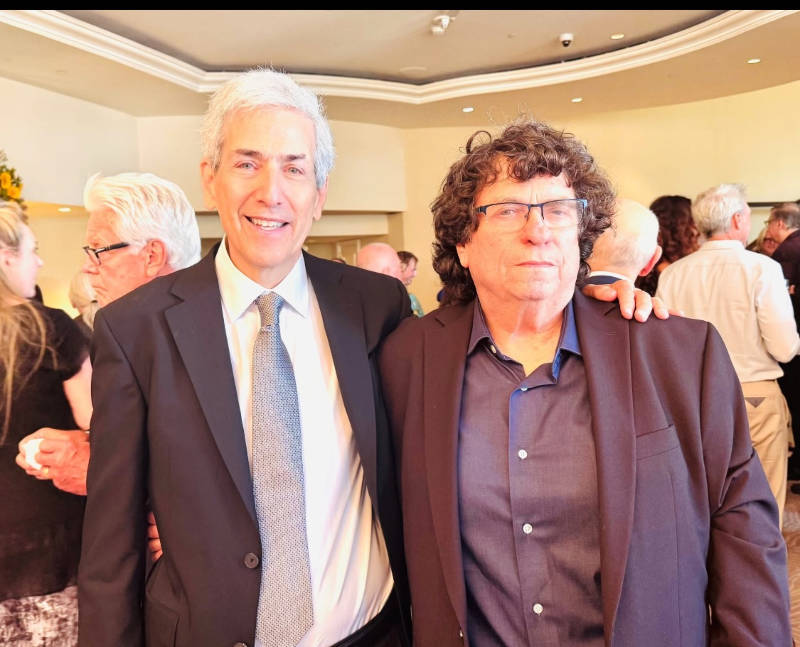
David Leaf, the writer/director/producer of Beautiful Dreamer: Brian Wilson & the Story of SMiLE and author of the two books in the Grammy-nominated The Pet Sounds Sessions box set (as well as 2025’s acclaimed SMiLE: The Rise, Fall & Resurrection of Brian Wilson), sent me a brief excerpt from a forthcoming book:
“Why are we still talking about this album? The beautifully expressed romantic longing, desire, love, melancholy, and heartbreak of Pet Sounds (‘Wouldn’t It Be Nice,’ ‘God Only Knows,’ Brian’s first solo single, ‘Caroline, No,’ et al) moves generation after generation as they get lost in these songs that hit home in every imaginable way: emotionally, lyrically, spiritually, and with one jaw-dropping vocal and instrumental moment after another. Brian turns the three-word phrase ‘I wanna cry’ into a musical kaleidoscope.
“Regardless of your age and generation, the album speaks to the angst of growing up. Who hasn’t wondered, but couldn’t express, the ideas in ‘I Just Wasn’t Made For These Times’? And the magnificent, groundbreaking arrangements and production bowls over every musician who hears it, leaving them to ask, ‘How did he do that?’
“It’s no exaggeration to say that it changed music history. Just ask Sir Paul McCartney, who told me in 1990, ‘Nobody is educated musically ‘til they’ve heard Pet Sounds.’ And the late, great Beatles producer Sir George Martin stunned me when he explained that ‘Sgt. Pepper was our attempt to equal Pet Sounds.’ Emphasis on ‘attempt.’
“For even just fans of great music, its start-to-finish beauty is all we need to hear to believe in love and God. It’s why, in 1977, I named my fanzine Pet Sounds. Why I renamed my biography of Brian, updated in 2022, God Only Knows. I describe this album as Brian Wilson’s emotional autobiography. And it’s a central reason why I…and so many others…worship at the Church of Brian Wilson.”
During this century I asked songwriters, music journalists, writers, authors, online music editors, deejays, and musicians about Pet Sounds.
Richard Williams: If you’d listened to side two of The Beach Boys Today! in early 1965, you were at least partially primed for what was to come. And then, three months later, the anticipation was sharpened by “California Girls”, “Let Him Run Wild” and “Girl Don’t Tell Me” from Summer Days (and Summer Nights!!!). Very obviously, the dreaminess and introspection first glimpsed in “Surfer Girl” and “In My Room” were acquiring new depths of feeling and new layers of musical imagination. And then, in the spring of 1966, came the real thing: Pet Sounds, a song cycle of extraordinary sophistication and shimmering beauty.
Sixty years later, “God Only Knows” and “Wouldn’t It Be Nice” are known to and cherished by just about everyone, of every age, their matchless contours still clear, their heartfelt message undimmed. The porcelain fragility of “Caroline, No”, “Don’t Talk (Put Your Head on My Shoulder)” and “I Just Wasn’t Made For These Times” has survived without a single chip or stain. The very best of its time, Pet Sounds is an album that continues to sound better with each passing year.”
Kirk Silsbee: In one respect, you can take the temperature of a jazz person by where they land on the issue of Brian Wilson’s music. Answers can be surprising. One dyed-in-the wool saxophonist from New York heard the Beatles and saw the potential for exciting and intelligent pop music. He switched to electric bass and played in rock bands yet he can’t get past the girls-cars-surf lyrics of the early Beach Boys. Maybe it’s an East Coast blind spot. Composer Don Specht (whose mentors were the harmonically advanced Ralph Burns and Tiny Kahn) heard “God Only Knows” for the first time recently. He was stunned and pronounced it “absolutely beautiful.” Veteran producer Ed Michel wondered why, with Wilson’s use of chords and harmony and arranging skills, he didn’t become a jazz musician.
The reason, of course, is that Brian was born to rock, not to swing. His two great inspirations were Chuck Berry and the Four Freshmen. The latter opened his head up to the possibilities of sublime and sophisticated vocal harmony. The former appealed to the teenager’s need for physical exhilaration in musical form. Berry and the Freshmen represented and appealed to two different chakras, far removed from each other.
The Beatles opened the possibilities of the long-playing 33 1/3 record with Rubber Soul. Albums could suddenly be more than just a few hit singles surrounded by filler; each song could be meaningful. Wilson responded with Pet Sounds, a song cycle of themes and moods that were at once distinctly Southern Californian yet also universal. The album was credited to the Beach Boys but the group was cast like actors in an audible movie, by Brian, who had become a full-fledged auteur. He not only wrote for the voices, but a unique combination of instruments. Pet Sounds was conceived in relation to what was possible in the recording studio.
Good lyricists always lifted Wilson’s songs and Tony Asher supplied a large measure of grace to Brian’s knotty personal themes. Along with joyous anthems like “Wouldn’t It Be Nice” and “Sloop John B.”–Capitol Records put the arm on Wilson to include a hit–the slow tempos add to the introspective posture. “Don’t Talk (Put Your Head On My Shoulder)” is a floating treatise on love and extra sensory perception. This is not teenage music. The Pet Sounds songs are full of self-doubt, loss and melancholy, exemplified by “I Just Wasn’t Made For These Times.” Who among us hasn’t felt that way?”
David Kessel: I was in Switzerland in school when the album Pet Sounds came out. Having grown up with all the studio musicians in Los Angeles, I knew exactly what was going on, and I knew Brian was tripping out in a really good way. Pet Sounds was really a growth from teenager to adulthood musically, for Brian. Brian purposely sent the band on the road with Glen Campbell playing the bass and singing, to keep them away from the studio while he was making the album.
My father, Barney Kessel on the Pet Sounds sessions. I think he is heard on 4 songs. Afterwards, he said to Brian when Brian played the vocal tracks back for Barney, Carol Kaye and others who were on the dates, “Brian, I take back everything I ever said about you, this is absolutely brilliant.”
So, when the rest of the band came back from being on tour, the vocal parts that Brian did while they were gone, were already ready and waiting for them so they just copied what Brian did.
I can see how Pet Sounds led to the Beatles doing Rubber Soul. Pet Sounds is a true artistic masterpiece. After Pet Sounds was out, Brian sent a nice note to my father for playing on several tracks.”
Mark Sebastian: No Pop album has affected my writing as much as Pet Sounds. It confirmed my belief that pop music was getting license to become more complex musically. I had often been told to write more simply, but hearing “I Just Wasn’t Made For These Times”” gave me hope that we were evolving beyond the Brill Building formulas. Years later, when Brian Wilson invited me to write with him, I could tell him it was the influence of his creation of Pet Sounds that had so changed my musical world.”
Morley Bartnof: The first time I heard “Sloop John B” on AM radio—KRLA in Los Angeles—I knew the Beach Boys weren’t cruising the coastline or singing about surfboards and hot rods anymore. Something had shifted. Even though the track was a traditional cover, you could feel Brian Wilson reaching beyond the familiar sun-drenched formula. The harmonies were richer, the emotional palette deeper. It was clear he’d stepped off the beach and into far more complex musical territory, pushing himself in ways that felt like a direct challenge to the Beatles’ own evolution.
With my allowance in hand, I bought Pet Sounds at Sears on Manchester in Inglewood, and I was absolutely unprepared for what awaited me. The melodies were haunting and unconventional, the orchestrations bold and intricate, and the overall intent felt almost defiantly non-commercial. It was as if the band had quietly turned their backs on AM-radio expectations and invited listeners into an entirely new world—Brian’s world—full of introspection, sophistication, and vulnerability.
From that point on, everything changed. Nothing about the Beach Boys, or pop music for that matter, would ever quite be the same.”
Jeff Tamarkin: I had been a Beach Boys fan for a couple of years by 1966, beginning with “I Get Around,” and had eagerly devoured every new single they’d released. I had heard the advance buzz that Pet Sounds was something different though, that—like the Beatles with Rubber Soul—the Beach Boys’ music had evolved, become more mature. That idea appealed to me so I bought the album with my allowance at the local department store and took it home.
Nothing could have prepared me for what I experienced as the music introduced itself to me. From the first time I played it, it became my favorite album, and 60 years later that hasn’t changed. The songs on Pet Sounds spoke to me directly, almost serving as a guide through life as a young person growing up in America in the ’60s. This wasn’t the out-of-reach (for an East Coast kid) California dream of sun and surf, as the Beach Boys past songs had been. This was music to grow up by.
As I was only 13, of course, some of the lyrics didn’t apply—I wasn’t about to get married or split for the city and there was no one to put their head on my shoulder—but even at that tender age, there were life lessons embedded in these songs. Who didn’t want to fit in and live their life better? Pet Sounds said it was OK to feel emotions, to want to seek out who you really are, to ask questions and even make mistakes and to learn from them. It was both fragile and powerful, tender and self-assured. And one day, I hoped, perhaps I might find answers, maybe even find someone who believed in me (although I had no interest in sailing on a sloop, whatever that was—still don’t).
Beyond Tony Asher’s words, though, was the music itself—rich, lush, widescreen vistas, yet so simple at their core, songs that opened themselves to interpretation by each listener, yet imbued with universal truths.
Songs like “God Only Knows” and “Caroline, No” were things of beauty, taking pop music to a place it had never before even dreamed of going. Even the instrumentals—the Beach Boys sans singing?—were captivating works of art. Brian Wilson and the group had created music that one could not only relate to but snuggle up with. Over the years it has served me well countless times, lifting my mood when it needed lifting or simply reminding me that there is good to be found in the world—and that one way to find it was through art.
I’m in my 70s now, a long way from 13, and so I approach these songs from a different perspective. But the feeling I felt upon first absorbing this music remains intact. Pet Sounds has never been just an album; it’s a companion, a trusted and reliable friend. It assured me that the music would always be there for me, and it was right.”
Gene Aguilera: Remember this my friends, there would be no Revolver and Sgt. Pepper’s if it wasn’t for Pet Sounds. With Brian Wilson at the helm, the bar was raised ridiculously high in 1966 for album excellence and experimentation even in that “golden age” of musical fertility. But when the Beatles first started listening to Pet Sounds (a year before “The Summer of Love”), they faced the sobering task of trying to top it.
In 1965 the Beach Boys released their 10th album, Beach Boys Party!, an LP of unusual cover songs to fulfill Capitol Records request for a new record. Incredulously only one year later they went from the Party! album to Pet Sounds, a quantum, gargantuan leap forward in terms of complex melodies, mature songwriting, and lush orchestration. It was a bold step away from treading on the easy money “surfing and girls” formula they knew so well.
My two favorite album tracks were both written by Brian Wilson and Tony Asher. God Only Knows was the first rock ‘n’ roll song to feature God in its title and plays as one of the most beautiful secular love songs ever written. The gorgeous closing track “Caroline, No” originally came out on a 45 single credited to Brian Wilson as a solo artist (released March 7, 1966) but interestingly found its way as the closing track on Pet Sounds a few months later.
The thematic and sonic production of Pet Sounds confused even the most ardent Beach Boys fans upon its release, as they waited for the next “Surfin’ U.S.A.” or “California Girls.” But the Pet Sounds influence has stood the test of time, spotlighting the true genius of Brian Wilson as he leaned on the Beatles Rubber Soul and Phil Spector’s Wall of Sound for moral support.
As for me, I let the album soak-in my consciousness for a couple of years before buying it on the used racks. Of course, I was down for the good ol’ Beach Boys sounding 45’s as they came out on the Capitol yellow and orange swirl label—purchasing “Wouldn’t It Be Nice” and “Sloop John B.” at my local East Los sock-hop shop. But little did anyone know at the time that Pet Sounds (now celebrating its 60th anniversary) would rule the world someday.”
David N. Pepperell: When Pet Sounds was first released, I looked at its corny cover with the group feeding animals with a tacky green backdrop, and thought “just another Beach Boys album” and didn’t consider buying it with my limited finances. I did lash out and buy the single “Wouldn’t It Be Nice” b/w “God Only Knows” which I liked a lot and played often.
Like Paul McCartney I love “God Only Knows” the most of all the group’s amazing songs.
Some years later however when the Beach Boys released their album Carl and The Passions – So Tough they coupled it with a mono pressing of Pet Sounds so I took it home and had a close listen to it.
I was completely dazzled!
From the opening crescendo of “Wouldn’t It Be Nice” to the truly haunting, aching “Caroline, No” it glued me to my chair and I only got up once while I was listening to it and that was to turn the record over. It played like a symphonic work, like movements in a major composition that, like a novel, had a beginning and an end and so much wonder in between. The crystalline harmonies, the power of the backing tracks, the constant boom of Carol Kaye’s magic bass together with hot guitar solos and even a tinge of Theremin tickled my ears like they had never been so stimulated before.
This truly was the New Rock Music, a continuation and rival to what the Beatles had just achieved with “Rubber Soul”, that is to create a kind of infinite sound that was far more and much different to what popular music had ever been.
The teenage wistfulness owed quite a bit to Brian’s idol Phil Spector but Brian, being a bit younger, created a feeling of wonder at being alive in the world as well as a slight fear, even an angst, regarding his own place in the time he was living in. What could sum up a young person’s feelings in the mid-60s more than “I Just Wasn’t Made For these Times” or “I Know There’s An Answer”?
Perfectly sung, perfectly written and perfectly played the song cycle of Pet Sounds is universal and forever. It cannot date because Love, Belief and Beauty are infinite, they have no end.
The record did not sell in big quantities in Australia at the time, despite many favourable reviews, but the Beach Boys were seen as a bit “old hat” in the minds of young Beatles fans over here. “Wouldn’t It Be Nice” made it to number 2 on the singles chart and then the album was pretty much forgotten until Paul McCartney’s continuing raves about it made people take a second listen.
Today of course it is regarded as one of the masterworks of the era along with Revolver, Sgt. Peppers and Highway 61 Revisited. It’s a glorious album, as new as the day you listen to it and like all things of beauty it is truly a joy forever.
Michael Macdonald: I was only ten years old when Pet Sounds was released in Australia and it took another 20 years for me to understand its significance. By 1966, most Australian listeners had probably begun to dismiss The Beach Boys as uncool or, worse still, has-beens and Pet Sounds, more or less, came and went.
I remember “Wouldn’t It Be Nice” getting some airplay and once it dropped off the charts there wasn’t much follow up. It wasn’t until the 1980s when Paul McCartney got quite vocal about Pet Sounds’ magnificence that I decided to take notice. As an adult I could really appreciate Brian Wilson’s vision. Pet Sounds was and still is an album that stands alone – American Pop had never sounded so lush and ambitious. Wilson, with the aid of fellow Beach Boys and Wrecking Crew members, created a rich song cycle that chronicled loss of innocence and confusion in the world at large. “I Wasn’t Meant For These Times” and “Caroline, No” were Wilson at his most confessional. Melancholy and introspective, Pet Sounds remains a perfect example of orchestrated Pop music and can be ranked alongside Bob Dylan’s Blonde On Blonde and The Beatles Revolver as one of the genuine groundbreaking albums of the 1960s.”
Bill Mumy: Like most everyone in the world in general, I agree that Brian Wilson’s Pet Sounds is one of the greatest pop music albums of all time. Brian raised the bar to a height that few albums have ever reached and arguably none have surpassed. But as we know, upon its initial release it was not received with the praise or commercial success it deserved and eventually attained. Why?
First off all, the package and cover design are, in my opinion, fairly lame. They were out of date and boring and antiquated from the get go. 1966 was a huge year for the evolution of pop music.
Pet Sounds is an amazing album but there were a lot of amazing albums released within months of it that had striking album covers that caught your eye when placed on the “New Releases” shelves of your neighborhood record store. Here are a few. Check them out and compare them to the Pet Sounds album cover. Bob Dylan’s Blonde on Blonde, Donovan’s Sunshine Superman, The Byrds 5D, The Mamas & Papas (second album), The Monkees and let us not forget the album that inspired Brian to create Pet Sounds… Rubber Soul by the Beatles. All those albums had huge hits on them that customers were very familiar with and they had striking covers.
Too bad Capital Records didn’t allow Pet Sounds to have a proper artistic design that really popped and a bigger promotional budget. The green stripe at the top of the Pet Sounds cover with a list of song titles, to my eye, looks straight out of 1963; light years behind what was going on in 1966.
Musically, perhaps Pet Sounds was legitimately ahead of its time. Sloop John B, (which I played and sang the Kingston Trio’s version of on an episode of Lost in Space the same year as Pet Sounds) “Wouldn’t It Be Nice” and “God Only Knows” are instant ear candy classics that are very hard to resist. But the rest of the tracks on this brilliant album take multiple listens to get into. (At least they did for me when I was 12). Today, they resonate as masterpieces, but they are extremely complex compositions with sparse orchestral arrangements and there is a somber tone to many of the lyrics on Pet Sounds.
I admit, brilliant as it is, it is not my favorite Beach Boys album and it never has been. In my mind there exists in the Multiverse a timeline where Pet Sounds and Brian and Van Dyke’s wonderful SMiLE albums were completed and released as Brian Wilson SOLO albums. The Beach Boys released “Good Vibrations” and then followed that smash hit with more big hits like “Darlin’,” “Do It Again,” “I Can Hear Music,” etc… In that world, Brian’s confidence was never rattled to the point of shattering. Mike Love perhaps kept some likeability and his massive ego was pleased with his continued co-writes. Dennis Wilson never picked up the Manson girls hitch hiking and maybe someone along the way taught the Beach Boys how to dress.
“Anyway, I’m going to listen to “Caroline, No,” and then The Beach Boys Love You now.
Abigail DeVoe: In interview with Cameron Crowe for Rolling Stone, Joni Mitchell said this about writing her Blue album: “…there’s hardly a dishonest note in the vocals. At that period of my life, I had no personal defenses. I felt like a cellophane wrapper on a pack of cigarettes. I felt like I had absolutely no secrets from the world, and I couldn’t pretend in my life to be strong. Or to be happy. But the advantage of it in the music was that there were no defenses there either.”
Despite well-documented confusion of listeners who expected Shut Down Vol. 3, Pet Sounds didn’t come out of nowhere. The Beach Boys had been subtly building their double-identity for years. Look to Brian’s first masterpiece, “Lonely Sea.” Using the image of a vast, open ocean, he articulates insecurity, loneliness, and sorrow. (This is on the same LP as “Surfin’ USA,” mind you!) These qualities developed through some of my favorite Beach Boys songs: “Don’t Worry Baby,” “In My Room,” and my very favorite, “She Knows Me Too Well.”
Brian knew that kids aren’t dumb. Though they struggle to articulate them, they feel complex emotions just as adults do. Simple and blunt doesn’t mean dumbed-down. It means direct. Brian and Pet Sounds cowriter Tony Asher expressed coming-of-age the way the Beach Boys communicated: musically complex, lyrically simple and blunt. Take the opening admission of “God Only Knows”: “I may not always love you…” From “That’s Not Me,” “I went through all kinds of changes, took a look at myself, and said, ‘That’s not me.” The narrator of “Caroline, No” struggles to cope with his childhood sweetheart having grown past the girl of his memory. “Where did your long hair go? Where is the girl I used to know?” Man or woman, you can listen to Pet Sounds and remember some scenario from young adulthood.
Ironically, the heart of Pet Sounds revolves around a feeling Tony later confessed he couldn’t relate to. “I keep looking for a place to fit in Where I can speak my mind, And I’ve been tryin’ hard to find the people That I won’t leave behind.” He can no longer pretend to be strong, or the happy-go-lucky kid in the striped shirt. A 24-year-old can only sing about surfing, cars, and girls for so long. Even the kids who “fit in” feel unsure of their place in the world as they grow into who they’re supposed to be. “They say I got brains, But they ain’t doin’ me no good. I wish they would. Each time things start to happen again, I think I got somethin’ good goin’ for myself, But what goes wrong?”
This experience is distinctly Brian’s. Change is natural, but it doesn’t make it any less painful, especially when the band is quite literally your family. Though he’s smart and should “fit in,” he finds he just can’t anymore. Then, he wallops us with: “Sometimes, I feel very sad.” It’s unusually restrained. More revealing confessions happen in the background. But when you don’t know how to be anything but honest and are asked to express a complex feeling by the people you’re expressing said feeling with, what else can you say?
I was not an athlete in school, I am not in a world-famous band with my family, and I’m most certainly not a musical genius! I was an awkward, unfortunate kid who grew up. I made space for myself to “fit in” to. We all have to do so at some point in order to cope with the world. The kid still dictates things I do, and certainly how I feel. Sometimes, I feel very sad. This is how I experience Pet Sounds – not as the 26-year-old, but as the lonely, out-of-step kid. Of course, there’s Blue, and Dylan’s Blood On The Tracks. Impenetrable as old Van’s lyrics may be, you can’t deny the rawness of Astral Weeks.
On the darker side of the spectrum lies John Lennon’s Plastic Ono Band. But who else so openly confessed what “I Just Wasn’t Made For These Times” does, on a pop album, in 1966? Yes, Brian Wilson was a genius. Pet Sounds is undeniably one of his finest bodies of work as composer and arranger. But I cannot speak to that element of the record. I can speak to the human element of rock-and-roll; the musicians’ personalities, their lived experiences, and how they dictate the music. This album remains breathtaking in how devastatingly earnest Brian’s confessions are. Tony Asher wrote around these feelings, and the Boys brought their words to life, all to the advantage of the music. Six decades on, Pet Sounds firmly holds its place as pop music’s first “cellophane wrapper” album.”
Gary Pig Gold: I was indeed quite a few years late to this particular Party,” admits wannaBeach Boy Gary Pig Gold, having not encountered Pet Sounds in its entirety until I first found it coupled alongside Carl and his So Tough Passions in the Spring of ’72. But even then, as I lowered the tonearm I somehow knew I was about to experience something special, so I prepared myself accordingly: Headphones on, lights off.
Intrigued, and confused initially by that cryptic liner note This recording is pressed in monophonic sound, the way Brian cut it, by the time Banana and Louie had barked that Southern Pacific sleeper train on its way thirty-six minutes later, I understood. Fully. More subtle and nuanced than Spector’s Wall ever was, subsequent 21st Century pan-happy stereo recasts of this past masterpiece to my ears is like taking apart a vintage automobile’s innards and spreading them across the garage floor: sure, you can now see what’s under the hood …but that car no longer runs.
Yes indeed, to say the very least Pet Sounds through my headphones that inaugural evening fifty-four years ago launched me upon such an epic sonic journey; one which most happily, and rewardingly continues to this very day. Thank you, Brian.”
Michael Fremer: The version of Pet Sounds that comes as the second record with Carl and the Passions is in my opinion the best sounding version of the album out there. It’s the same record as the separate Pet Sounds WB issued around the same time…all others are lacking, especially the original Capitol mono pressing, which is like the cover art: awful…”
Kent Kotal: It has been said numerous times over the years that without Pet Sounds there would have been no Sgt. Pepper” … Yet Pepper has been declared The Album of the Century while Capitol Records had so little faith in Pet Sounds that they released a Beach Boys Greatest Hits album to compete with it!
Appreciated now for all its depth and glory, it almost seems impossible that one man could have conceived this entire masterpiece on his own. (At least Lennon had McCartney … and vice versa!) But Brian Wilson, genius that he was, heard the finished album in his head before he even started making it.
The world would have been a different place if Brian had released it as a solo album … he had the whole thing virtually recorded while the Beach Boys were out on tour … but instead, he waited for them to return so they could put their voices on it in order to make it a true Beach Boys album (even though he practically told them every note to sing.) An INCREDIBLE piece of work created by a true genius, Pet Sounds now ranks on everyone’s Greatest Albums Of All Time list. I just wish Brian could have felt some of that love come back to him at the time.”
Dr. James Cushing: At this very moment, sixty years ago, Brian Wilson was already creating his emotional autobiography, Pet Sounds. The melancholy in his songs and voice had first drawn me in on “In My Room” and “The Warmth of The Sun” and “Don’t Worry Baby.” His 1965 work, especially, Side Two of Beach Boys Today, and Summer Days’ “Let Him Run Wild…the single he produced for Glen Campbell, “Guess I’m Dumb.” They all sound like a prequel to Pet Sounds, and the single, “The Little Girl I Once Knew,” should have ended Side 1 instead of “Sloop John B” which was a hit but had nothing to do with the rest of the record.
Regardless, sixty years later, listening to Pet Sounds hits one as hard as it ever did, maybe even harder, since its creator left us in 2025, just a few days shy of his 83rd birthday. Brian was wrong about one thing. He wasn’t just made for his times but all time. This music is forever.
Side Two of The Beach Boys Today! comes across in 2026 as a “dress rehearsal” for the complex arrangements and grown-up concerns that dominate Pet Sounds and would have climaxed with SMiLE (“California Girls,” “Let Him Run Wild” and “You’re So Good to Me” from Summer Days also offered clues). “Kiss Me, Baby,” “Please Let Me Wonder,” and “In the Back of My Mind” are thousands of miles away from the world of surfing ‘n’ cars, but close in spirit to “God Only Knows” or “Caroline, No.”
Pet Sounds opens with “Wouldn’t It Be Nice,” a song that yearns for adult status — agency, power, knowledge — and the rest of the album gives a sense of what that status costs, emotionally. Our man knows there’s an answer, but where is it? How long must he wait for the day when she can love again? Oh, don’t talk, put your head on my shoulder. But wait! Where did your long hair go? To exist in the world is to be plagued with doubt and to be required to ride out changes you’ll never see coming.
Pet Sounds is a consoling album. I’m not sure the 13-year-old me would have felt the need for consolation in 1966 (I felt the need for excitement more vividly).
However, in 2001, as a 48-year-old adult cleaning out his late parents’ home, I was glad I had brought a CD of Pet Sounds, because it (along with the Harry Smith Anthology) was the only music I wanted to listen to as I said farewell, over and over again, to the people who had raised me and bought me my first record player.”
During 1999 I invited Elvis Costello up to the Brian and Melinda Wilson home. John Anderson and Maggie Magee were directing and producing a Brian Wilson documentary taping. The duo has made six films with Brian through Anderson Productions.
Elvis mentioned he saw the Beach Boys in May 1972, and recently produced a cover version of a Pet Sounds selection, “Don’t Talk (Put You Head on My Shoulder)” with vocalist Anne Sofie von Otter. I filled Brian in who Elvis was. He was delighted about Elvis and her doing the song. Brian touted percussionist Frank Capp and guitarist Billy Strange on his original session while Melinda gifted Elvis with a copy of Brian’s current album.
In 2004, I went to a Burbank rehearsal room where Brian and his band were preparing to debut SMiLE in the UK. I watched with actor Tony Dow, songwriter/producer Andy Paley and guitarist, bassist, author, music teacher Carol Kaye.
On November 4, 2004, SMile was presented in Los Angeles at the Walt Disney Concert Hall venue. To record collectors, natives of Los Angeles, the congregation and for Brian Wilson and Van Dyke Parks, bio-regional psychic relief and closure was omnipresent that evening.
In a November 2023 dinner conversation, after interviewing Carol Kaye for a documentary about her career, I wanted to know if she met any of the Beatles.
Carol put down her fork. “Paul McCartney called me many years ago when he found out I played on the ‘Good Vibrations’ sessions. We traded picks.”
Bonus Track:
Brian Wilson and Harvey Kubernik 2007 Interview Beverly Glen Delicatessen
Q: Brian, please order.
A: OK. I’ll have two boxes of raisin brain, egg whites with salsa. Perrier water. My back went out on me the other day. I went to a Chinese chiropractor that made me feel better.
Q: I would like the Thai salad with chicken and an unsweetened ice tea.
A: That’s caffeine!
Q: Well, I have to keep up with you.
A: No, I have to keep up with you.
Q: What is your daily routine?
A: I get up at 6:00 a.m. and 7:30 go to the park. I go to eat at 9:00 a.m. Play piano. Go back to the park, and go play piano again. Go buy some batteries for my stupid cassette recorder. (laughs). I’m writing new songs. I don’t use a computer. My wife Melinda does email business for me.
Q: Have you ever really thought about why England has become your spiritual second home and why the country embraced your work much wider than America? I mean, you debuted SMiLE at the Royal Festival Hall there, and you perform this summer in the UK and also debuted a new piece at the same venue.
A: Because they appreciate good music more than Americans. The music goes to their heart. Those people are more in tune with and more grateful to hear music than America. The British people are my favorite people except for Japanese people. They are the friendliest people in the world. When you are 85 years old, and that’s not for a while, you’ll still love music just as much, or even more, when you are 85. London is like that.
Q: Do you like listening to music on compact discs or do you miss vinyl?
A: You know I like compact discs. God yes. I could never tell the difference between the sound on vinyl and CD’s. I don’t like listening to songs on cassette, or DAT. I’m a CD boy. More songs on a CD, too.
Q: Gotta restaurant you can suggest?
A: The Grill. Great salad. Pita bread. Good pasta dishes.
Q: Do you like Chinese food?
A: I love Chinese food. Sample plates.
Q: What about Japanese food.
A: I love Japanese food. Sushi! Next time let’s go right next door.
Q: You have always told me the Four Freshmen were a big vocal influence on you.
A: I was 14 years old. It was at the Coconut Grove (at the Ambassador Hotel) in Los Angeles, and I was shaking. I was so scared to meet the Four Freshmen after seeing the show. And my dad said, ‘Hi. I’m Murry Wilson. This is my son Brian.’ I was so afraid. I was a big-time fan and shaking so hard I could hardly talk. It was my first live music. They could reproduce their album sound on stage. Absolutely. The high singer, Bob Flanagan, came to our Hawthorne landmark event a few years ago.
Q: Do you remember the first day you went into Capitol Records in 1962?
A: Yes. I remember walking into the building with my father and Gary Usher. We met the A&R man, Nik Venet. And he listened to our demos and he signed us right on the spot. We played him “409” and “Surfin’ Safari.” “I want to sign you guys right now.” I just wanted to make records. I didn’t know how big it would get. I didn’t think it would.
Q: And look what it became for all of us on the planet. Thank you for the music.
A: Thank you for opening a can of worms I’ve forgot about. (laughs).
Q: What’s your favorite hamburger in Hollywood or L.A.?
A: Believe it or not, The Cheesecake Factory. The big deluxe cheese mushroom burger. You get French fries with it. And the fries have to be crispy and well done with a little salt.
Q: What about Hamburger Hamlet? That was our place for years with Kalinich.
A: I like Hamburger Hamlet but they don’t do the French fries right. I like the fruit there.
Q: Do you eat hot dogs?
A: Yes. Chili, with a little bit of catsup and some onions on top. Pink’s Hot Dogs on La Brea. I could eat five of them right at this second. But I haven’t had one in 3 years.
Q: You told me the first time you ever heard “Surfin’” on the radio from DJ Wink Martindale on radio KFWB that you had to pull over to the side of the road.
A: I couldn’t believe I was actually on the radio. Could not believe it. And, when I heard “Good Vibrations” on the radio for the first time on the radio I cried my eyes out. I was in my house in Bel-Air when I heard it on the radio. My God!
Q: Do you still like pizza?
A: We just ordered three of them last night! And two boxes of pizza are in our refrigerator just waiting for some idiot to eat them. (laughs). From Pizza Hut. Everything on them. Anchovies. Garlic.
Q: You of all people will appreciate this. Jack Nitzsche once told me that “garlic is like echo. You can never get enough of it.”
A: Oh my God! Very good. Just the way you want it, I understand it!
Q: One of my favorite records of yours is “Wendy.”
A: It was not written about my daughter Wendy. This was way before she was born. You know it starts with a bass slowed down with a guitar. It was an attempt to flatter the Four Seasons. I wanted to try and imitate the Four Seasons in a way they would like to hear it. ‘Cause I like (producer) Bob Crewe and the way they do their vocals.
Q: Have you ever gone to Herb Alpert’s restaurant and jazz club Vibrato?
A: At least 20 times. The raisin bread! Steak. Medium rare.
Q: I love the Ahi tuna there. Herb is sometimes around. He’s a fellow Fairfax High graduate like Marilyn and myself. He played a benefit show for a Mexico recovery fund after a big earthquake happened there at our school in 1966 or ‘67. That was mind blowing. The Tijuana Brass bouncing off the gymnasium walls.
A: Herb Alpert is a very nice man. Phil Spector singing the demo of “Spanish Harlem” sounds like Herb Alpert.
Q: I saw Elton John play at the Troubadour. In 1970 I remember that Leon Russell was there, and Danny Hutton (of Three Dog Night) arranged afterwards for Elton to meet you during the engagement. Three Dog Night had covered a couple of Elton and Bernie Taupin’s songs.
A: Yes. Danny Hutton brought Elton up to my house in Bel-Air in 1970. Three Dog Night earlier did “Your Song,” still my favorite of Elton’s, and Elton had just played the Troubadour. I heard he was nervous to meet me when they rang the intercom system. I was nervous to see him! So, I answered the buzzer and sang “It’s a little bit funny” to them before they came up. And at Elton’s 60th party I sang a verse of “Your Song” to him. I love Elton and Billy Joel, too. Billy is my favorite piano player. He plays up and down and all around!
Q: In November 2004 you were inducted into the Hollywood Bowl Hall of Fame along with violinist Sarah Chang and composer/conductor and arranger Henry Mancini. Hank really liked your work. Around 15 years ago we saw Andrew Previn together at UCLA’s Royce Hall. I remember saying to Henry at the time that I hoped one day Brian Wilson would do a solo concert at Royce Hall. And this past November you pulled it off! Tell me about the Hollywood Bowl. I don’t think you ever went there before the Beach Boys performed in 1963. In 1965 you played there as well.
A: Right. I went to the ceremony in 2004, and in 1963 we first went there. The Honeys were also on the bill with us. I don’t remember how long a set we did but it was a pretty big set. I had never been there before that. And I later played the Hollywood Bowl in 2000 and 2006. The Hollywood Bowl reminds me of a huge ear that acts like a speaker! It acts like a speaker the way it’s structured. The sound comes off the stage through a gigantic speaker. That’s physics. I swear to God. That’s how I look at that damn thing. It was special being in the Hollywood Bowl ceremony because it’s my hometown.
Q: Do titles of songs come first?
A: Titles usually come after the lyrics are done.
Q: “Please Let Me Wonder.” The stereo mix sounds a bit more cinematic.
A: That was cut at 4:30 in the morning. I went to the studio in the middle of the night. I called my engineer, Chuck Britz, at Western, so my wife Marilyn and I went to the studio. We were there 5-8 a.m. One of my favorite recording sessions I ever had in my life.
Q: “Let Him Run Wild.” I really dig that record. But I know you never liked your super high lead vocal on it.
A: I was just a little too effeminate on it. If I played it right at this moment with my wife or friends are around, I just push the stop button.
Q: What about a seafood restaurant?
A: Gladstone’s at the beach. Salmon. Because I know it’s good for me and has fish oil in it and unclogs my arteries.
Q: When did you start to drink Perrier water at each meal?
A: What happened was I drank soft drinks for five years and it fouled up my sleeping schedule, screwed up my thought process, fucked up my nerves, the sugar and caffeine, and two months ago I got off of it and feel 20 times better. What a lesson to learn… I take 22 vitamins every morning.
Q: Let me finally use my San Diego State University Health, Sociology and Literature degree. I can name most of the vitamins just by looking at you. C, E, A, B, Garlic, Barlean’s Flax Seed Oil, Selenium, Omega 3 fish oils. Probably a general multi-vitamin and a multi-mineral.
A: Wow!
Q: I take some of these same vitamins. Aloe Vera Juice? Do you not take it anymore?
A: I used to. I haven’t done it for a long time. I’ll get back on it.
Q: I’m sure you gulp Niacin. But not too much.
A: Yes.
Q: Ever turn red?
A: Yes. I went to a health food store and heard that niacin gives you a rush. But they told me not to take too many. And I did. My face turned bright red. I was afraid to go home because I knew I would get in trouble. So, I had to sit in my car for five hours until the redness went away! (laughs).
(Harvey Kubernik is the author of 20 books, including 2009’s Canyon Of Dreams: The Magic And The Music Of Laurel Canyon, 2014’s Turn Up The Radio! Rock, Pop and Roll In Los Angeles 1956-1972, 2015’s Every Body Knows: Leonard Cohen, 2016’s Heart of Gold Neil Young and 2017’s 1967: A Complete Rock Music History of the Summer of Love.
Sterling/Barnes and Noble in 2018 published Harvey and Kenneth Kubernik’s The Story Of The Band: From Big Pink To The Last Waltz. In 2021 they wrote Jimi Hendrix: Voodoo Child for Sterling/Barnes and Noble.
Otherworld Cottage Industries in 2020 published Harvey’s Docs That Rock, Music That Matters. His Screen Gems: (Pop Music Documentaries and Rock ‘n’ Roll TV Scenes) was published on February 6, 2026 by BearManor Media.
Harvey spoke at the special hearings in 2006 initiated by the Library of Congress held in Hollywood, California, discussing archiving practices and audiotape preservation.
In 2017, he appeared at the Rock & Roll Hall of Fame in Cleveland, Ohio, in its Distinguished Speakers Series and as a panelist discussing the forty-fifth anniversary of The Last Waltz at the Grammy Museum in Los Angeles in 2023.
During 2025, Kubernik was interviewed in the Siobhan Logue-written and -directed documentary The Sound of Protest, airing on the Apple TVOD TV broadcasting service. The film also features Smokey Robinson, Hozier, Skin (Skunk Anansie), Two-Tone’s Jerry Dammers, Angélique Kidjo, Holly Johnson, David McAlmont, Rhiannon Giddens, and more.
Harvey was an interview subject along with Iggy Pop, the Beach Boys’ Bruce Johnston, Love’s Johnny Echols, the Bangles’ Susanna Hoffs, Victoria and Debbi Peterson, and the founding members of the Seeds for director/producer Neil Norman’s documentary The Seeds: Pushin’ Too Hard. In summer 2026, GNP Crescendo will release the film on DVD/Blu-ray). Author Miss Pamela Des Barres narrates.