Musicians, Record Producers, Engineers and Deejays Remember Eddie Cochran
By Harvey Kubernik Copyright 2026
Eddie Cochran, guitarist, singer, and songwriter was a pioneering rock and roll icon who left an indelible mark on countless musicians. Dying and just age 21 in 1960, his unique rebellious spirit and influence still resonate with recording artists, deejays, fans, record collectors and rock music historians.
The first official documentary about West Coast rocker Eddie Cochran, Don’t Forget Me, is due later this year.
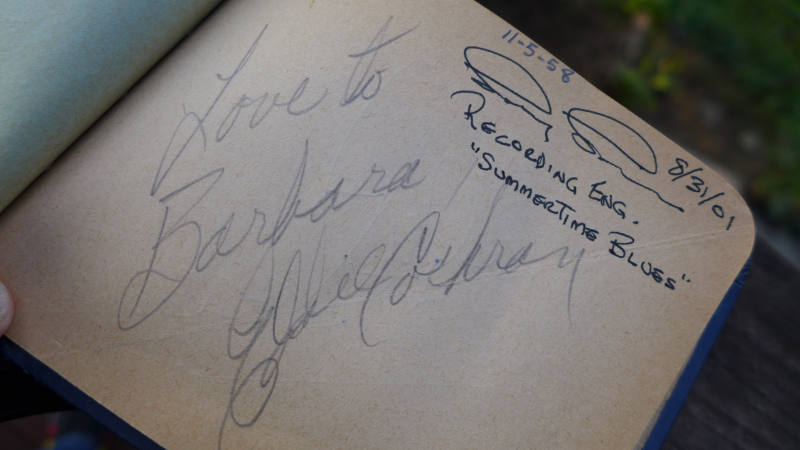
Director Kirsty Bell has lensed on-camera interviews with Keith Richards, Rod Stewart, Ronnie Wood, Roger Daltrey, Peter Frampton, Linda Perry, Alan Jackson, Alice Cooper, Sting, Billy Idol, Suzi Quatro, Brian Setzer, Yungblud, Kiefer Sutherland, members of Cochran’s family and additional talking heads.
Production on the documentary started in 2022. A release date will be announced in the upcoming months.
Kirsty Bell is a UK based filmmaker, producer and executive producer of well over 90 feature films in her career including Executive Producing the 2023 Best Short Film Oscar and BAFTA winner An Irish Goodbye. The Cochran Estate has partnered with Goldfinch Entertainment, Universal Music Enterprises and the Rock & Roll Hall of Fame.
Blue Cheer, Rod Stewart, Humble Pie, the Move, Joan Jett & the Blackhearts, Sheiks of Shake, the Rolling Stones, Stray Cats, the Who, Van Halen, Shakin Stevens, the Beach Boys, Mike Love, Alex Chilton, Bruce Springsteen & the E Street Band, T-Rex, Ritchie Valens, Dion, Terry Reid, the Flaming Lips, Sex Pistols, Buck Owens, Levon Helm, Bobby Vee, Blow Up, Jimmy Barnes, the Flying Lizards, Olivia Newton-John and Tom Petty & the Heartbreakers have recorded or performed versions of Cochran’s “Cut Across Shorty,” “Sittin’ In The Balcony,” “Summertime Blues,” “Twenty Flight Rock,” “Somethin’ Else” and “C’Mon Everybody.”
Many movies and commercials have also licensed Cochran’s master recordings.
Paul McCartney, as a 15-year-old performed a rendition of Cochran’s “Twenty Flight Rock” as the first song when he auditioned for John Lennon’s skiffle group The Quarrymen on July 6, 1957 in Liverpool.
Bob Dylan’s The Philosophy of Modern Song published in 2022 has a 1957 photo of Cochran, Little Richard, and Alis Lesley in Australia as the front cover image.
In 1987 Eddie Cochran was inducted into the Rock and Roll Hall of Fame by Mick Jones.
Born Ray Edward Cochran on October 3 1938 in Albert Lea, Minnesota, his family relocated to Bell Gardens, California in 1952 and he began playing guitar in 1954. He subsequently joined with songwriter Hank Cochran forming the Cochran Brothers, but weren’t related.
It was then when Cochran started working a session musician and began writing songs which led to making a demonstration recording with Jerry Capehart. Eddie’s first solo single was released in 1956 on the Crest Record label, owned by a music publisher Sylvester Cross.
In 1956, Eddie made his screen debut in director Frank Tashlin’s The Girl Can’t Help It, singing his rockabilly-inspired “Twenty Flight Rock.”
Cochran then co-starred in the 1957 teensploitation flick Untamed Youth alongside Mamie Van Doren directed by Howard W. Koch.
Eddie played guitar and occasionally contributed vocals and arrangements for Van Doren, rockabilly giant Johnny Burnette, country music singer and songwriter, Wynn Stewart, and friend, songwriter Baker Knight.
During 1958, Cochran did television appearances on the Philadelphia-based American Bandstand and Dick Clark’s Saturday Night Beech-Nut show.
Eddie had a seismic February 7, 1959 live booking on the Los Angeles (Compton-based) and Hadley’s Furniture sponsored Town Hall Party program in 1960 that was broadcast on KTTV-TV with Dick D’Agostin and the Swingers.
In 1959, Cochran, Ritchie Valens, Jimmy Clanton, the Cadillacs, Harvey Fuqua, the Moonglows, Sandy Stewart, Jackie Wilson, Jo Ann Campbell, DJ Alan Freed and other acts starred in Go, Johnny, Go! directed by Paul Landres.
On January 24, 1960 Eddie and rockabilly star Gene Vincent embarked on nearly two-month British tour.
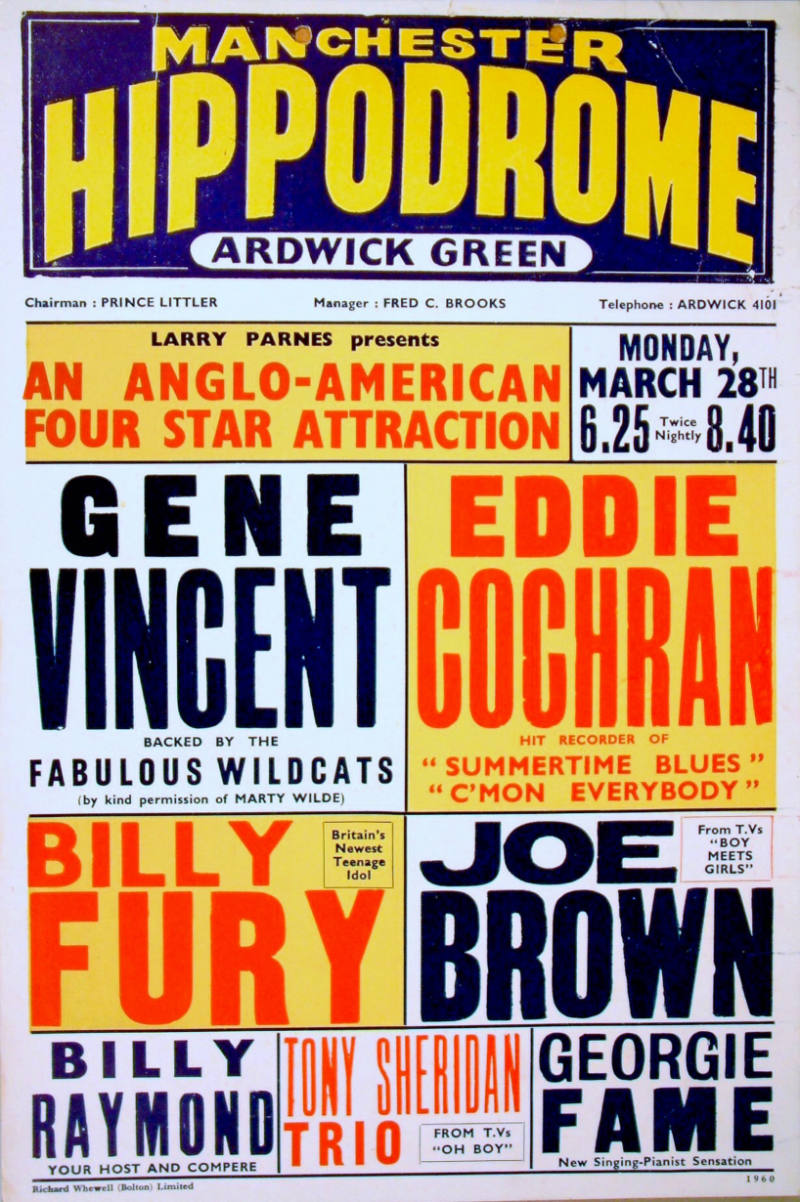
After a show at the Bristol Hippodrome on April 16th, a hired cab driven by George Martin carrying agent Patrick Tompkins, Vincent, Cochran and his fiancée songwriter Sharon Sheeley was involved in a horrific car accident at the end of their trek in Chippenham, Wiltshire.
Vincent and Sheeley were seriously injured and Cochran died the following day in Bath, Somerset at St Martin’s Hospital.
Eddie Cochran was buried April 25th at Forest Lawn Memorial Park in Cypress, CA.
Sheely had co-written “Somethin’ Else” with Eddie’s brother Bill Cochran and “Love Again” and “Cherished Memories” for Cochran. She penned “Poor Little Fool,” recorded by Ricky Nelson, and “Hurry Up” for Ritchie Valens. Following the tragic 1960 accident, Sheely wrote Brenda Lee’s “Dum Dum” with singer and songwriter Jackie DeShannon.
Eddie was booked for The Ed Sullivan Show before his death.
Two previous England-produced documentaries before Don’t Forget Me were made on Cochran’s life by the BBC: Three Steps to Heaven in 1982, and 2001’s Cherished Memories.
In his memoir Life, Keith Richards crafted a playlist of the most influential songs in his life. “Summertime Blues” was in it.
On their 1981 US tour the Rolling Stones included “20 Flight Rock” in their repertoire. On his 1993 Main Offender tour, Keith Richards and the X-Pensive Winos, opened their set nightly with “Somethin’ Else.”
During June and July of 1997, I attended recording sessions by the Rolling Stones for their Bridges to Babylon album in Hollywood at Ocean Way recording studios on 6050 Sunset Blvd. Drummers Charlie Watts and Jim Keltner extended an invitation to me.
One evening in the kitchen lounge I was chatting with Jim. We were discussing Liberty Records formerly housed nearby at 6920 Sunset Blvd. Keltner in 1965-1967 played on many Snuff Garrett produced and Leon Russell arranged Gary Lewis & the Playboys sessions released by Liberty.
Cochran, Gene McDaniels, Timi Yuro, the Fleetwoods, Jan & Dean, Del Shannon, the Ventures, Canned Heat, Johnny Rivers, Bobby Vee and Jackie DeShannon were Liberty recording artists.
In fact, it was Eddie in a late fifties mid-west tour who told Kentucky-born former Sharon Lee Myers pka Jackie DeShannon to head to Hollywood and find a career as “a California girl.”
Just when my Liberty-centric conversation with Jim turned to Cochran, the lounge door swung open and like on cue Keith Richards dashed in, carrying a bottle of Stolichnaya Vodka and a can of cherry juice.
Richards sat silently and then politely interrupted me. “Hey son, who played drums on Eddie’s records?”
I replied, “Earl Palmer was on many dates, but Eddie was the drummer on some sessions and demos, playing on a suitcase.”
Richards immediately stuck out his hand. “My name’s Keith.”
I declined the alcoholic drink offered but took a puff on a joint he lit up.
“Hang around for [“You Don’t Have to Mean It”] I’m mixing with [engineers] Rob Fraboni and Dan [Bosworth].”
Keith continued to chat about Eddie. He had total recall of Cochran on “the tele” in 1960 on Jack Good’s landmark Oh Boy! and Boy Meets Girl television programs.
On February 3, 1999 I interviewed Keith around a Rolling Stones concert in San Diego. We talked about his just issued Wingless Angels album.
It wasn’t lost on each of us that 40 years earlier, Buddy Holly, one of his musical heroes, died. An early Rolling Stones hit single was “Not Fade Away,” produced by Andrew Loog Oldham, was the B-side to Buddy Holly’s “Oh Boy!”
Keith and I briefly discussed how his Wingless Angels collaboration, anything he heard on the Sun, Chess and Stax labels, along with Holly and Cochran made a lasting impression on him, decades after initial radio airplay or retail discovery.
“I think because it’s timeless music. I call it ‘marrow music.’ Not even bone music. It strikes to the marrow. It’s like a faint echo . . . The body responds to it and I don’t know why…”
Over the last half century, I’ve asked friends and associates about Eddie Cochran and his legacy. Some worked and recorded with Eddie, others knew him, caught Cochran on stage, and inspired by his catalog.
Just about every Cochran recording, and his Billboard hit singles, “Summertime Blues,” “Twenty Flight Rock,” “C’Mon Everybody” and “Somethin’ Else’ were done in Hollywood at Gold Star Recording Studios with producer and occasionally co-writer, Jerry Capehart, for Liberty Records.
In an interview published in my 2014 book Turn Up The Radio! Pop, Rock and Roll in Los Angeles 1956-1972, Stan Ross, co-founder/owner with Dave Gold of the Gold Star recording studio, built in 1950 at 6252 Santa Monica Boulevard.
Many chart records were cut there during 1956-1968 by Cochran, Ritchie Valens, the Champs, Sonny & Cher, Dobie Gray, the Ronettes, the Crystals, the Righteous Brothers, the Mermaids, Chris Montez, Buffalo Springfield, Chan Romero, the Turtles, Larry Verne, Thee Midniters, Iron Butterfly and Herb Alpert & the Tijuana Brass.
Gold Star closed its doors in 1984, owning to shifting economics, the increase in home studios, and a fire in ’84 that destroyed the property.
In 1958, Stan Ross was at their legendary sound board on the Phil Spector-produced Teddy Bear’s record, “To Know Him Is to Love Him,” and with engineer Larry Levine at the console for Spector’s 1962-1966 studio excursions.
“He was as concerned as they were about the song — one of the reasons Phil’s songs have durability and are copied. I saw a lot of growth with Phil very early. He came out of our studio tradition.
“Eddie Cochran used our Studio B, down the stairs by the parking lot. I did a whole lot of Eddie’s records with engineer Larry Levine, including ‘Summertime Blues,’ ‘Twenty Flight Rock,’ and ‘C’Mon Everybody.’”
“As far as the room sound and the drum sound for the Eddie and Phil recordings,” clarified Levine in a 2002 interview we did, “because the rooms were small with low ceilings, unlike other studios with isolation, your drums sounded the way you wanted them to sound. They would change accordingly to whatever leakage was involved.
“The echo enhanced the melding of the Wall of Sound, but it didn’t create it. Within the room itself, all of this was happening, and the echo was glue that kept it together.”
Gold Star also had a reputation for their on-site mastering room which enhanced final vinyl products, pleasing many independent and corporate record label clients.
“Gold Star was built for the songwriters,” Stan Ross underscored. “They were fun, wonderful people to be around—Jimmy Van Heusen, Jimmy McHugh, Ben Weisman, Bob and Dick Sherman, Johnny Mercer, Frank Loesser, Sammy Fain, Don Robertson, Sonny Burke.
“[The studio’s echo chamber] gave it the Wall of Sound feel. Dave [Gold] built the equipment and the echo chamber. We had so much fun with that echo chamber; it never sounded the same way twice.
“Gold Star brought an emotional feeling. Gold Star was not a dead studio, but a live studio. The room was thirty by forty feet. It was all tube microphones. We kept tubes on longer than anyone else, because we understood that when a kick drum kicks into a tube, it’s not going to distort. A tube can expand.
“The microphones with tubes were better than the ones without the tubes, because if you don’t have a tube and you hit it heavy, suddenly it breaks up. But when you have a tube, it’s warm and emotional. It gets bigger and it expands. It allows for impulse. We didn’t use pop filters and wind screens—we got mouth noises. Isn’t that life?”
Multi-instrumentalist, record producer, deejay David Kessel is CEO of CaveHollywood.com and an avid fan of Eddie Cochran.
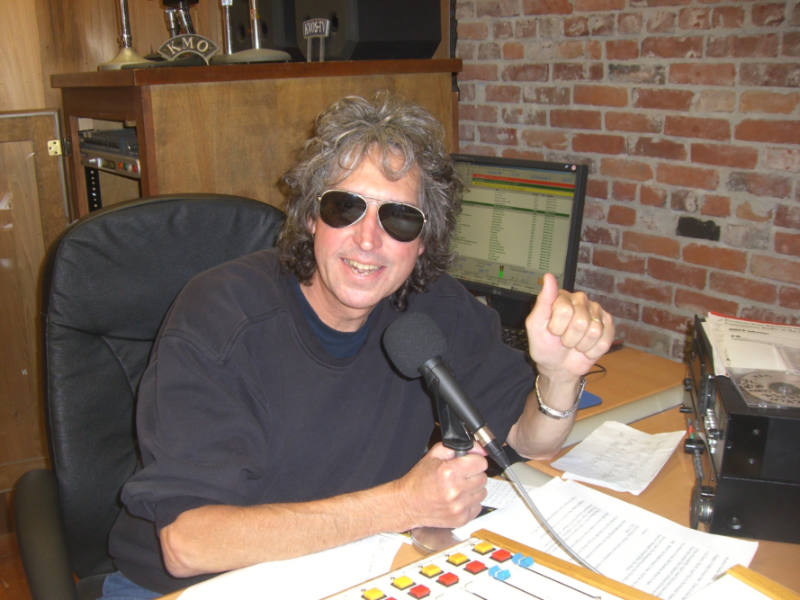
David is the son of guitarist and jazz legend, Barney Kessel, and step-son of background singer and vocal contractor B.J. Baker, who were both on dozens of record dates at Gold Star.
As a child in the sixties, and as a musician and record producer in the seventies and eighties, David logged more hours at Gold Star than anyone I know.
This century he emailed some technical observations about Gold Star and the influential sound and pound of Eddie Cochran’s records.
“The board at Gold Star was very important and essential to the records cut there. Because of the quality of the metal inside the board and the wiring. It was very thick and extremely powerful.
“Not like today where you have all the digital stuff and then you have to bring in all the boxes and try to beef it up. You know what I mean, where at Gold Star that was the real deal. The metals made after World War 2 were sufficiently degraded from the metal before World War 2. Much weaker metal because they had to use so much during the war. It became thinner, got into aluminum, transistors. Stuff like that.
“When they have the real deal metal, real deal magnets, and the real deal wiring, that really informs the sound. And when you bring in brilliant acoustics with a powerful board and you have Phil Spector, Ritchie Valens, Eddie Cochran, Shel Talmy, Jack Nitzsche, Sonny Bono working the musicians, hearing those sounds in their heads, being able to articulate it with the help of Larry Levine, Stan Ross and Dave Gold.
“Larry, Stan and Dave were strictly known as engineers, and they didn’t have aspirations of being record producers, running a record label or operating a music publishing division. They weren’t going to award shows every week to work the room.
“One of the reasons we still dig and marvel about the hit singles from Gold Star in the fifties and Phil’s stuff was that they were cut in mono.
“Well, first of all, it’s all powerful and coming out of both speakers the same. OK? That means you are getting the full signal right at you. With the ‘Wall of Sound’ in mono you are not having to worry about stereo placement.
“Originally, you were or are making these records for a transistor radio. And ultimately you want it to sound really great out of that small transistor radio speaker. You’re also thinking in terms of when the needle goes down on the record. It’s going to go out through the needle as a whole signal.
“Whereas when you start dividing the instruments, ‘part of this on the left side, part of this on the right side,’ you can hear that on some of the Beatles’ mid-career records, trying to get a stereo thing going, but you lose the full impact of the solid centered power. With mono you get a thicker piece of music on tape.
“Eddie Cochran was a powerhouse. He was completely rock and roll. As a teen himself, he delivered the passion and angst of the teenagers of that era. His swagger and pounding rhythm helped create ROCK AND ROLL. With him you get a guy who put together the multi-musical genres happening at that 1956-1960 time period.
“Eddie was a great musician. He played drums and guitar, overdubbed sounds and had a great songwriter music producer understanding of what he wanted.
“I grew up at Gold Star starting at age 6. My father and step-mom always took us to the studio if we weren’t in school. There was no such thing as day care centers 60 years ago in Hollywood. You sat on a couch, watched the cats set up their equipment, play and smoke cigarettes.
“My brother Dan and I produced recordings at Gold Star and did all kinds of sessions with the American Federation of Musicians Local 47 union members. They were never called the Wrecking Crew.
“I worked there all the time with Phil Spector, recording with Leonard Cohen, Dion and the Ramones, played on their album End of the Century, and more.
“You can explore Gold Star and Eddie’s history in the room, but you need to really take note: The guitar we hear on Eddie’s records is a Gretsch 6120 hollow body electric guitar. It had some punch power and was a very versatile guitar with F holes, huge pickups and added more depth to the sound.
“It’s the F holes. When you have a hollow body electric guitar with F holes, it makes the guitar breathe. When you’re putting it through an amplifier, it breathes extra. It’s the F holes that allow it to get air in there and breathe.
“Gretsch instrument company was founded in 1883 and had a major renaissance in the 1950’s and 1960’s.
“Many artists grooved to Gretsch, and there are many: Duane Eddy, Malcolm from ACDC, Pete Townsend from the Who, and the Stray Cats’ Brian Setzer. George Harrison used a Gretch Chet Atkins Country Gentlemen in the height of Beatlemania.”
In 2012’s Kindle edition of British author and broadcaster Spencer Leigh’s THINGS DO GO WRONG which tells the story of the ill-fated Gene Vincent and Eddie Cochran UK 1960 tour, English musician, singer and guitarist Joe Brown further illuminated Cochran’s unique guitar prowess.
“Eddie had a great trick, it had probably been used in America for years, but we didn’t know about it over here. He used to put a second string instead of a third string on his guitar, so that he had an unwound string and he could bend it and get those bluesy sounds that you never heard in England.”
Marshall Berle started his career at the William Morris Agency in 1960, signing the Beach Boys to an agency contract representing the band from the beginning of their career through 1965.
As a booking agent, he repped Little Richard, Spirit, Canned Heat, Creedence Clearwater Revival, Ike and Tina Turner Revue, Marvin Gaye, Taj Mahal, Rufus, and Bachman-Turner Overdrive.
“I went to Fairfax High School with Phil Spector,” recalled Berlein a 2012 interview we conducted.
“We both earlier went to Laurel Elementary. I met Eddie Cochran at Gold Star just before he died. Phil invited me down. I went into the Navy in 1956, ‘57 and out in 1960. I was still in the Navy and Phil wanted to play me something. And in the other studio was this guy, Eddie Cochran.
“In those days instead of using a drum they sometimes used a cardboard box or a suitcase. It was really cool. He had not gone to England yet and this was before Phil moved to New York.”
Russ Titelman is a record producer and songwriter. He’s won three Grammy Awards producing Steve Winwood and Eric Clapton.
In the early sixties Titelman spent many hours at Gold Star around Spector sessions. In 1965 he was the rhythm guitarist on the Shindig! television show. He was later a staff producer for Warner Bros. for 20 years.
“In 1959 or ’60 Lou Adler and Herb Alpert produced a TV pilot for a dance TV show that they shot at the Renaissance Club on Sunset,” reminisced Russ in a 2014 interview we conducted.
“Eddie Cochran was the guest and I was on as one of the dancers. He had magic. Man, I’ll tell you. ‘Summertime Blues.’ ‘C’Mon, Everybody.’ The sound that he got with his guitar and bass was so completely compelling.”
Music man Robert Marchese won a Grammy for producing in 1968 the live Richard Pryor album at The Troubadour.
Robert witnessed Elvis Presley in 1957 and Eddie Cochran during 1959 in Pittsburgh, Pennsylvania.
“I saw Eddie at the Syria Mosque,” emphasized Marchese by telephone. “Buddy Holly played there 4 times in 1957 and ’58. Elvis blew the roof off the house.
“Believe me, Eddie Cochran was the only person I ever saw who could ever give Elvis a run for his money.
“He sang about girls, cars, had moves and nervous energy we all had. Cochran actually wrote a lot of his stuff. Good lookin’ boy. The chicks were swooning. Eddie was on a bill with Chuck Berry and Huey “Piano” Smith and His Clowns, who were terrific. Mickey & Sylvia were on the show. Her dress was so tight she couldn’t walk! The brothers were going crazy.”
Malcolm Leo is a film director who with Andrew Solt wrote and directed the documentaries This Is Elvis, The Beach Boys: An American Band and in 1979 the groundbreaking television movie Heroes of Rock and Roll.
“I saw Elvis at the Pan-Pacific Auditorium in October 1957,” proclaimed Leo. “The appearance of Elvis in Los Angeles not only changed the culture, but he catalyzed the whole record industry.
“The world before Elvis was the 5/4 Ballroom at Fifty-Fourth and Broadway in downtown L.A. “I had an older friend, Leland States, who could drive and he took me to see Eddie Cochran. Leeland and I were classmates at North Hollywood High School.
“It was Eddie’s hair, shiny shirts, cool slacks that packed the punch when we caught him doing ‘Somethin’ Else.’”
“I heard the Spector and Cochran records in the UK,” volunteered author, and 1964-1967 record producer of the Rolling Stones, Andrew Loog Oldham in a 2000 interview with me.
“It made an impact because of the use of room. The usage of tape delay. You knew something was going on, even if you didn’t know what it was. Later, after, I’d recorded the Rolling Stones’ ‘Not Fade Away’—or let’s say ‘Little Red Rooster.’ You realized, by recording in similar mono circumstances, in London’s Regent Sound as opposed to Gold Star, or where Phil did ‘To Know Him Is to Love Him,’ what the room brought to the game.
“There is a lot of magic to that record. Maybe one of the things that drew me to it was that there was a subliminal audio text from Eddie Cochran records. Eddie had already done ‘Summertime Blues’ at Gold Star. So, we didn’t know, but you do know, man. That’s my memory of it.
“In my book Stoned, Soho was the playground, London was where we made all the pieces fit – the growing pains of pop and vision. How vaudeville and World War II begot a middle-class trad-jazz which begot skiffle and imitative well-meaning pop and eventually this little cluster of about 300 white kids with a passion for rhythm ‘n’ blues.
“How before the Beatles there was a Jack Good, Eddie Cochran, Little Richard, Buddy Holly, Billy Fury, Marty Wilde and Cliff Richard and the Shadows that ran that first all-important mile.
“How bigger than life, defining our behavior, up there on the screen was Elvis and Jimmy Dean.
“There is also The Girl Can’t Help It film. There’s no soundtrack album to it.
“The Gene Vincent and Eddie Cochran sequences aren’t just slotted-in videos. I saw it before I saw Eddie play live. I saw them on-screen, and later in the UK at a personal appearance. Both galvanized me. Dark-haired guys didn’t interest me, only blondes, because I could be it.”
“After we were at the Monterey International Pop Festival [in June 1967], emailed Pete Townsend of the Who in a 2007 correspondence, “a side issue was that we played at the Fillmore [in San Francisco] on this trip, and that was probably more important to us, because Bill Graham insisted that we play a longer set than we were used to. It was around this time we began to include songs like ‘Young Man Blues’ and ‘Summertime Blues.’”
Ian Whitcomb was an English piano player, singer-songwriter, record producer, historian, author and broadcaster.
I spoke with him in 2013.
“I’m rooted in Eddie Cochran, Jerry Lee Lewis and George Formby. I also love rock ‘n’ roll. Elvis Presley, Gene Vincent, and Fats Domino. Cochran is sort of overlooked in history. He didn’t make that many records and got killed too early,” lamented Whitcomb.
During 2014 I had a conversation with record producer and songwriter Kim Fowley about Cochran and Gold Star. Fowley was a deejay on satellite radio SiriusXM’s Little Steven’s Underground Garage.
“I went to Gold Star my first day in Hollywood, on February 3, 1959. It was the day Buddy Holly, Ritchie Valens, and the Big Bopper died in an airplane crash in Iowa,” reminisced Kim.
“I met the rockabilly cats Johnny and Dorsey Burnette in 1959. It was during that day in Hollywood at Gold Star, around a Champs recording session I was covering for Dig magazine. I was their campus correspondent and invited to have lunch with Dorsey and Johnny.
“I then encountered Eddie Cochran, songwriters Sharon Sheeley, Jackie DeShannon and Eddie’s record producer and co-writer, Jerry Capehart.
“As a visitor to Gold Star, it was the epicenter of teenage rock ’n’ roll recording culture in 1959. If you were in Memphis, Tennessee, you would knock on the door of Sun Records. If you were in Detroit, Michigan, you would knock on the door at Motown. But in 1959, I went to Gold Star.
“It was possibly a double-edged sword for Larry Levine, Stan Ross, and Dave Gold, because they figured they would service the emerging rock ’n’ roll community. At that point, the other studios in town had a suit-and-tie vibration. So, if some kid had a hundred dollars, he couldn’t even get in those places but he could cut a record at Gold Star for a hundred bucks if he saved money or got his friends and family to pitch in with band members.
“You could go in there and not get intimidated. You had equal footing with legendary guys like Eddie Cochran who I saw work at Gold Star. He invited me in to watch, listen, and learn. I also attended his session for ‘Sittin’ in the Balcony’ that came out on Liberty.
“Eddie, Sharon Sheely, Jimmy O’Neill, Danny Hutton, Bobby Womack, Sam Cooke and I shared the same music business attorney, Walter E. Hurst.
“In 1960 I was throwing shows on Sunset Blvd. for teenagers at Jimmy Maddin’s venue, The Summit-later The Red Velvet. Deejays Frosty Harris and Jimmy O’Neill, who were on radio station KRLA, would come down.
“I was the last guy to book Eddie Cochran in America before he died. He came out and did ‘Three Steps to Heaven.’ Eddie then died three weeks later in England.”
A deejay on Little Steven’s Underground Garage with Rockabilly Rave-Up is Slim Jim Phatom, drummer of the Stray Cats.
In 2022 I bumped into him in Sherman Oaks, Ca. We chatted briefly about Eddie Cochran. Slim Jim praised the sonic aspects of the Cochran/Capeheart discs and Eddie’s threads.
The Stray Cats have a tune called “Gene and Eddie,” and at every concert you can hear them play “Twenty Flight Rock,” “Summertime Blues” and “C’Mon, Everybody.”
“Eddie Cochran. A great one for sure,” Slim Jim emailed. “We always say Eddie is the greatest rock star ever!”
“I first became aware of Eddie via Blue Cheer’s ‘Summertime Blues’ on their turns-air-into-cottage-cheese masterpiece Vincebus Eruptum,” admits twenty-flight rocker Gary Pig Gold, “which my teenaged garage combo spent the entire summertime of ’69 struggling to learn.
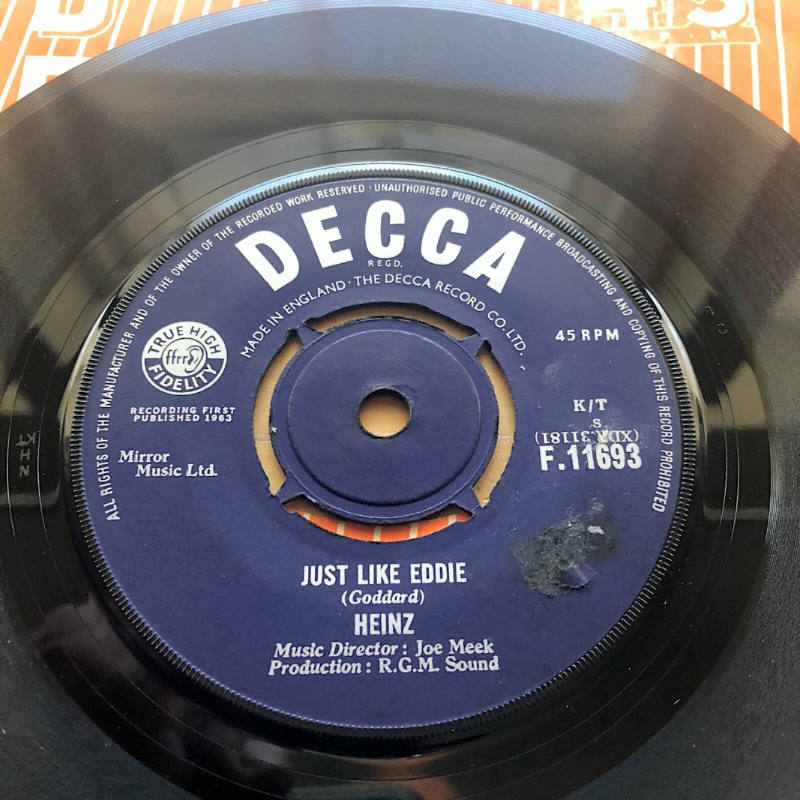
“That most seasonal of numbers next popped up on yours truly’s Live at Leeds of course, and then – and most indelibly – as the subject matter of the Joe Meek-produced gem ‘Just Like Eddie,’ a battered UK 45 of which my drummist at the time happened to bring to practice one afternoon.
“Curiosity completely piqued by then lured me straight to United Artists’ exemplary Legendary Masters Series No. 4: a, yes, legendary 30-track, Lenny Kaye-liner’d compilation circa ’72 whose four long-playing sides rightfully spent almost as much time on my high school phonograph as UA’s adjacent Jan & Dean Anthology Album, I’ll have you all know. Though I later ‘graduated’ to Liberty of England’s Eddie Cochran 20th Anniversary big boxed set, with its four, as opposed to ‘just’ two LPs …85 generous tracks, including Sides 7 and 8 full of audio from his (sadly, only) British tour plus television appearances.
“Needless to say, the sound and rugged spirit of all things Cochran lived most durably upward and onward across the ages, clear through Sid Vicious’ two – count ’em! – covers on the Pistols’ aptly-named Great Rock ‘n’ Roll Swindle soundtrack then well beyond indeed as we can hear right here in Century 21.
“In fact, just as the above-mentioned Meek melody recommends, to this day (and I quote), Whenever I’m sad, whenever I’m blue, Whenever my troubles are heavy, Beneath the stars I play my guitar… Just like Eddie.”
(Harvey Kubernik is the author of 20 books, including 2009’s Canyon Of Dreams: The Magic And The Music Of Laurel Canyon, 2014’s Turn Up The Radio! Rock, Pop and Roll In Los Angeles 1956-1972, 2015’s Every Body Knows: Leonard Cohen, 2016’s Heart of Gold Neil Young and 2017’s 1967: A Complete Rock Music History of the Summer of Love.
Sterling/Barnes and Noble in 2018 published Harvey and Kenneth Kubernik’s The Story Of The Band: From Big Pink To The Last Waltz. In 2021 they wrote Jimi Hendrix: Voodoo Child for Sterling/Barnes and Noble.
Otherworld Cottage Industries in 2020 published Harvey’s Docs That Rock, Music That Matters. His Screen Gems: (Pop Music Documentaries and Rock ‘n’ Roll TV Scenes) was published in 2026 publication by BearManor Media.
Harvey spoke at the special hearings in 2006 initiated by the Library of Congress held in Hollywood, California, discussing archiving practices and audiotape preservation.
In 2017, he appeared at the Rock & Roll Hall of Fame in Cleveland, Ohio, in its Distinguished Speakers Series and as a panelist discussing the forty-fifth anniversary of The Last Waltz at the Grammy Museum in Los Angeles in 2023).