By Harvey Kubernik © 2026
Visuals Courtesy of Gary Pig Gold Archives
The legacy of Ritchie Valens and Buddy Holly continues in 2026. A remake of the iconic 1987 film La Bamba is currently in development by Mucho Mas Media and Sony Pictures. Luis Valdez who wrote and directed the 1987 movie will be the executive producer of the remake. The new screenplay will be written by Jose Rivera, who penned the Oscar-nominated The Motorcycle Diaries. A year ago, the Ritchie Valens Recreation Center in Pacoima housed victims of the Southern California Wildfires.
On February 14, 2026, Joshia Josue will bring his annual tribute Come On, Let’s Go Celebrating the Legacy of Buddy Holly & Ritchie Valens at the Hidden Hall venue in Bellingham, Washington. This year’s event also marks the album release of Broadcast to the Surf Ballroom — a project in which Joshua completes several unfinished songs by Ritchie Valens and Buddy Holly, respectfully recorded and newly brought to life for modern audiences.
The American Theatre Guild, the largest not-for-profit touring Broadway presenter in the nation, just announced the 2025–2026 Season for The Buddy Holly Hall in Lubbock, Texas. The 25–26 Broadway at the Buddy Holly Hall Series will include the Broadway touring productions: WATER FOR ELEPHANTS, MRS. DOUBTFIRE, BLUE MAN GROUP, HADESTOWN, CLUE and Meredith Willson’s THE MUSIC MAN.
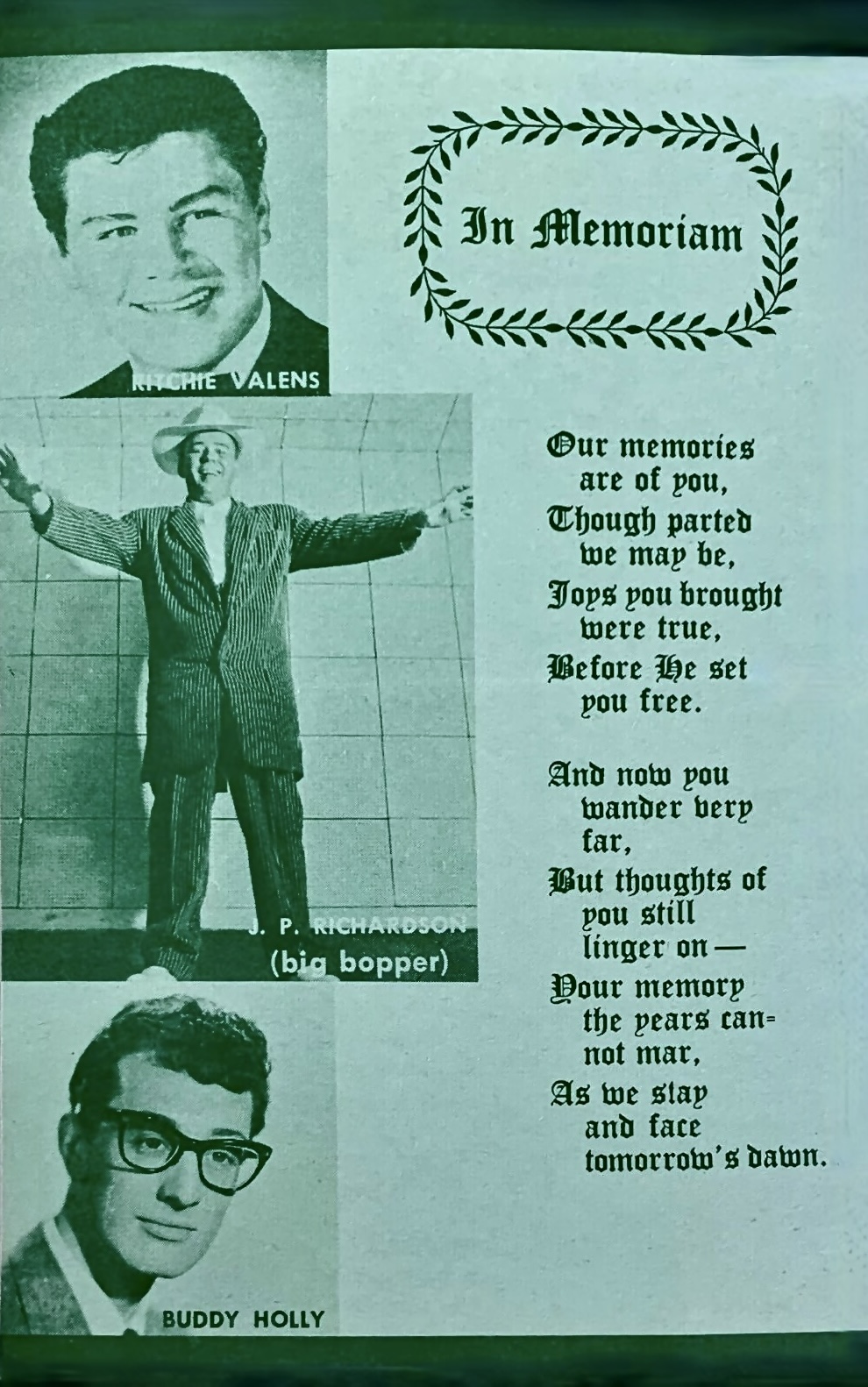
February 3, 2026 is the 67th “anniversary” of tragic airplane crash that has become to some people and media members known as “The Day the Music Died,” referenced in Don McLean’s song, “American Pie.” Buddy Holly, Ritchie Valens and J.P. Richardson aka The Big Bopper died along with pilot Roger Peterson.
After a February 2, 1959 Winter Dance Party show in Clear Lake, Iowa, Buddy Holly, Ritchie Valens and J.P. Richardson took off from the Mason City airport, in a three-passenger airplane that Holly chartered piloted by Roger Peterson during inclement weather. It crashed into a cornfield in nearby Macon City, Iowa, just minutes after take-off.
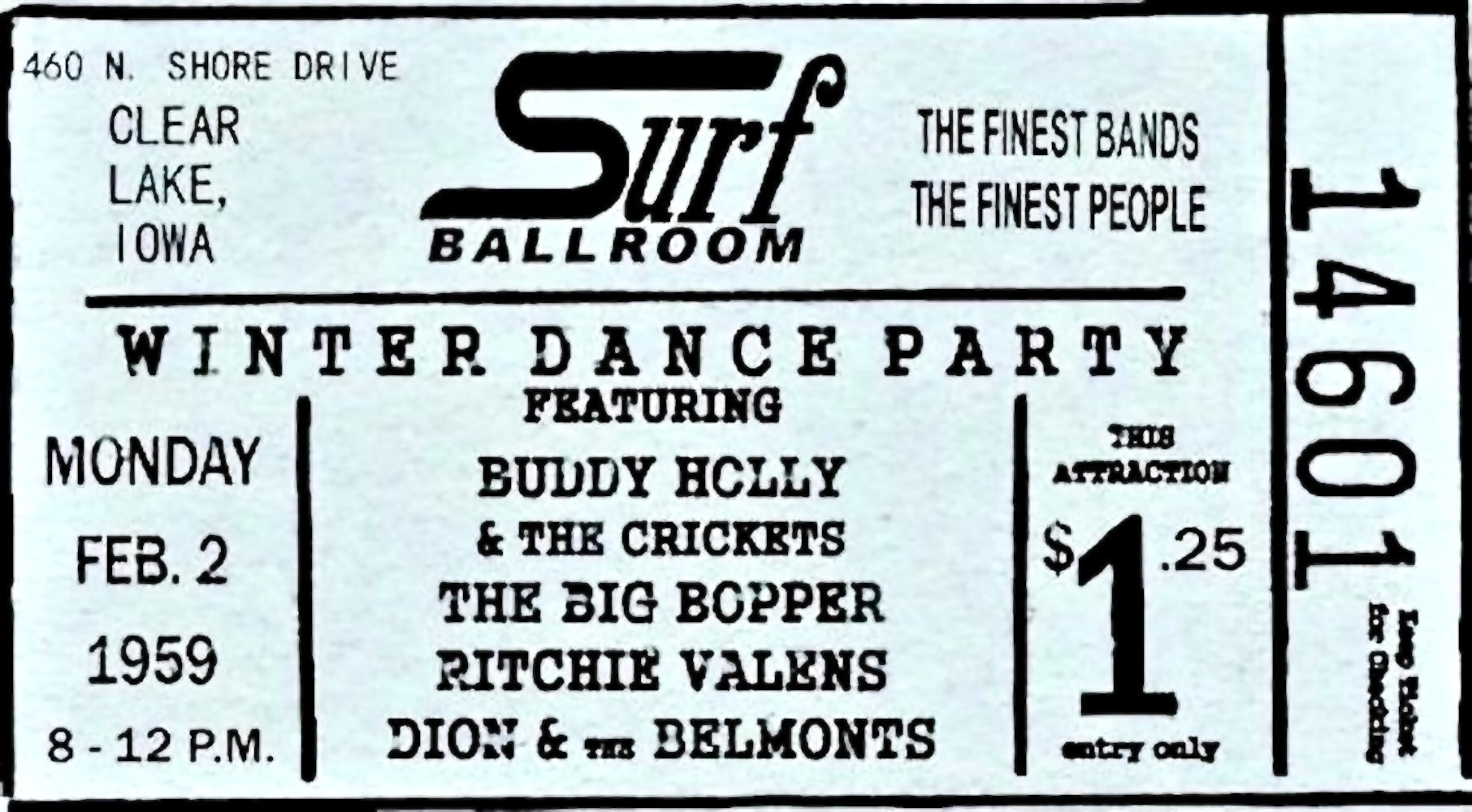
I will always remember the February 3, 1959 front page headline in The Los Angeles Times-Mirror, a daily newspaper who reported this accident.
Ritchie Valen’s death was a very big regional loss. He was from Pacoima, a suburb in Southern California. Ritchie’s records were very popular in Los Angeles and the surrounding communities. It was KFWB-AM deejay Gene Weed who first spun his music and the radio station held what seemed like an all-day shiva celebrating the life of Valens, whose record label, Del-Fi, was based in Hollywood.
I saw Buddy Holly from his appearances on Dick Clark’s American Bandstand and from ’57 when he was on The Ed Sullivan Show. Holly’s records were also spun on KFWB. “Chantilly Lace” by The Big Bopper was a national hit.
On February 3, 1999 I interviewed Keith Richards around a Rolling Stones concert in San Diego. We talked primarily about his just released Wingless Angels album.
However, it wasn’t lost on each of us that 42 years earlier, Buddy Holly, one of his musical heroes, passed.
An early hit record of the Rolling Stones was “Not Fade Away,” produced by Andrew Loog Oldham, was the B-side to Buddy Holly’s 1957 chart hit “Oh Boy!”
In March 1958, 14-year old Mick Jagger saw his first rock concert in London at the Woolwich, Granada. “Not Fade Away” made a big impression.
Keith and I had a brief discussion how some music, like his Wingless Angeles endeavour or the sounds of the Sun Records label, or anything by Holly and Eddie Cochran made immediate impact and a connection on your soul, even decades after initial airplay or retail discovery.
“I think because it’s timeless music I call it ‘marrow music.’ Not even bone music. It strikes to the marrow. It’s like a faint echo . . . The body responds to it and I don’t know why…”
The music and recorded catalogue of Buddy Holly never really died, as well as the sonic legacy of Ritchie Valens. There is also a recent documentary, The Winter Dance Party, directed by Eric Smith, on the 1959 Winter Dance Party tour.
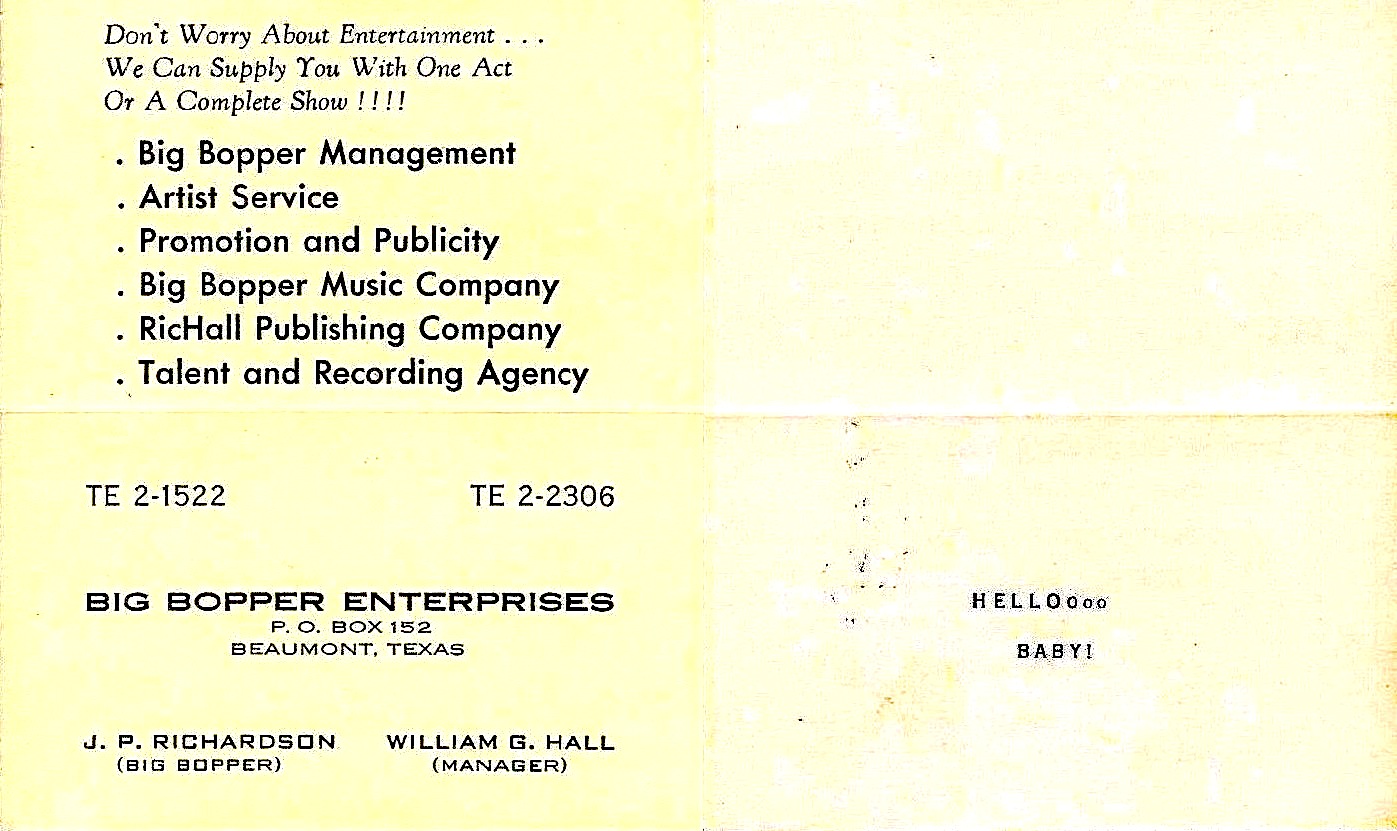
“Chantilly Lace” by The Big Bopper is constantly heard daily on oldies and classic rock radio stations. Humourist and songwriter J.P. Richardson, pka The Big Bopper, wrote “White Lighting” that George Jones recorded, and penned “Running Bear” for Johnny Horton. He’s in the Rockabilly Hall of Fame.
I asked two dear friends of mine author/music historian, Roger Steffens and the late multi-instrumentalist Chris Darrow, to share their memories of witnessing Buddy Holly and Ritchie Valens live on stage.
Roger Steffens: At Christmas 1957 I went to my first rock and roll show, Alan Freed’s giant Christmas Jubilee of Stars at the Paramount Theater on Times Square. The run broke all attendance records, including the previous best, a Frank Sinatra tour in 1944.My friends and I had to lie to our parents, because they were sure we would be mugged if we went to a show where a lot of black kids were going to be.
“So, we told them we were going to Hackensack to see a movie, but got on the bus to the Port Authority instead and walked the few blocks to the Paramount, which had a line stretching three times around the block.
“The show included Fats Domino, Jerry Lee Lewis (back to back), the teenage Everly Brothers, the Teenagers, Lee Andrews and the Hearts (with Questlove’s father), Danny and The Juniors, the Dubs (dear to my reggae soul) and eight others. Most of the second line performers got only one or two songs each, but Buddy Holly and the Crickets got five, because they were on the charts under both names at the time. They were all dressed in tuxedos, and played with a stand-up bass.
“The audience went wild for Buddy, clapping along with his rhythms, and singing along with his parade of hits. I remember watching Alan Freed’s 5-6 pm Rock and Roll Party TV show on WABD, Channel 5, in New York City.
“He interviewed Buddy about the national tour they had done together in 1956, during which they flew in a small plane to get to a gig, and encountered severe turbulence. Buddy recalled the ‘woop-woop’ as the plane fell and climbed and fell again. What a premonition!
“It was one of the saddest days of my youth when we learned of that terrible crash that took his life, and the first time I cried over the loss of a performer. Odd that one of the final releases during his short lifetime was ‘It Doesn’t Matter Anymore,’” underlined Steffens.
Chris Darrow: I saw Ritchie Valens a month before his death in Pomona at the Rainbow Gardens, an all-wooden building, with a low ceiling that was just south of the YMCA in Pomona, California. It later was to burn to the ground.
“I was from a mixed race white and Hispanic neighborhood in Claremont, called Arbol Verde. My best friend Roger Palos was Mexican, and he and I were both learning to play guitar and we would sing together a lot. The songs that we learned that were not from the folk music genre, were popular songs mainly by Elvis Presley, the Everly Brothers, Buddy Holly, and Ritchie Valens. For some reason our favorite song of Ritchie’s was not ‘La Bamba’ or ‘Oh, Donna’ but ‘Hi – Tone.’ We just loved that song. Most of Ritchie’s recordings were cut at Gold Star recording studios in Hollywood or at the Del-Fi studio.
“I was 15 and in the ninth grade and was not allowed to go out many places by myself at night. I was attending a private school in Claremont, called Webb, which had sons of famous people in my class. Chris Mitchum, son of Robert, Chris Reynolds, his father owned the L.A. Angels professional baseball team, Tom Mitchell, whose father invented the Mitchell 35mm movie camera and Bob Washburn, whose dad was the head of 7UP.
“Since I wasn’t driving yet, it took a lot for my folks to let me go into the dark part of Pomona to see a rock ‘n’ roll show in 1959. My parents weren’t square but my mom always worried about me.
‘“I went with Roger Palos and Jon Dearborn to the concert, and it was kind of a pilgrimage for us. Since I really identified with the Mexican culture and wasn’t afraid, I couldn’t wait to see one of my main men, Ritchie Valens. After all he was only 17 and not much older than Roger and me. I wore my bright, red corduroy coat with silver buttons that my Grandma Darrow had made for me that Christmas. I also wore white bucks, white pants and red argyle socks. I looked sharp!
“I’m not sure who the house band was, but it could have been Manual and the Renegades, or the Mixtures, for they both used to be regulars at the Rainbow Gardens. I was very excited and hadn’t been to too many concerts before this.
“I listened to a lot of radio at the time and because of the heavy Mexican influence in my life, I got turned on to KDAY with Art Laboe, who would broadcast live from Scribner’s Drive-In, and Ol’ HH -Hunter Hancock- who had a great show called Harlem Matinee. These were the guys that the Mexicans listened to on the radio. I was also into KFWB, with Al Jarvis, Bill Balance and Ted Quillan, and Dick Hugg ‘Huggy Boy’ on KGFJ. He was on so late at night that I would have to listen to him under the covers of my bed in my room. So, what is now called doo-wop was big with me, as well as the white dominated music so prevalent on major radio stations of the time. The Oldies but Goodies albums by Laboe on Original Sound were right up my alley.
“I was really into dancing at the time and had a chance to dance a few numbers with some strangers at the show. The opening act for Ritchie was Jan & Dean; possibly really Jan & Arnie. In those days no one had their own bands and acts would use house bands as their own. Either the band didn’t like Jan & Dean or they just didn’t care. Before they could get through the first song, which sounded awful, Jan stopped, ran off the stage followed by Dean, and plowed through the locked stage door and out into the night. Jan just kicked it open like some thug in a movie. I was so shocked and dumbstruck by this. They never came back.
“After the commotion died down and it was time for Ritchie to come on. He whirled in, probably from some other gig earlier that night, and I went right up next to the edge of the stage. He was a pretty big guy and loomed on-stage with a graceful power. He was not overtly hard core in his presentation but was very soulful and I ate it up. There was a tenderness and sweetness about him, even as he rocked. The house band knew his stuff and did a great job on the songs. He did ‘La Bamba’ and ‘Oh, Donna’ and even played my favorite song, ‘Hi-Tone.’
“I liken Ritchie to another L.A. guy, Eddie Cochran. Both had the soul and drive of the Sun /Clovis, New Mexico records, but they were from our own backyard. As soon as Ritchie finished, he was whisked off in a flash. There was no chance to say ‘hello’ or offer a handshake, but I was ecstatic over the event.
“The house band played on to people doing the Stomp and I was awarded a prize for being one of the five best- dressed guys of the night. A perfect end to a perfect evening.
“I read somewhere that Frank Zappa saw Ritchie in Pomona, so he was probably there, too. A month after the gig I was at school and heard about the deaths of Ritchie, Buddy and The Big Bopper. I was crushed and went off by myself and cried like a baby. It was the first time I remember crying for someone who had died. Ritchie Valens and Buddy Holly were like gods to me at the time and could do no wrong. It was one of the great losses in rock and roll history,” lamented Darrow.
During Bob Dylan’s 2016 Nobel Prize for Literature acceptance speech, the singer-songwriter paid tribute to Holly, who he saw perform on January 31, 1959 in Duluth, Minnesota.
“If I was to go back to the dawning of it all, I guess I’d have to start with Buddy Holly.
“Buddy died when I was about 18, and he was 22. From the moment I first heard him, I felt akin. I felt related like he was an older brother. I even thought I resembled him. Buddy played the music that I loved – the music I grew up on: country western, rock ‘n’ roll, and rhythm and blues.
“Three separate strands of music that he intertwined and infused into one genre. One brand. And Buddy wrote songs – songs that had beautiful melodies and imaginative verses. And he sang great – sang in more than a few voices. He was the archetype. Everything I wasn’t and wanted to be. I saw him only but once, and that was a few days before.”
Dylan also acknowledged Holly after winning the Grammy for ‘Album of the Year’ with Time Out Of Mind in 1998. “I just want to say that when I was 16 or 17 years old, I went to see Buddy Holly play at Duluth National Guard Armory and I was three feet away from him…and he looked at me. And I just have some sort of feeling that he was — I don’t know how or why — but I know he was with us all the time we were making this record in some kind of way.”
Harvey Kubernik is the author of 20 books, including 2009’s Canyon Of Dreams: The Magic And The Music Of Laurel Canyon, 2014’s Turn Up The Radio! Rock, Pop and Roll In Los Angeles 1956-1972, 2015’s Every Body Knows: Leonard Cohen, 2016’s Heart of Gold Neil Young and 2017’s 1967: A Complete Rock Music History of the Summer of Love. Sterling/Barnes and Noble in 2018 published Harvey and Kenneth Kubernik’s The Story Of The Band: From Big Pink To The Last Waltz. In 2021 the duo wrote Jimi Hendrix: Voodoo Child for Sterling/Barnes and Noble.
Otherworld Cottage Industries in 2020 published Harvey’s Docs That Rock, Music That Matters. His Screen Gems: (Pop Music Documentaries and Rock ‘n’ Roll TV Scenes) is scheduled for January 2026 publication from BearManor Media.
Harvey spoke at the special hearings in 2006 initiated by the Library of Congress held in Hollywood, California, discussing archiving practices and audiotape preservation. In 2017, he appeared at the Rock & Roll Hall of Fame in Cleveland, Ohio, in its heralded Distinguished Speakers Series and also a panelist discussing the forty-fifth anniversary of The Last Waltz at the Grammy Museum in Los Angeles in 2023.
During 2025, Kubernik was spotlighted in the Siobhan Logue-written and -directed documentary The Sound of Protest, airing on the Apple TVOD TV broadcasting service. The film also features Smokey Robinson, Hozier, Skin (Skunk Anansie), Two-Tone’s Jerry Dammers, Angélique Kidjo, Holly Johnson, David McAlmont, Rhiannon Giddens, and more. Kubernik is a featured interview in the documentary Elvis, Rocky and Me: The Carol Connors Story that premiered January 3, 2026 at the 37th Palm Springs International Film Festival. The twice Academy Award nominated songwriter’s career is captured by director Alex Rotaru with on-camera interviews from her friends Bill Conti, Talia Shire, Dionne Warwick, Diane Warren, David Shire, Barbi Benton, Mike Tyson and Irwin Winkler. Connors [formerly Annette Kleinbard] was Phil Spector’s muse as the lead singer on the Teddy Bears’ “To Know Him is to Love Him.” Her songwriting credits include the Rip Chords 1964 hit “Hey Little Cobra,” and the 1980 Billy Preston & Syreeta Wright duet “With You I’m Born Again.” During 1977, Carol Connors co-wrote the anthemic “Gonna Fly Now (Theme from Rocky).”